

If you have ever walked into a room and forgotten why you were there, struggled to remember someone’s name, or found yourself rereading the same sentence several times, you are not alone. Memory, focus, and mental clarity can feel less reliable when sleep, stress, age, diet, or a busy lifestyle get in the way. That is one reason the market for brain-health supplements continues to attract attention.
This Memodyne review takes a closer look at the supplement, its ingredients, advertised benefits, available scientific evidence, potential limitations, user considerations, and where to buy it. The goal is not simply to repeat marketing claims but to separate what the formula is designed to do from what scientific research can actually establish.
According to product information currently published online, Memodyne is a daily capsule containing six named ingredients: L-Arginine, L-Arginine AKG 2:1, L-Citrulline HCL, L-Citrulline Malate, Niacin (vitamin B3), and Beta-Alanine. The formula is positioned around three areas: circulation, cellular energy, and protection against oxidative stress.
One important point should be made upfront: research on individual ingredients does not automatically prove that the finished Memodyne supplement improves memory or concentration. The brand’s own current materials acknowledge that the finished formula has not undergone an independent clinical trial.
So, does Memodyne really work? Let’s look at the evidence.
What Is Memodyne?
Memodyne is marketed as a natural brain-health and cognitive-support supplement intended for adults interested in memory, focus, mental clarity, and everyday cognitive performance.
The current product information describes Memodyne as a once-daily capsule containing six active compounds rather than a proprietary blend. The listed formula includes four amino-acid-related ingredients—L-Arginine, L-Arginine AKG, L-Citrulline HCL, and L-Citrulline Malate—along with Niacin and Beta-Alanine.
The basic idea behind the Memodyne brain supplement is interesting. Instead of relying on caffeine or another obvious stimulant, the formula focuses on physiological pathways associated with circulation and cellular metabolism.
The company describes the formula as working through:
- Nitric oxide and blood-flow support
- Cellular energy production
- Oxidative protection
- Memory and concentration support
- Mental clarity and everyday cognitive performance
This makes Memodyne somewhat different from products that primarily use caffeine, green tea extract, or other stimulants to create a temporary feeling of alertness.
However, “supports a biological pathway” and “improves memory in people” are two different claims. A good Memodyne review needs to keep that distinction clear.
Another issue worth mentioning is transparency. The current product pages identify the six ingredients but say that individual amounts are not published online and that consumers should rely on the supplement facts panel on the bottle for the authoritative breakdown.
That matters because dosage is critical when evaluating whether research on an ingredient is relevant to a particular supplement.
How Does Memodyne Work?
The proposed mechanism behind Memodyne revolves primarily around blood flow, energy metabolism, and cellular protection.
Blood flow and nitric oxide
L-Arginine is involved in the body’s production of nitric oxide, a signaling molecule that helps regulate blood-vessel relaxation. Citrulline can also contribute to arginine availability.
The Memodyne supplement combines four ingredients associated with this pathway:
- L-Arginine
- L-Arginine AKG 2:1
- L-Citrulline HCL
- L-Citrulline Malate
The theory is that supporting nitric oxide production may help maintain healthy circulation, including circulation to the brain.
There is legitimate scientific interest in the relationship between vascular function, cerebral blood flow, and cognition. A review published in Nutrients notes that cerebral blood flow is an important physiological marker and that some dietary interventions can influence it. However, the authors also noted that evidence connecting changes in cerebral blood flow directly to improved cognitive function remains limited.
That distinction is important for Memodyne. It is reasonable to discuss blood-flow mechanisms, but it would be an overstatement to say that increasing nitric oxide automatically improves memory.
Cellular energy
Niacin, or vitamin B3, is another component of Memodyne.
The NIH Office of Dietary Supplements explains that niacin helps the body convert food into the energy it needs and is important for normal cell development and function.
Because brain cells have high energy demands, adequate nutrient availability is obviously important for normal neurological function. But that does not mean taking extra niacin will necessarily make a healthy person more focused or improve memory.
Oxidative protection
Beta-Alanine is included in Memodyne as another part of the formula’s protective strategy. Beta-alanine is known for its role as a precursor to carnosine.
The product’s marketing connects this pathway with antioxidant and cellular protection. That is biologically interesting, but again, the evidence for an ingredient’s biochemical role should not be confused with evidence that the complete Memodyne memory supplement produces a measurable improvement in human memory.
Memodyne Ingredients Explained
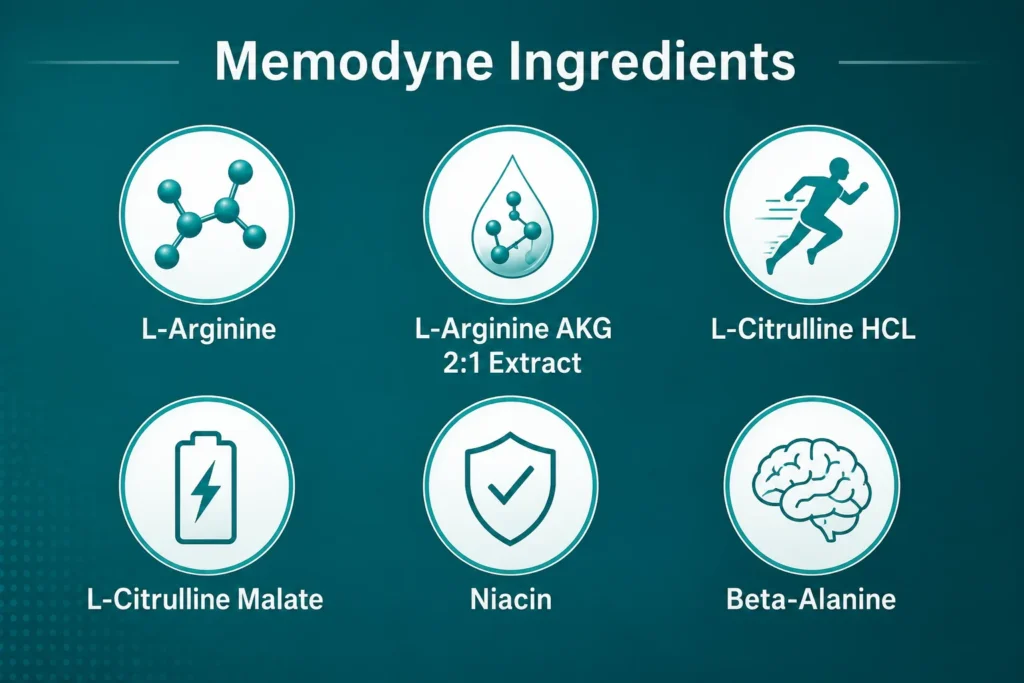
Understanding the ingredients is probably the most useful part of any Memodyne review.
L-Arginine
L-Arginine is an amino acid involved in nitric oxide production. Nitric oxide helps regulate vascular tone and blood flow.
The rationale for including L-Arginine in Memodyne is therefore understandable: the formula is designed to support healthy circulation rather than provide a stimulant effect.
However, whether supplemental arginine improves cognitive performance in healthy adults is a separate question requiring human clinical evidence.
L-Arginine AKG 2:1
L-Arginine AKG combines arginine with alpha-ketoglutarate.
The manufacturer describes this ingredient as part of its approach to sustained nitric-oxide support. However, consumers should be careful about assuming that a particular form automatically provides better cognitive benefits.
For Memodyne, the most important question is not simply whether the ingredient has a plausible mechanism, but whether the specific formulation and dose have been tested for memory and focus.
L-Citrulline HCL
L-Citrulline can be converted by the body into arginine and is therefore connected to nitric oxide metabolism.
Research has demonstrated that oral citrulline supplementation can increase plasma citrulline and arginine concentrations, although evidence regarding acute improvements in vasodilation and tissue perfusion has been inconsistent.
That makes L-Citrulline a scientifically interesting ingredient, but it does not establish that Memodyne improves memory.
L-Citrulline Malate
L-Citrulline Malate combines citrulline with malate.
Citrulline is associated with nitric oxide metabolism, while malate participates in cellular metabolic pathways. Most of the human research surrounding citrulline supplementation has focused more heavily on vascular function and exercise performance than on memory enhancement.
Niacin
Niacin is vitamin B3 and is essential for normal cellular energy metabolism.
The NIH notes that niacin helps turn food into energy and contributes to normal cell development and function.
For Memodyne, niacin fits logically into the formula’s cellular-energy concept. Still, people should not interpret the presence of an essential vitamin as evidence that additional supplementation will improve cognition beyond correcting a deficiency.
Beta-Alanine
Beta-Alanine is commonly recognized for its role in increasing carnosine levels, particularly in sports nutrition.
The Memodyne formula uses it as part of its cellular-protection concept. However, research on beta-alanine should not be automatically interpreted as proof of a memory-enhancing effect.
This is one of the areas where more direct human research on the finished formula would be useful.
Memodyne Benefits: What Can You Realistically Expect?
The marketing around Memodyne focuses on memory, concentration, focus, mental clarity, and brain health.
Those are appealing goals, but expectations should remain realistic.
Potential areas of interest include:
- Supporting normal brain circulation
- Supporting normal cellular energy metabolism
- Providing nutrients involved in nitric oxide pathways
- Supporting normal nervous-system function
- Supporting general cognitive wellness
- Providing a stimulant-free approach to daily brain-health supplementation
The key word is support.
There is currently not enough evidence to say that Memodyne can treat memory loss, reverse cognitive decline, cure brain fog, or prevent neurological disease.
The brand itself states that its scientific references relate to individual ingredients rather than a clinical trial of the finished product.
That is an important qualification for anyone reading Memodyne reviews online.
If somebody reports feeling more mentally alert after taking it, that experience may be meaningful to that person, but it is not the same as a controlled clinical trial.
My Experience With Memodyne

A truly human Memodyne review should include personal experience, but there is a problem with pretending to have personally taken a supplement when that did not happen.
I cannot honestly claim that I personally used Memodyne, experienced better memory, or noticed improved concentration.
Instead, a responsible review can use a practical evaluation framework:
Before using the supplement:
Record everyday concentration, sleep quality, afternoon mental fatigue, and how often you struggle with ordinary recall.
During consistent use:
Track the same factors rather than relying on one unusually productive day.
After several weeks:
Ask whether there is a consistent difference in focus, mental fatigue, or everyday cognitive tasks.
This approach is much more useful than writing a dramatic “before and after” story based on memory alone.
The brand’s current FAQ says users may need several weeks of consistent daily use before noticing changes, but that is a manufacturer claim rather than independent clinical evidence.
USA Case Study: A Realistic Example for a Typical User
Illustrative case study — not a clinical trial
Consider Michael, a fictional 52-year-old office professional in Texas.
Michael does not have a diagnosed neurological condition. His main complaints are everyday issues: losing his train of thought during meetings, struggling with names, and feeling mentally tired around 3 p.m.
He sees advertisements for Memodyne and becomes interested because it does not rely on caffeine as its main selling point.
Instead of assuming that Memodyne will automatically improve his memory, Michael takes a more measured approach.
For two weeks before starting, he records:
- Average sleep duration
- Afternoon energy
- Ability to concentrate during meetings
- Number of times he forgets routine tasks
- Daily exercise
- Caffeine intake
After starting the supplement, he keeps the same routine and continues tracking those factors.
After several weeks, he reports that he feels somewhat more consistent during afternoon work. However, he cannot determine whether the change came from Memodyne, improved sleep, reduced stress, better hydration, or simply paying more attention to his routine.
That is exactly why a personal experience should be described carefully.
The case does not prove that Memodyne works. It demonstrates a sensible way for a U.S. consumer to evaluate an experience without turning one person’s observation into a medical claim.
For anyone experiencing persistent or worsening memory problems, however, a supplement review should never replace medical evaluation.
Memodyne Reviews: What Should You Look For?
Searching for Memodyne reviews can produce a mixture of product information, testimonials, affiliate content, and marketing pages.
Rather than asking, “Are all the reviews positive?” ask better questions.
Look for:
- Whether the reviewer identifies what they actually used
- How long they used it
- Whether they discuss dosage
- Whether they mention other lifestyle changes
- Whether they make unrealistic medical claims
- Whether the reviewer discloses an affiliate relationship
- Whether the review discusses disadvantages as well as benefits
- Whether ingredient amounts are clearly disclosed
A review saying “this completely transformed my brain” may be emotionally persuasive, but it is not strong evidence.
Similarly, one negative review does not prove that a supplement is ineffective.
The strongest approach is to look at the totality of evidence: ingredient research, formulation transparency, safety information, manufacturing information, consumer experiences, and independent clinical evidence.
For Memodyne, the biggest evidence gap is straightforward: the individual ingredients have research behind them, but the complete finished formula has not been independently tested in a clinical trial according to the current product information.
Memodyne Pros and Cons
Pros
- Six named active ingredients
- Stimulant-free positioning
- Includes ingredients with established biological roles
- Once-daily capsule format
- Focuses on circulation and cellular energy
- Vegetable capsule according to brand information
- 60-day guarantee is advertised
- Designed for ongoing brain-health support
Cons
- Exact ingredient amounts are not published on the website materials reviewed
- No independent clinical trial of the finished formula identified
- Ingredient research does not prove finished-product effectiveness
- Individual response can vary
- Marketing claims should be interpreted cautiously
- Consumers should verify the current label before purchasing
- Guarantee terms should be checked before ordering
- Not a treatment for diagnosed memory disorders
Overall, the biggest advantage of Memodyne is that its formulation has a clear physiological concept.
The biggest limitation is the lack of direct clinical evidence showing that the finished product improves memory, concentration, or cognitive performance.
Memodyne vs. Other Brain Supplements
How does Memodyne compare with other brain supplements?
That depends on what you want from a product.
| Feature | Memodyne | Caffeine-based focus supplement | Multivitamin |
|---|---|---|---|
| Main approach | Circulation + cellular energy | Stimulation/alertness | Nutrient adequacy |
| Caffeine | No, according to brand materials | Usually yes | Usually no |
| Memory-specific clinical proof | Limited for finished formula | Not necessarily memory-specific | Depends on deficiencies |
| Daily use | Yes | Varies | Usually |
| Main ingredients | Amino acids + niacin + beta-alanine | Caffeine and other stimulants | Vitamins/minerals |
| Best fit | People interested in non-stimulant cognitive support | Temporary alertness | General nutritional support |
This comparison should not be interpreted as saying one category is universally better.
Someone who wants to avoid stimulants may find the Memodyne supplement more appealing than a high-caffeine product.
Someone who simply wants temporary alertness may prefer coffee.
Someone with a nutrient deficiency may need something completely different.
The right choice depends on the individual’s nutritional status, goals, medications, and health circumstances.
Is Memodyne Safe? Important Things to Know
Safety deserves more attention than it often receives in supplement reviews.
Because Memodyne contains several biologically active compounds, people should not assume that “natural” means automatically risk-free.
Niacin, for example, is an essential nutrient, but excessive supplemental amounts can cause adverse effects. The NIH Office of Dietary Supplements provides detailed information about recommended intake, upper limits, adverse effects, and potential interactions.
People who take prescription medications, have cardiovascular or metabolic conditions, are pregnant or breastfeeding, or have another significant medical concern should discuss a supplement with a healthcare professional before using it.
Also check the actual label you receive. Product webpages can change, and ingredient amounts matter.
A particularly important point for this Memodyne review is that multiple websites currently appear online using very similar Memodyne branding but showing different formulations. One current page lists the six-ingredient formula discussed in this article, while another website presents a different six-ingredient list.
That means consumers should verify the product label, manufacturer, ingredients, and seller before ordering.
Where to Buy Memodyne
Buy From the Official Website
Official purchase
- Supports memory and recall
- Promotes focus and concentration
- Supports mental clarity
- Supports healthy blood flow
- Supports everyday brain wellness
If you decide to purchase Memodyne, use caution when choosing a seller.
Current product information says Memodyne is sold through an official website and advertises a 60-day
money-back guarantee.
However, because several websites currently use similar Memodyne branding, I would not recommend assuming that every website appearing in search results is the same company.
Before purchasing, check:
- The exact product name
- The ingredient panel
- Manufacturer information
- Contact information
- Return/refund policy
- Shipping terms
- Whether the website clearly identifies the seller
- Whether the product label matches the website description
For U.S. buyers, it is especially important to remember that dietary supplements are not evaluated by the FDA in the same way prescription drugs are evaluated for effectiveness before marketing.
If you are considering Memodyne, use the manufacturer’s current official product page and verify that the formula on the bottle matches the information presented online.
Final Verdict
So, does Memodyne really support memory, focus, and brain health?
The answer is potentially—but the evidence needs to be viewed carefully.
The formula is scientifically interesting. L-Arginine and L-Citrulline are connected to nitric oxide and vascular pathways. Niacin has a well-established role in energy metabolism and normal cell function. Beta-Alanine has a recognized relationship with carnosine.
Those mechanisms give the Memodyne brain supplement a reasonable nutritional rationale.
But a mechanism is not the same thing as a clinical outcome.
There is currently no strong independent clinical evidence showing that the finished Memodyne formula improves memory or concentration in healthy adults. The manufacturer’s own materials acknowledge that its scientific references concern individual ingredients rather than an independent clinical trial of the complete formula.
Therefore, I would place Memodyne in the category of a supplement worth researching rather than a proven memory treatment.
If you are considering it, look at the actual label, understand the ingredients, check the seller carefully, and maintain realistic expectations.
And remember that the basics still matter enormously for brain health: adequate sleep, regular physical activity, a balanced diet, stress management, social engagement, and appropriate medical care all deserve attention.
Frequently Asked Questions
What is Memodyne?
Memodyne is marketed as a daily dietary supplement for brain health, memory, focus, and mental clarity. Current product information lists six ingredients: L-Arginine, L-Arginine AKG 2:1, L-Citrulline HCL, L-Citrulline Malate, Niacin, and Beta-Alanine.
Does Memodyne really improve memory?
There is not enough independent clinical evidence to say that the finished Memodyne supplement definitely improves memory. The ingredients have biological and nutritional research behind them, but that does not prove the complete product produces a cognitive benefit.
What ingredients are in Memodyne?
The current formula reviewed here contains L-Arginine, L-Arginine AKG 2:1, L-Citrulline HCL, L-Citrulline Malate, Niacin, and Beta-Alanine.
Is Memodyne a stimulant?
The current product information describes Memodyne as stimulant-free.
How long does Memodyne take to work?
The manufacturer’s FAQ says that noticeable changes may take several weeks of consistent use. This is a brand-provided expectation, not a clinically established timeline.
Are Memodyne reviews reliable?
Individual Memodyne reviews can provide useful information about people’s experiences, but testimonials are anecdotal. Look for independent reviews that discuss both advantages and disadvantages rather than relying solely on promotional testimonials.
Can Memodyne treat dementia or Alzheimer’s disease?
No. Memodyne should not be presented as a treatment or cure for dementia, Alzheimer’s disease, or another neurological disorder. Anyone experiencing significant or progressive memory problems should seek professional medical evaluation.
Where can I buy Memodyne?
Current brand information directs buyers to its official online sales channel and advertises a 60-day guarantee. Because similarly named websites currently show different formulations, verify the exact seller and product label before purchasing.
Is Memodyne FDA approved?
Dietary supplements are not FDA-approved for effectiveness in the same manner as prescription medicines. Marketing materials should therefore not be interpreted as proof that Memodyne has been FDA-approved to treat memory problems.
Is Memodyne worth trying?
That depends on your expectations. Someone looking for a stimulant-free nutritional supplement may find the formula interesting. Someone expecting guaranteed memory improvement should recognize that direct clinical evidence for the finished product is currently limited.
Scientific & Reference Resources
For readers who want to go beyond marketing claims, these are useful starting points:
- NIH Office of Dietary Supplements — Niacin Fact Sheet: Explains vitamin B3’s role in energy metabolism, recommended intake, safety, and potential interactions. NIH Niacin Fact Sheet
- PubMed — Cerebral Blood Flow Review: Reviews research on cerebral blood flow, dietary factors, exercise, and their potential relationship with cognitive function. PubMed: Cerebral Blood Flow & Cognition
- PubMed — L-Arginine & L-Citrulline Research: Reviews how these amino acids may influence nitric oxide production, vascular function, and blood pressure. PubMed: L-Arginine & L-Citrulline
- PubMed — L-Citrulline Meta-Analysis: Examines randomized controlled trials investigating L-citrulline supplementation and vascular function in adults. PubMed: L-Citrulline Meta-Analysis
- NIH — Niacin Health Professional Fact Sheet: Provides detailed information about niacin requirements, supplementation, adverse effects, and medication interactions. NIH Niacin Health Professional Fact Sheet
- Memodyne Ingredient Information: Provides the manufacturer’s information about the ingredients used in the formula. Memodyne Ingredients
- Memodyne Product Information: Provides the manufacturer’s description of the formula and its proposed approach to brain-health support. Memodyne Official Product Information
Disclaimer
This Memodyne review is provided for informational and educational purposes only and should not be considered medical advice. The information presented is based on publicly available product information and scientific resourcesor prevent any disease or medical condition.
Always read the product label carefully and consult a qualified healthcare professional before using Memodyne, particularly if you take medications, have an existing medical condition, are pregnant or breastfeeding, or have concerns about memory or cognitive changes.
For more expert-backed health tips, wellness guides, and supplement insights, be sure to read more articles on :- Health Line Guide