

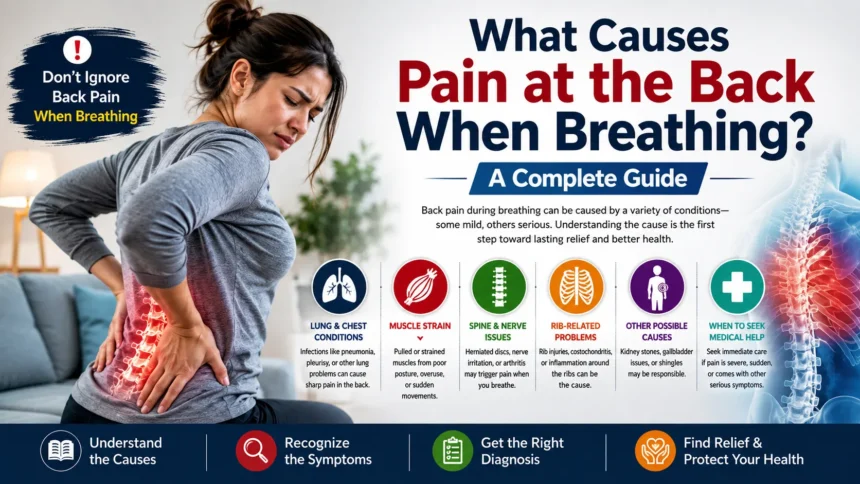
Picture this: you’re stretching after a long day, you take one deep breath in, and out of nowhere — a sharp jab hits you in the back. Or maybe it’s been building slowly, a dull ache that gets worse every time you fill your lungs. Either way, you’re probably here because you Googled something like “why does my back hurt when I breathe” at 1 a.m., half-worried and half-annoyed.
You’re not alone. Pain at the back when breathing is one of those symptoms that can mean almost nothing (a pulled muscle from yesterday’s workout) or something that genuinely needs a doctor’s attention (like a blood clot in the lung). This guide breaks it all down in plain English — no scary medical jargon, just real answers, real causes, and a clear idea of when to relax versus when to call your doctor.
Quick Summary: What You Need to Know
- Back pain when breathing is usually linked to the muscles, ribs, and joints that move as your chest expands.
- Most cases are harmless — think muscle strain, poor posture, or a pulled intercostal muscle.
- Some causes are more serious, including pneumonia, pleurisy, a pulmonary embolism, or heart-related issues.
- Side matters: back pain when breathing in on the left side can sometimes point to the heart or spleen, while pain when I breathe in on the right side is more often tied to the liver, gallbladder, or right lung.
- If it hurts to inhale deeply along with shortness of breath, fever, or chest tightness, treat it as urgent.
Why Does Breathing Affect Your Back At All?
It seems strange at first — breathing is a lung thing, right? Not exactly. Every time you inhale, your rib cage expands outward and upward, your diaphragm pulls down, and a whole network of small muscles between your ribs (called intercostal muscles) and around your spine has to move in sync. Your thoracic spine — the middle section of your back — is directly connected to your ribs through small joints.
So when any of these structures are irritated, inflamed, strained, or injured, a deep breath stretches or compresses them just enough to trigger pain. That’s the simple mechanical reason behind most cases of back pain with deep breath. But breathing also connects to your lungs, heart, and major blood vessels, which is why not every case is purely muscular.
Common Causes of Pain at the Back When Breathing
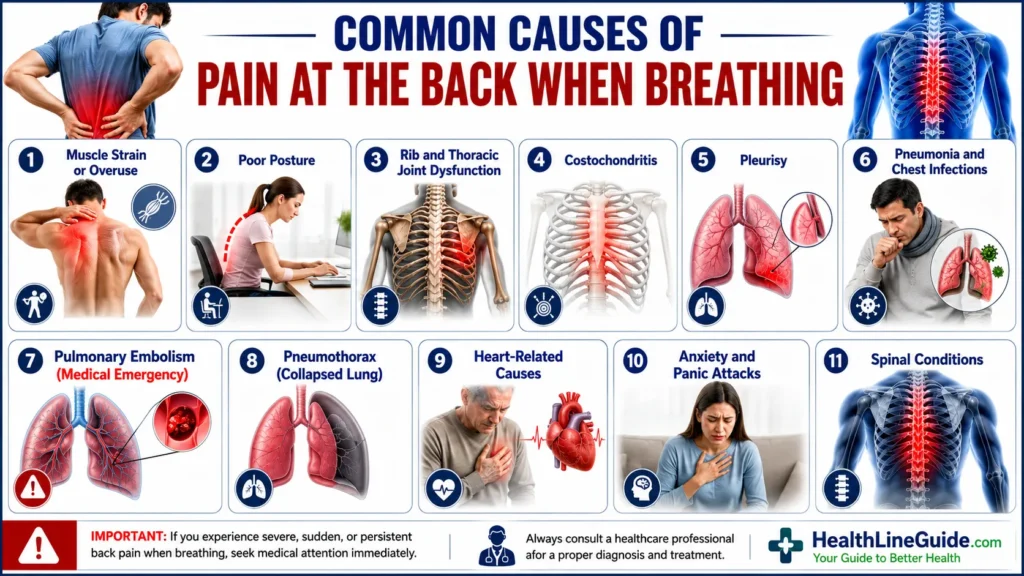
Let’s go through the most common reasons, starting with the least worrying and moving toward the ones that need urgent care.
1. Muscle Strain or Overuse
This is, by far, the most common reason people feel pain at the back when breathing. Lifting something heavy, sleeping in an odd position, an intense workout, or even a bad cough can strain the intercostal muscles or the muscles along your spine. The pain usually:
- Feels sharp or pulling with movement or deep breaths
- Improves with rest, heat, or gentle stretching
- Is localized to one specific spot you can press on and reproduce the pain
2. Poor Posture
Hours hunched over a laptop or phone (a very “2026” problem) shortens your chest muscles and overstretches your upper back muscles. Over time, this tension makes deep breathing genuinely uncomfortable, especially by the end of a workday.
3. Rib and Thoracic Joint Dysfunction
The joints where your ribs meet your spine (costovertebral joints) can get stiff or irritated from repetitive movement, injury, or even sleeping wrong. This is a very common but often overlooked cause of back pain when breathing, and it’s frequently mistaken for a lung problem.
4. Costochondritis
This is inflammation of the cartilage connecting your ribs to your breastbone. While the pain is usually felt in the chest, it can radiate to the back and worsen with deep breathing, coughing, or pressure on the area.
5. Pleurisy
Pleurisy happens when the thin lining around your lungs (the pleura) becomes inflamed, often from a viral or bacterial infection. It causes a sharp, stabbing pain that gets worse when you breathe in, cough, or sneeze — and it can radiate to the back and shoulders.
6. Pneumonia and Chest Infections
Lung infections cause inflammation and fluid buildup, which can make every breath feel like an effort. Along with back pain when breathing, pneumonia usually comes with fever, chills, a persistent cough, and fatigue.
7. Pulmonary Embolism (Medical Emergency)
A pulmonary embolism (PE) is a blood clot that travels to the lungs and blocks blood flow. This is one of the more serious causes of sudden back and chest pain during breathing. Warning signs include:
- Sudden, sharp chest or back pain that worsens with a deep breath
- Shortness of breath that comes on quickly
- Rapid heartbeat
- Lightheadedness or fainting
- Coughing up blood
If you suspect a PE, this is a 911 situation — don’t wait it out.
8. Pneumothorax (Collapsed Lung)
When air leaks into the space between the lung and chest wall, the lung can partially collapse. This causes sudden sharp pain, often on one side, that worsens with breathing, plus noticeable shortness of breath.
9. Heart-Related Causes
It’s easy to assume heart problems only cause chest pain, but the nerves in your heart and upper back share pathways. A heart attack — especially in women — can present as back pain, nausea, fatigue, or shortness of breath instead of the “classic” chest-clutching pain we see in movies.
10. Anxiety and Panic Attacks
Anxiety can cause shallow, rapid breathing and muscle tension around the chest and back, which genuinely feels like back pain when breathing — even though there’s nothing structurally wrong. This doesn’t make the pain any less real, but it usually eases with slow, controlled breathing and stress management.
11. Spinal Conditions
Arthritis, scoliosis, or degenerative disc issues in the thoracic spine can restrict how well your rib cage expands, making deep breaths feel tight or achy, particularly in older adults.
Left Side vs. Right Side: Does It Matter Where It Hurts?
Yes, actually — the side of your back pain when breathing can offer useful clues (though it’s never a substitute for a proper diagnosis).
| Side | More Likely Related To |
|---|---|
| Left side | Heart-related issues, spleen problems, pleurisy on the left lung, muscle strain, panic/anxiety |
| Right side | Liver or gallbladder issues, right lung pneumonia or pleurisy, muscle strain, rib injury |
| Both sides/center | Spinal issues, poor posture, generalized muscle tension, costochondritis |
If you’re specifically dealing with back pain when breathing in left side, and it’s paired with chest tightness, jaw or arm pain, or nausea, treat it seriously and seek medical evaluation. If it’s pain when I breathe in on the
right side along with fever or abdominal discomfort, gallbladder or liver involvement should be ruled out.
When It Hurts to Inhale Deeply: What That Might Mean
If it specifically hurts to inhale deeply — but shallow breathing feels totally fine — that’s a strong clue pointing toward a mechanical cause: muscle strain, rib joint irritation, or pleurisy. Conditions like a heart attack tend to cause more constant pain regardless of breath depth, though there’s plenty of overlap, which is exactly why self-diagnosis has its limits.
Case Study: Sarah’s Story (Austin, Texas)
Sarah, a 34-year-old marketing coordinator from Austin, Texas, started noticing a sharp pain between her shoulder blades every time she took a deep breath. It had started a few days after an intense CrossFit session. At first, she assumed it would fade on its own, but the back pain when breathing kept nagging at her, especially during long client calls when she’d unconsciously take deep sighs.
Worried it might be something serious, Sarah booked an urgent care visit. After a physical exam and a quick round of questions about her recent activity, fever, and breathing difficulty, her doctor diagnosed an intercostal muscle strain — a very common finding in people who’ve recently increased their workout intensity. She was advised to use heat therapy, take short-term over-the-counter anti-inflammatories, and modify her workouts for two weeks.
Within ten days, the pain was essentially gone. Sarah’s case is a good real-world reminder: most back pain when breathing cases in otherwise healthy adults turn out to be musculoskeletal — but getting checked out (rather than guessing) is what gave her peace of mind and a clear recovery plan.
Pros and Cons: Home Remedies vs. Seeing a Doctor
| Approach | Pros | Cons |
|---|---|---|
| Home care (heat, rest, stretching, OTC meds) | Fast, low-cost, works well for mild muscle strain and posture-related pain | Won’t fix infections, blood clots, or heart issues; delays proper diagnosis if the cause is serious |
| Physical therapy | Targets posture and joint mobility long-term, reduces recurrence | Takes multiple sessions, not useful for infections or emergencies |
| Urgent care/doctor visit | Rules out dangerous causes, gives a proper diagnosis, access to imaging and tests | Costs more, takes time, may involve waiting for appointments |
| Emergency room | Necessary and life-saving for PE, heart attack, or collapsed lung | Not needed for minor muscle strain; overuse can be costly and unnecessary |
Comparison: Muscular Causes vs. Organ-Related Causes
| Feature | Muscular / Joint Causes | Organ-Related Causes (Lung, Heart) |
|---|---|---|
| Onset | Often after activity, lifting, or bad posture | Can be sudden or gradual, unrelated to activity |
| Pain type | Sharp, localized, reproducible by pressing the area | Deep, diffuse, sometimes radiating to chest, arm, or jaw |
| Other symptoms | Usually none besides tenderness | Often fever, cough, shortness of breath, dizziness, or nausea |
| Response to rest | Improves with rest and heat | May not improve, or worsens over time |
| Urgency | Usually low | Can be a medical emergency |
Red Flags: When Pain at the Back When Breathing Needs Immediate Care
Seek emergency medical attention if your back pain when breathing comes with any of the following:
- Sudden, severe shortness of breath
- Chest pain or pressure that spreads to your arm, jaw, or neck
- Coughing up blood
- Fainting, dizziness, or a racing heartbeat
- A fever above 100.4°F (38°C) with chills
- Pain after a significant injury, fall, or car accident
- Bluish tint to lips or fingertips
How Doctors Diagnose the Cause
A doctor typically starts with a physical exam and a review of your symptoms, medical history, and recent activities. Depending on what they suspect, they may order:
- Chest X-ray — checks for pneumonia, rib fractures, or a collapsed lung
- CT scan — useful for detecting a pulmonary embolism or spinal issues
- EKG (electrocardiogram) — rules out heart-related causes
- Blood tests — check for infection markers or clotting issues
- MRI — evaluates the spine and soft tissue in more detail
Treatment and Relief Tips
For mild, muscle-related pain at the back when breathing, these tips often help:
- Apply heat to relax tight muscles, or ice within the first 48 hours of an injury
- Practice gentle stretching for the chest, shoulders, and upper back
- Improve your sitting posture and take breaks from screens every 30–45 minutes
- Try slow, controlled breathing exercises to ease tension-related pain
- Use OTC anti-inflammatory medication as directed, if appropriate for you
- Avoid heavy lifting or twisting movements until the pain settles
- Get evaluated by a physical therapist if the pain keeps returning
Prevention Tips for the Future
- Warm up properly before workouts, especially ones involving your back and chest
- Strengthen your core and upper back muscles to support your spine
- Correct slouched posture at your desk — a monitor at eye level makes a real difference
- Manage stress and anxiety, since chronic tension often shows up as back pain
- Don’t ignore a lingering cough or cold — treat respiratory infections early
- Stay active with regular movement to keep your thoracic spine mobile
Frequently Asked Questions
1. Is back pain with deep breath always serious?
No. Most of the time, back pain with deep breath comes from a strained muscle or a stiff rib joint, especially after exercise or poor posture. It only becomes concerning when paired with fever, shortness of breath, or chest pressure.
2. What does it mean if I have back pain when breathing in on my left side specifically?
It can range from a simple muscle strain to something related to the heart, spleen, or left lung. Because the heart sits slightly left of center, any left-sided pain paired with chest tightness or arm pain should be checked out promptly.
3. Why does it hurt to inhale deeply but not when I breathe normally?
This pattern usually points to a mechanical cause — like a strained intercostal muscle, irritated rib joint, or pleurisy — since these tissues stretch more during a full, deep breath than during shallow breathing.
4. I have pain when I breathe in on my right side. Should I worry?
Right-sided pain is often linked to muscle strain, rib issues, or occasionally the liver or gallbladder. If it’s accompanied by nausea, fever, or abdominal tenderness, get it checked by a doctor.
5. How long does back pain when breathing usually last?
Muscle-related pain typically improves within one to two weeks with rest and self-care. Pain lasting longer than two weeks, or worsening instead of improving, deserves a medical evaluation.
6. Can anxiety really cause back pain when breathing?
Yes. Anxiety and panic attacks can cause shallow breathing and muscle tightness around the chest and back, producing real physical pain even without any structural injury.
7. When should I go to the ER instead of urgent care?
Go to the ER for sudden, severe pain, difficulty breathing, fainting, coughing up blood, or any symptoms that feel like they could be a heart attack or blood clot. Urgent care is fine for milder, gradual pain without these warning signs.
Final Thoughts
Pain at the back when breathing is one of those symptoms with a huge range — from “I slept weird” to “I need to see a doctor today.” The good news is that most cases fall on the mild end, tied to muscles, posture, or minor joint irritation. Pay attention to the details: which side hurts, whether it’s constant or only with deep breaths, and whether you have other symptoms like fever or shortness of breath. When in doubt, a quick visit to your doctor is always worth the peace of mind — as Sarah’s story shows, getting checked out is often the fastest way back to feeling normal again.
This article is for informational purposes only and is not a substitute for professional medical advice, diagnosis, or treatment. Always consult a qualified healthcare provider about any new or worsening symptoms.
Sources and References
- HealthCentral — Back Pain When Breathing: Is It Serious?
- Hinge Health — Back Pain When Breathing: Causes and Treatments
- Medical News Today — Back pain when breathing: 8 causes and when to see a doctor
- Summit Orthopedics — Why Does My Back Hurt When I Take Deep Breaths?
- HSS Health — Upper Back Pain When Breathing & Moving: Causes & Treatments
- Mayo Clinic — Pulmonary Embolism: Symptoms and Causes
- Cleveland Clinic — Pleurisy: Symptoms, Causes and Treatment
- American Heart Association — Heart Attack Symptoms in Women
- National Heart, Lung, and Blood Institute (NIH) — Pneumothorax
Disclaimer: The content published on HealthLineGuide.com is carefully researched and reviewed to provide accurate, up-to-date, and reliable health information. However, this article is intended for educational and informational purposes only and should not be considered medical advice, diagnosis, or treatment. If you experience severe, sudden, or persistent pain at the back when breathing, difficulty breathing, chest pain, fever, or any other concerning symptoms, seek prompt evaluation from a qualified healthcare professional. Always consult your physician or another licensed medical provider for personalized medical advice, diagnosis, and treatment based on your individual health needs.
Website: https://www.healthlineguide.com/