

GLPatches is marketed as a convenient wellness patch intended to complement routines focused on appetite management, metabolic wellness, and weight-management goals. The advertised ingredient list includes berberine extract, Garcinia cambogia, green tea extract, cinnamon extract, B-complex vitamins, chromium, potassium, and L-glutamine.
For people who prefer not to take another capsule or powder, a patch may sound like an appealing alternative. However, there is an important question to consider: can the ingredients in a patch be absorbed through the skin in amounts that provide the advertised benefits?
In this GLPatches review, we examine the advertised ingredients, potential benefits, scientific evidence, safety concerns, customer feedback, pricing considerations, and buying options. We also compare the patch with other weight-management approaches so readers can make an informed decision.
- Product category: Weight-management and metabolic wellness patch
- Advertised goals: Appetite management, metabolic support, and healthy blood sugar balance
- Key ingredients: Berberine, Garcinia cambogia, green tea, cinnamon, B vitamins, chromium, potassium, and L-glutamine
- Evidence status: Individual ingredients have been studied, but research on the finished GLPatches patch has not been established for this review
- Important distinction: GLPatches is not a prescription GLP-1 medication

What Is GLPatches?
GLPro GLPatch is a daily wellness patch positioned around appetite management, healthy blood sugar balance, and weight-management goals. You stick it on clean, dry skin, such as the inner arm, shoulder, or thigh. It is meant for people who would rather not add another capsule or powder to their routine.
The name causes confusion. “GLP” refers to glucagon-like peptide-1, a gut hormone that helps regulate appetite and blood sugar. Prescription drugs such as Ozempic, Wegovy, Mounjaro, and Zepbound mimic that hormone. GLPatches does not contain those drugs. It contains plant extracts, vitamins, minerals, and an amino acid that are marketed as supporting the same areas of health. Treating the two as equivalent is the most common mistake in this category.
One more warning: several “GLPro” products exist. One published review notes that the GLPro-branded lineup includes more than one product, and that its coverage is limited to the transdermal patch sold through glpatch. shop. Some of what you find online describes the capsule version. Make sure any review you read matches the patch.
Is GLPatches the Same as a GLP-1 Medication?
No. The product name may remind consumers of GLP-1 medications, but the advertised ingredients are plant extracts, vitamins, minerals, and an amino acid.
Prescription GLP-1 medicines are specific drugs that act on the glucagon-like peptide-1 pathway. They have defined formulations, dosing instructions, and clinical evidence for their approved uses.
The listed GLPatches ingredients are not GLP-1 prescription medicines. Their presence does not establish that the patch mimics the effects of a prescription medication or produces comparable weight loss.
Consumers should be cautious of advertisements that use terms such as “GLP-1 support” without clearly explaining the difference between a supplement and an approved medicine.
GLPatches Ingredients: What Is in the Formula?
According to the product information supplied for this review, GLPatches features seven listed ingredient groups. These include several plant extracts, B-complex vitamins, chromium and potassium, and L-glutamine.
The B vitamins and the two minerals are grouped in the supplied ingredient table, but that does not mean they are a single ingredient. Their exact forms and amounts should be checked on the complete product label.
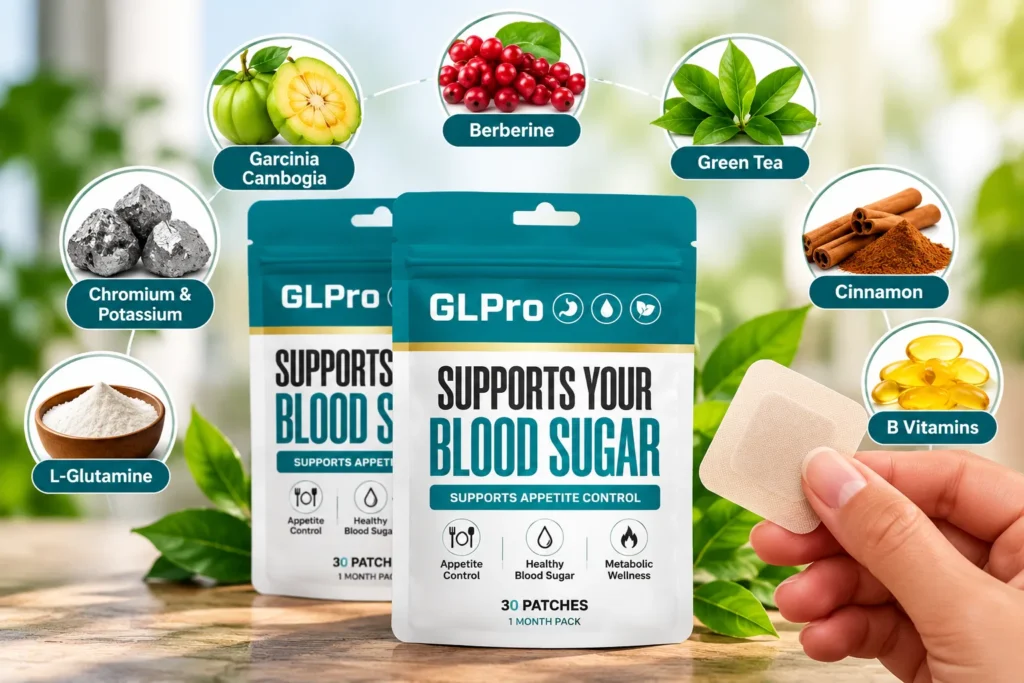
The following analysis describes the potential roles of these ingredients and the limits of the available evidence. It does not establish that the finished patch delivers them effectively.
1. Berberine Extract
Berberine is a naturally occurring plant compound that has attracted scientific interest because of its potential effects on glucose and lipid metabolism.
Researchers have investigated berberine mainly in oral formulations. Some studies suggest possible benefits for certain blood sugar and cholesterol measures, but research quality, study size, dosage, and participant characteristics vary.
Potential areas of interest:
- Glucose metabolism.
- Lipid metabolism.
- General metabolic health.
The important limitation is that oral berberine research cannot prove that berberine delivered through a patch produces the same effects.
Berberine can also interact with medicines and may cause digestive symptoms. People who take diabetes medication or other prescription drugs should speak with a qualified healthcare professional before using a product containing it.
For GLPatches, the amount of berberine and evidence of skin absorption would be necessary to assess whether the ingredient could provide meaningful exposure.
2. Garcinia Cambogia
Garcinia cambogia is a tropical fruit extract commonly marketed in weight-management supplements. Its rind contains hydroxycitric acid, often called HCA, which has been studied for possible effects on appetite and fat production.
Despite its popularity, the evidence for weight loss remains inconsistent. Some studies suggest small effects, while others have not found meaningful benefits.
The National Center for Complementary and Integrative Health notes that it remains unclear whether Garcinia cambogia helps people lose weight. Reports of liver injury have also raised safety concerns.
Potential area of interest: Appetite and weight management.
Important limitation: The evidence does not establish reliable weight loss from Garcinia cambogia, and oral studies cannot confirm its effectiveness in a transdermal patch.
People with liver problems or those taking medication should obtain professional advice before using supplements containing this extract.
3. Green Tea Extract
Green tea extract contains plant compounds called catechins. Depending on the formulation, it may also contain caffeine.
Green tea and its extracts have been investigated for their possible effects on energy expenditure and fat metabolism. However, any effect on body weight tends to be limited and should not be treated as a substitute for sustainable lifestyle changes.
Potential areas of interest:
- Antioxidant activity.
- Energy metabolism.
- Modest effects on weight-management measures in some research settings.
The concentration of catechins and caffeine can vary considerably between products. Their absorption through the skin also depends on the delivery system.
The presence of green tea extract in GLPatches does not establish that the patch increases calorie burning or produces measurable fat loss.
Consumers should also avoid assuming that an ingredient is automatically safe because it comes from a plant. Concentrated green tea extracts have been associated with adverse effects, including rare cases of liver injury when taken orally.
4. Cinnamon Extract
Cinnamon is a familiar culinary spice that has also been studied for its potential effects on blood glucose and other metabolic markers.
Some research has reported changes in blood sugar measurements after oral cinnamon supplementation, but findings are inconsistent. Differences in cinnamon species, extract composition, dosage, and study design make the evidence difficult to interpret.
The NCCIH review concludes that research does not clearly establish cinnamon as an effective treatment for a health condition, and its usefulness for diabetes or weight loss remains uncertain.
Potential area of interest: Glucose metabolism.
Important limitation: There is no basis for assuming that cinnamon in a skin patch will reproduce findings from oral studies.
The type of cinnamon also matters. Cassia cinnamon can contain coumarin, a compound that may be harmful to the liver when consumed in high amounts over time.
Anyone managing diabetes should not replace prescribed treatment with cinnamon supplements or products marketed for blood sugar balance.
5. B-Complex Vitamins
B-complex vitamins are a group of nutrients that includes several vitamins involved in normal energy metabolism.
These vitamins help the body process carbohydrates, fats, and proteins. Some also contribute to nervous system function and red blood cell production.
Potential nutritional roles:
- Supporting normal energy metabolism.
- Helping maintain normal nervous system function.
- Contributing to overall nutritional adequacy.
However, B vitamins do not automatically increase energy or cause weight loss in people who already obtain sufficient amounts.
The distinction between oral and transdermal delivery is important here. A patch containing a vitamin does not necessarily deliver a useful amount into the body.
To evaluate GLPatches properly, buyers would need to know which B vitamins are included, their amounts, and whether the delivery system has been tested.
6. Chromium and Potassium
Chromium and potassium are two different minerals with different functions in the body.
Chromium has been studied for its possible involvement in insulin action and glucose metabolism. However, research has not established that chromium supplements reliably produce meaningful weight loss or blood sugar benefits for everyone.
The NIH Office of Dietary Supplements provides a detailed review of chromium research, including its limitations and possible medication interactions.
Potassium is an essential electrolyte that helps support normal muscle function, nerve signaling, and fluid balance. It is not a direct fat-burning ingredient.
Neither mineral should be assumed to provide a benefit simply because it appears on a product label. The amount delivered, the person’s nutritional status, and the route of administration all influence whether a product can be useful.
People with kidney disease or those taking medicines that affect potassium levels should be particularly careful with potassium supplementation and seek professional advice.
7. L-Glutamine
L-glutamine is an amino acid involved in several processes in the body. It is used by cells in the intestine and plays a role in normal nitrogen metabolism.
It is sometimes marketed for digestive wellness, exercise recovery, or other general health goals. However, its inclusion in a weight-management product does not establish that it reduces hunger or causes weight loss.
Potential areas of interest:
- Amino acid metabolism.
- Normal cellular functions.
- Research into intestinal health in specific clinical settings.
The evidence for L-glutamine depends on the intended use, formulation, and population studied.
For GLPatches, it would be necessary to establish whether the amino acid can be delivered through the skin in a meaningful amount before concluding its potential role.
GLPatches Ingredients Summary
| Ingredient | Advertised or researched role | Main evidence limitation |
|---|---|---|
| Berberine extract | Metabolic support | Research is mainly oral; patch absorption is unverified |
| Garcinia cambogia | Appetite and weight management | Human weight-loss findings are inconsistent |
| Green tea extract | Energy metabolism | Effects on weight are limited or uncertain |
| Cinnamon extract | Glucose metabolism | Evidence is mixed and primarily based on oral use |
| B-complex vitamins | Normal energy metabolism | Benefits depend on nutritional status and delivered dose |
| Chromium | Glucose metabolism | Evidence for meaningful benefits is limited |
| Potassium | Electrolyte and muscle function | Not a direct weight-loss ingredient |
| L-glutamine | Amino acid and intestinal functions | Weight-loss benefits are not established |
The supplied marketing describes seven ingredient groups, with chromium and potassium counted together and the B-complex listed as another group. The table above separates these nutrients so their individual roles are easier to understand.
GLPatches Benefits: What Might Users Expect?
The product is marketed for appetite management, metabolic wellness, and weight-management support. Whether it delivers these benefits is a separate question from whether its ingredients have been researched individually.
1. Convenient Daily Use
One potential appeal is the patch format. Some people prefer not to swallow capsules or mix powders into drinks.
A patch may also be easy to incorporate into a daily routine. However, convenience alone does not establish effectiveness, and consumers should follow the product’s actual instructions rather than assuming that longer wear or more patches will improve results.
2. Interest in Appetite Management
Garcinia cambogia and other ingredients in weight-management products are often promoted for appetite-related effects.
Nevertheless, the evidence for the listed ingredients is mixed, and the finished patch has not been established as an effective appetite-control treatment.
Appetite is influenced by several factors, including sleep, stress, meal composition, medication use, and underlying health conditions. A supplement patch should not be assumed to address all of them.
3. Support for General Metabolic Wellness
Several advertised ingredients have roles in normal metabolic processes. B vitamins help the body use energy from food, while chromium has been investigated in relation to glucose metabolism.
These functions do not mean that adding more of the nutrients will necessarily improve metabolism. Nor do they prove that a patch delivers enough of them to make a measurable difference.
A balanced diet, appropriate activity, sleep, and medical care remain more established foundations for metabolic health.
4. A Possible Alternative to Oral Supplements
The patch format may appeal to people who dislike taking pills. However, a transdermal product must be specifically engineered to move its active ingredients through the skin.
Not every nutrient or plant compound can cross the skin barrier efficiently. Some formulations use specialized delivery technologies, but the presence of a patch does not demonstrate that such technology is effective.
For GLPatches, product-specific absorption data would be important evidence to look for.
5. A Simple Addition to a Wellness Routine
Some adults prefer products that fit into an existing routine with minimal preparation. Even so, a supplement should be evaluated based on its safety, evidence, and cost rather than the simplicity of its use.
Before considering GLPatches, determine whether the product offers a demonstrated benefit beyond healthy habits and whether its ingredients are suitable for your circumstances.
Does GLPatches Work?
This is the most important question in any GLPatches review.
At present, the available information is insufficient to conclude that GLPatches reliably causes weight loss, controls appetite, or improves blood sugar levels.
There are several reasons for this conclusion.
First, the individual ingredients have different evidence profiles. Some have been investigated for metabolic effects, but many findings are inconsistent or limited.
Second, much of the research on these ingredients involves oral supplements. A patch must overcome the skin’s natural barrier, and the amount absorbed may differ substantially from the amount swallowed.
Third, the finished GLPatches formulation has not been established as the subject of a published clinical trial for this review. That means the individual ingredient studies cannot be used as proof that the complete product works.
Before buying, look for answers to these questions:
- Is the complete ingredient list available?
- Does the label specify the amount of each ingredient?
- Is there independent evidence that the ingredients are absorbed through the skin?
- Has the finished patch been tested in a well-designed human clinical trial?
- Are the seller’s claims consistent with established scientific evidence?
- Is there independent quality testing for identity, purity, and contaminants?
If these details are unavailable, it is difficult to determine whether the product offers meaningful benefits.
Consumers should also be cautious of claims that a patch can produce rapid or effortless weight loss without dietary changes, activity, or other evidence-based measures.
GLPatches Customer Reviews and Complaints
People searching for GLPatches customer reviews usually want to know whether the product is effective, easy to use, reasonably priced, and worth ordering.
Customer feedback can be useful for understanding practical issues such as delivery times, packaging, customer service, or the process of requesting a refund. However, testimonials cannot establish that a product causes weight loss or improves blood sugar.
For this article, an independently verified collection of GLPatches customer reviews and complaints was not established. This does not prove that the product has no satisfied customers or that complaints exist. It means a reliable summary of the overall customer experience cannot be provided from the available information.
Before relying on a review, consider the following:
Look for specific details. Reviews that describe the ordering process, length of use, and actual experience are more informative than vague statements that a product is “amazing.”
Check independent sources. Reviews hosted entirely on a seller’s own website may not provide a complete picture.
Look for repeated patterns. Multiple reports of billing problems, delayed delivery, or difficulty obtaining refunds deserve more attention than a single unverified comment.
Be skeptical of dramatic claims. Statements promising substantial weight loss without any changes in eating or activity should be evaluated carefully.
Separate satisfaction from effectiveness. A customer may be happy with the packaging or service without having evidence that the product produced a health benefit.
A fair assessment of GLPatches should consider both the available customer information and the scientific limitations of the product.
U.S. Consumer Case Study
This is an example for educational purposes. It is a real customer testimonial or clinical evidence about GLPatches.
Consider a 39-year-old office worker living in Florida who wants to manage their weight. Long workdays, frequent restaurant meals, and limited time for exercise have made it difficult to maintain a consistent routine.
The worker sees an advertisement for GLPatches and likes the idea of a product that can be applied to the skin rather than taken as a capsule.
Instead of immediately placing an order, the worker takes several steps.
Step 1: Define the goal. The worker identifies a realistic goal focused on sustainable habits rather than rapid weight loss.
Step 2: Check the evidence. The worker learns that some advertised ingredients have been studied orally, but the finished patch has not been established as clinically effective.
Step 3: Review safety. Because the worker takes medication for a health condition, they ask a healthcare professional whether the ingredients could interact with treatment.
Step 4: Compare the cost. The worker calculates the total monthly expense and compares it with other options, including professional nutrition guidance.
Step 5: Choose a measurable plan. The worker focuses on regular meals, suitable portions, walking, sleep, and professional advice. If considering any supplement, the worker evaluates it separately rather than assuming it will produce results.
GLPatches Pros and Cons
| Pros | Cons |
|---|---|
| Patch format may appeal to people who dislike capsules | Skin absorption of the advertised ingredients has not been verified |
| Includes ingredients with established nutritional or biological roles | Ingredient research does not prove that the finished patch works |
| Marketed for several common wellness goals | Weight-loss and appetite-control benefits remain uncertain |
| May be simple to incorporate into a routine | Current pricing and verified customer feedback require checking |
| Encourages interest in metabolic health | Some ingredients may cause side effects or interact with medicines |
| Can be compared with other approaches before purchasing | It is not a substitute for GLP-1 prescription medication or medical care |
The most appealing feature is the convenience of the patch format. The biggest concern is the lack of verified evidence that the ingredients are absorbed through the skin in amounts that produce the advertised benefits.
GLPatches vs. Other Weight-Management Options
A comparison can help consumers understand where the patch fits among available approaches.
| Option | Main purpose | Evidence considerations |
|---|---|---|
| GLPatches | Marketed for appetite and metabolic support | Finished patch effectiveness and absorption are unverified |
| Oral weight-management supplements | Provide specific ingredients by mouth | Evidence varies by ingredient; benefits may be small or uncertain |
| Balanced nutrition and physical activity | Support sustainable weight management | Established foundations of weight management and general health |
| Registered dietitian support | Personalized nutrition guidance | Can help tailor eating strategies to individual needs |
| Prescription weight-management medicines | Treat eligible patients under medical supervision | Specific medicines have clinical evidence, eligibility criteria, and known risks |
| GLP-1 prescription medicines | Act on the GLP-1 pathway for approved indications | Not equivalent to a patch containing plant extracts and nutrients |
The right choice depends on individual needs, medical history, and goals. People who have obesity or weight-related health conditions may benefit from discussing evidence-based options with a healthcare professional.
GLPatches should not be treated as interchangeable with prescription medications, and no supplement should be used to discontinue prescribed treatment without medical guidance.
GLPatches Side Effects and Safety Considerations
The safety of GLPatches cannot be fully determined without a complete label, ingredient quantities, and evidence about the patch’s delivery system.
There are two areas to consider: possible effects of the ingredients and possible effects of applying the patch to the skin.
Potential Ingredient-Related Concerns
Garcinia cambogia: Oral products have been associated with digestive symptoms and reports of liver injury. The relevance to a patch depends on its actual formulation and absorption, which are not established here.
Berberine: Can cause digestive side effects and may interact with medicines. Anyone taking prescription medication should consult a healthcare professional.
Green tea extract: Concentrated oral extracts have been associated with rare cases of liver injury. The risk from this particular patch cannot be determined without product-specific data.
Cinnamon: Safety depends on the species, concentration, and exposure. Some cinnamon products contain coumarin, which can be a concern with high or prolonged intake.
Chromium: May interact with diabetes medicines and levothyroxine. People with kidney or liver disease should be particularly careful with chromium supplements.
Potassium: Excessive potassium intake can be dangerous for people with certain kidney conditions or those taking medications that increase potassium levels.
Possible Skin Reactions
Depending on the adhesive and other materials used, patches can cause redness, itching, irritation, or allergic reactions. The actual likelihood for GLPatches has not been verified.
Apply the product only according to its instructions. Do not apply it to damaged skin, and discontinue use if a concerning skin reaction develops.
Who Should Seek Professional Advice First?
Consult a qualified healthcare professional before using GLPatches or similar supplements if you:
- Take prescription medicines, especially diabetes medication.
- Have liver or kidney disease.
- Are pregnant, breastfeeding, or planning pregnancy.
- Have a history of allergic skin reactions.
- Already use other weight-management or metabolic supplements.
- Have a medical condition that affects blood sugar or electrolyte balance.
Do not stop prescribed medication or replace medical care with a supplement patch.
GLPatches Price: What Should You Check?
The current GLPatches price has not been independently verified for this article. Promotional prices and package deals can change, so the seller’s checkout page is the appropriate place to confirm the amount before purchasing.

However, the price of a product is only one part of its value.
Consider these points when evaluating the cost:
- Price per patch: Check the number of patches in each package.
- Cost per day: Calculate the cost using the seller’s stated recommended use.
- Shipping and taxes: Check whether they are included in the advertised price.
- Package discounts: Compare the total amount due, not only the claimed percentage discount.
- Recurring payments: Check whether the purchase automatically renews.
- Refund policy: Read the return window, eligibility conditions, and refund process.
- Evidence and quality: Consider whether the product provides meaningful documentation about ingredients, absorption, and testing.
A large discount does not establish that a product is effective. Similarly, a more expensive product is not necessarily better simply because it costs more.
Where to Buy GLPatches Online
Want to try GLPatches? Before ordering, check the seller’s authenticity, ingredient label, current price, and refund policy. Review customer feedback and verify product quality before making a purchase.
Where to Buy GLPatches Online
Check pricing, ingredients, and ordering details before you buy.
- Convenient patch format
- Designed for appetite management
- Marketed for metabolic wellness
- Supports daily wellness goals
Buying Tip: Choose a trustworthy seller and be cautious of unrealistic weight-loss claims. Remember, GLPatches is for proven weight-management treatments.
How to Support Healthy Weight Management Naturally
Whether or not you consider GLPatches, several practical habits can support long-term weight management.
Build Balanced Meals
Meals that include vegetables, suitable protein sources, whole grains, and other nutrient-rich foods can help support nutritional needs. Individual requirements vary, so a personalized plan may be helpful.
Make Physical Activity Consistent
Walking, cycling, swimming, strength training, or other suitable activities can contribute to general health. Start at a level that fits your current ability and increase activity gradually.
Pay Attention to Sleep
Insufficient sleep can affect appetite, energy, and daily routines. A consistent sleep schedule may make healthy habits easier to maintain.
Plan for Busy Days
Preparing meals in advance, keeping nutritious snacks available, and planning short periods of activity can reduce the pressure to make last-minute decisions.
Set Realistic Goals
Sustainable changes are generally more useful than extreme diets or products that promise rapid results. Tracking habits and discussing progress with a healthcare professional can help keep goals practical.
Seek Professional Guidance When Needed
People with obesity, diabetes, high blood pressure, or other health conditions may benefit from personalized support. A clinician can discuss appropriate treatment options and whether any supplement is suitable.
These approaches do not depend on GLPatches and can be adapted to a person’s circumstances.
Frequently Asked Questions
1. What is the GLPatches weight loss patch?
It’s a daily wearable supplement patch containing berberine, garcinia cambogia, green tea extract, cinnamon, B vitamins, chromium, potassium, and L-glutamine, marketed for appetite, blood sugar, and weight-management support.
2. Is GLPatches the same as Ozempic or Wegovy?
No. Those are prescription semaglutide drugs. GLPatches contains no GLP-1 medication.
3. Does GLPatches work for weight loss?
There’s no published trial of the finished patch, and the ingredient research is mostly oral and modest. Any weight change is likely to come mainly from diet, activity, and sleep.
4. What are the GLPatches ingredients?
Berberine, garcinia cambogia, green tea extract, cinnamon extract, B-complex vitamins, chromium, potassium, and L-glutamine.
5. How much does GLPatches cost?
Sources disagree. One review lists $49 to $79 depending on pack size, while another lists a much higher range. Check the official checkout page for current pricing.
6. Where can I buy GLPatches safely?
Use the official brand website, avoid look-alike domains and marketplace listings, and keep screenshots of the terms.
7. What are the GLPatches side effects?
Likely effects are skin irritation or allergic reactions. Ingredient-related concerns include digestive upset, caffeine sensitivity, and medication interactions.
8. Can I use GLPatches with diabetes medication?
Talk to your doctor first. Berberine and cinnamon may affect blood sugar, and combining them with medication could cause low blood sugar.
9. Are GLPatches customer reviews trustworthy?
Treat them cautiously. Many appear on brand-controlled or commission-based pages. Look for dated, balanced, independent feedback.
10. How long should I try it?
There’s no evidence-based timeline. If you test it, 30 days with a tracking log is a reasonable experiment, and you should stop if you have a reaction.
11. Can I use it while pregnant or breastfeeding?
Ask your healthcare provider first. Many botanical supplements aren’t well studied in pregnancy.
12. Is there a better alternative?
For clinically significant weight loss, evidence favors medical care: nutrition counseling, physical activity, behavioral support, and, where appropriate, FDA-approved medications under a clinician’s supervision.
Scientific References and Trusted Resources
These resources provide scientific and regulatory background on the ingredients and claims discussed in this review. They are not endorsements of GLPatches.
- National Center for Complementary and Integrative Health (NCCIH): Garcinia Cambogia
https://www.nccih.nih.gov/health/garcinia-cambogia
Reviews the evidence for weight loss and important safety concerns associated with Garcinia cambogia. - National Institutes of Health Office of Dietary Supplements: Chromium
https://ods.od.nih.gov/factsheets/Chromium/HealthProfessional/
Discusses chromium’s biological role, research limitations, and potential interactions. - National Center for Complementary and Integrative Health: Cinnamon
https://www.nccih.nih.gov/health/cinnamon
Reviews the evidence and safety considerations for cinnamon supplements. - National Center for Complementary and Integrative Health: Diabetes and Dietary Supplements
https://www.nccih.nih.gov/health/diabetes-and-dietary-supplements-what-you-need-to-know
Summarizes research limitations and safety considerations for supplements marketed for blood sugar control. - National Institutes of Health Office of Dietary Supplements: Dietary Supplements for Weight Loss
https://ods.od.nih.gov/factsheets/WeightLoss-HealthProfessional/
Provides an overview of the evidence for popular weight-loss supplement ingredients. - U.S. Food and Drug Administration: Questions and Answers on Dietary Supplements
https://www.fda.gov/food/information-consumers-using-dietary-supplements/questions-and-answers-dietary-supplements
Explains key points about dietary supplement regulation in the United States.
These sources help readers assess the evidence for individual ingredients and understand supplement safety. None establishes that the complete GLPatches formulation is effective.
Final Verdict: Is GLPatches Worth Trying?
GLPatches contains advertised ingredients associated with metabolic wellness, but its effectiveness for weight loss and blood sugar support has not been established.
Before buying, check the ingredient amounts, product quality, price, and available scientific evidence. Although the patch format is convenient, it should not replace healthy habits or prescribed treatment.
Bottom line: Review the product carefully and consult a healthcare professional before use.
Medical Disclaimer: This article provides educational information to help readers make informed decisions about dietary supplements and wellness. Supplements may complement a balanced diet and healthy lifestyle when used appropriately. For more expert-backed health tips, wellness guides, and supplement insights, be sure to read more articles on the Health Line Guide