
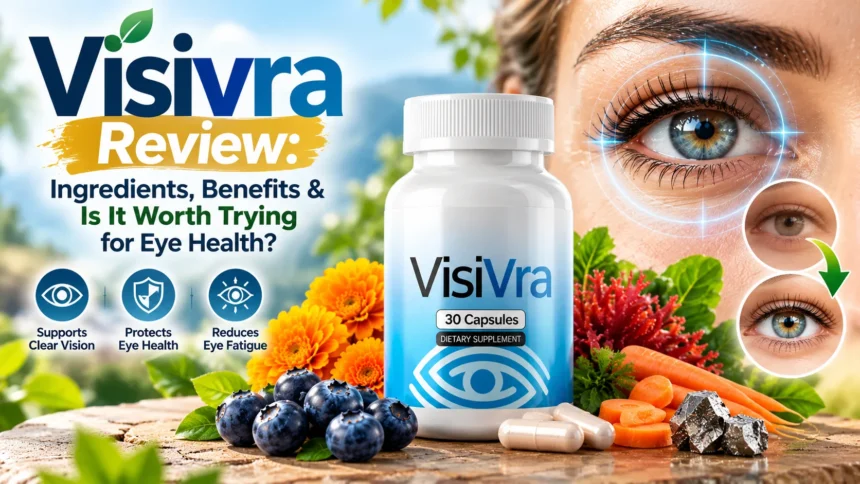
Visivra is a dietary supplement marketed for visual clarity, everyday eye comfort, and nutritional support for eye health. Its advertised formula contains six ingredients: lutein, zeaxanthin, bilberry extract, astaxanthin, zinc, and vitamin A. Although several of these nutrients have established roles in normal vision, the evidence for individual ingredients does not automatically prove that the finished Visivra supplement delivers the advertised benefits.
In this Visivra review, we examine the ingredients, potential benefits, safety considerations, price and purchasing questions, scientific evidence, and important factors to consider before buying.
- Product category: Eye health dietary supplement
- Advertised purpose: Visual comfort and nutritional eye support
- Key ingredients: Lutein, zeaxanthin, bilberry extract, astaxanthin, zinc, and vitamin A
- Best first step: Review the complete Supplement Facts label and discuss supplementation with an eye care professional when appropriate
- Important limitation: The exact ingredient quantities and independent clinical results for the finished product have not been verified for this review

What Is Visivra?
Visivra is marketed as a daily eye health supplement for adults who want to maintain their vision and support their eyes as they age. Its promotional material focuses on people who spend long hours using computers, phones, and other digital devices, as well as individuals concerned about tired eyes and age-related changes in vision.
The product’s advertised benefits include supporting visual clarity, helping with screen-related eye fatigue, and providing nutrients associated with retinal health. These goals may sound appealing, especially to people who work on computers throughout the day.
However, it is important to understand the difference between supporting normal eye function and treating a vision problem. A supplement may help fill a nutritional gap, but it cannot be assumed to correct refractive errors, remove cataracts, treat glaucoma, or reverse existing vision loss.
The National Eye Institute explains that specific nutritional formulas can slow the progression of certain stages of age-related macular degeneration (AMD), but they do not prevent AMD from developing in the first place. The benefits depend on the particular formula and the person’s eye condition.
This distinction matters when evaluating Visivra. Its six advertised ingredients have different nutritional roles, and each must be assessed individually before concluding the complete formula.
Why Are People Interested in Eye Health Supplements?
Modern lifestyles place considerable demands on our eyes. Many people spend several hours a day looking at screens for work, education, entertainment, and communication. Others become more conscious of their eyesight as they get older.
Common concerns include:
- Tired or uncomfortable eyes after extended screen use.
- Difficulty focusing after switching between near and distant objects.
- Blurry vision that may require a professional eye examination.
- Concerns about age-related changes in central vision.
- Questions about whether the diet provides enough essential vitamins and minerals.
These symptoms do not all have the same cause. Digital eye strain, dry eyes, uncorrected refractive errors, medication effects, and certain eye conditions can produce overlapping symptoms.
Visivra is promoted as a convenient nutritional option, but identifying the underlying cause of an eye problem is more important than choosing a supplement based on advertising alone.
Visivra Ingredients: What Is in the Formula?
According to the product information supplied for this review, Visivra contains six main ingredients. The scientific background of these nutrients is worth examining, although their presence alone does not establish the effectiveness of the finished product.
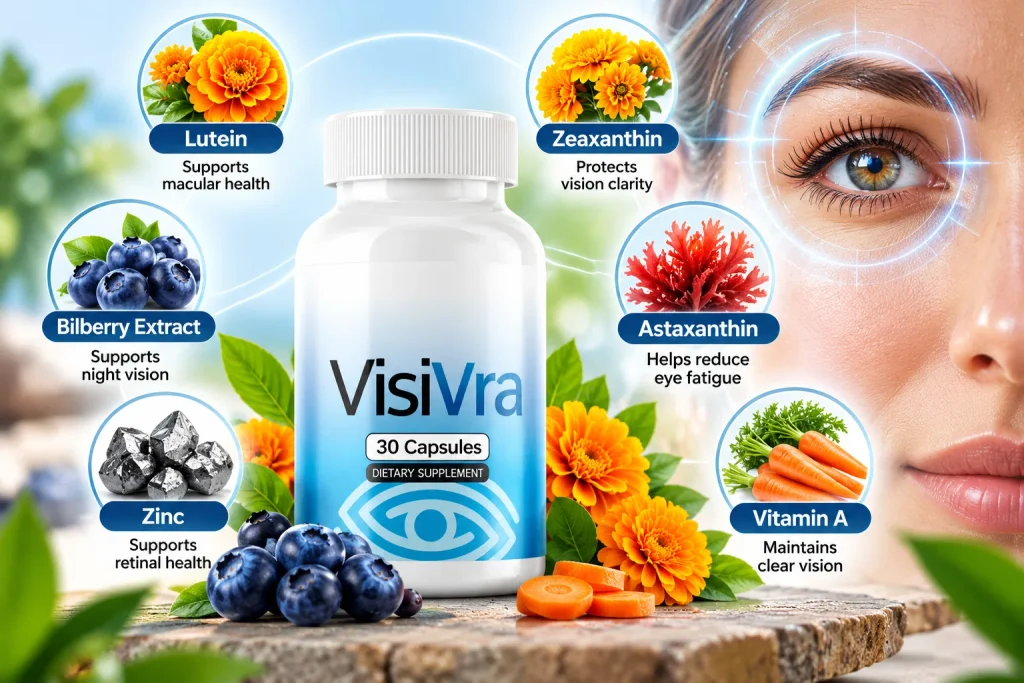
The most important information to verify is the amount of each ingredient per serving, its precise form, the recommended daily intake, and whether the product undergoes independent quality testing.
1. Lutein
Lutein is a carotenoid, a plant pigment found in leafy greens like spinach and kale. It builds up in the macula, the part of the retina responsible for detailed central vision. There, it filters high-energy blue light and acts as an antioxidant. It is among the most studied nutrients in eye research and a core ingredient in formulas based on the AREDS2 trial from the National Eye Institute.
2. Zeaxanthin
Zeaxanthin is lutein’s partner. Together they make up the macular pigment, a natural filter that protects the retina from light-induced oxidative stress. Zeaxanthin is most concentrated at the center of the fovea, the spot that handles your sharpest vision. Most supplements pair the two, and Visivra does too.
3. Bilberry Extract
Bilberry (Vaccinium myrtillus) is a European relative of the blueberry, rich in anthocyanins. These are antioxidant pigments traditionally linked to circulation and night vision. Bilberry is popular in eye formulas, but the clinical evidence is more mixed than for lutein and zeaxanthin. Some studies show benefits for eye fatigue, others show little effect. You can read the NIH-hosted overview of bilberry here.
4. Astaxanthin
Astaxanthin is a red carotenoid from microalgae, and it’s what gives salmon its color. It’s a strong antioxidant, and researchers have studied it for eye fatigue, accommodation (your eye’s focusing ability), and blood flow. A review of the research is available on PubMed Central. Early results are encouraging for digital eye strain, though many studies are small, so I’d call this “promising” rather than “proven.”
5. Zinc
Your retina contains a lot of zinc. It helps move vitamin A from the liver to the eye, and it supports enzymes involved in vision. Zinc was a key ingredient in the original AREDS studies on advanced age-related macular degeneration (AMD). The NIH Office of Dietary Supplements fact sheet on zinc also lists safe upper limits, which matter if you take other supplements.
6. Vitamin A
Vitamin A is used to make rhodopsin, the pigment that lets you see in dim light. It also helps keep the cornea healthy. True deficiency is rare in the U.S., but it’s a leading cause of preventable blindness worldwide. The NIH vitamin A fact sheet explains safe intake levels.
Excessive preformed vitamin A can be harmful, particularly during pregnancy. People who are pregnant, planning pregnancy, or taking medicines containing retinoids should seek professional advice before using vitamin A supplements.
Visivra Ingredients Summary
| Ingredient | Main nutritional role | Important limitation |
|---|---|---|
| Lutein | Macular pigment and antioxidant support | Benefits depend on the formulation and clinical context |
| Zeaxanthin | Supports macular pigment | Not a guaranteed eyesight enhancer |
| Bilberry extract | Provides anthocyanins | Evidence for many eye claims is limited |
| Astaxanthin | Antioxidant activity; studied for visual fatigue | Product-specific benefits remain unverified |
| Zinc | Essential mineral for normal visual function | Excess intake can cause adverse effects |
| Vitamin A | Supports normal vision and eye tissues | Excessive intake can be harmful |
Overall ingredient assessment: The six ingredients have plausible nutritional roles, but the full Supplement Facts label, quantities, and quality documentation are needed to judge the formulation properly.
Visivra Benefits: What Might It Help With?
The product is promoted for visual clarity, eye comfort, and long-term wellness. A fair assessment separates the possible benefits of adequate nutrient intake from claims that the finished supplement has been clinically proven to produce specific results.
1. Supporting Normal Visual Function
Vitamin A and zinc contribute to normal visual function. Lutein and zeaxanthin are concentrated in the macula and are relevant to retinal nutrition.
If someone has inadequate nutrient intake, correcting that deficiency can be important for health. However, people who already have adequate nutrition should not assume that an additional supplement will improve visual sharpness.
2. Providing Nutrients Associated With Retinal Health
The retina is a light-sensitive tissue that plays a central role in vision. It depends on adequate nutrition and normal blood supply to function properly.
Lutein, zeaxanthin, zinc, and vitamin A each have relevant biological roles. However, a supplement’s ingredient list does not establish that it prevents retinal disease or reverses existing damage.
For people with diagnosed AMD, an eye specialist may recommend an AREDS2 formulation when appropriate. Visivra should not be treated as an equivalent substitute unless its full composition is independently verified and a clinician confirms that it meets the person’s needs.
3. Potential Support for Screen-Related Eye Comfort
Long periods of screen use can contribute to tired eyes, temporary focusing difficulty, headaches, and discomfort. People may also blink less frequently while concentrating on digital devices.
Although Visivra is marketed for screen fatigue, strong evidence that this exact product reduces digital eye strain has not been established.
Practical steps may help more directly:
- Take regular breaks from close-up work.
- Look at a distant object periodically.
- Adjust screen brightness and text size.
- Reduce glare and position the monitor comfortably.
- Blink regularly and consider professional advice if dry-eye symptoms persist.
4. Supporting Nutritional Needs as People Age
Age-related eye conditions can affect central vision and daily independence. Good nutrition, regular eye examinations, and management of relevant health conditions are important parts of maintaining eye health.
The AREDS2 research supports a specific nutrient combination for certain people with AMD. It does not establish that Visivra prevents age-related vision loss in healthy adults.
The most reasonable approach is to assess diet, medical history, eye examination findings, and the actual supplement label before deciding whether additional nutrients are necessary.
Does Visivra Really Work for Eye Health?
This is the central question for anyone considering a purchase.
The answer depends on what “work” means. The ingredients have recognized nutritional functions, and some related nutrients have been studied in clinical trials. However, evidence supporting an ingredient is not the same as evidence demonstrating that the complete Visivra product improves eyesight.
The National Center for Complementary and Integrative Health explains that evidence for eye supplements varies by condition. Certain antioxidant and mineral combinations can slow progression to advanced AMD in appropriate patients, while other supplement claims have much less supporting evidence. NCCIH: Dietary Supplements for Eye Conditions.
A few questions are especially important:
- Does the label list the amount of each ingredient?
- Are those amounts consistent with relevant research or established nutritional guidance?
- Is there a published clinical trial on the finished Visivra formula?
- Is the product independently tested for identity, purity, and contaminants?
- Are the marketing claims consistent with the available scientific evidence?
Without reliable answers, it is not possible to conclude that Visivra reliably improves visual clarity, reduces screen fatigue, or protects against eye disease.
A supplement may be worth considering as nutritional support, but it should not replace an eye examination, prescribed treatment, corrective lenses, or other recommended care.
Visivra Customer Reviews and Complaints: What Should Buyers Know?
People searching for Visivra reviews often want to know whether customers notice meaningful benefits, whether there are complaints, and whether the product offers reasonable value.
Customer testimonials can provide information about purchasing experiences, capsule convenience, delivery, or perceived satisfaction. They cannot independently establish that a supplement treats an eye condition.
For a balanced review, it is important to distinguish between three types of evidence:
- Customer feedback: Individual experiences that may be genuine but are not controlled clinical evidence.
- Product claims: Statements made by the seller about intended benefits, ingredients, or manufacturing.
- Scientific research: Studies that investigate ingredients or specific formulations using defined methods.
No independently verified set of Visivra customer reviews or complaint records was established for this article. This does not mean that complaints exist or that the product is necessarily unreliable. It means the customer experience cannot be confidently summarized from the available evidence.
Before ordering, check recent reviews from sources independent of the seller, look for repeated patterns rather than isolated comments, and read the refund policy carefully.
Be cautious of testimonials claiming dramatic eyesight improvements, especially if they suggest that people can stop using prescribed glasses or medication.
U.S. Consumer Case Study: A Screen-Heavy Workday
Important: The following is a review created to support a consumer decision. It is not a real Visivra customer, a verified testimonial, or evidence from a clinical trial.
Consider a 42-year-old office worker in Texas who spends seven to nine hours a day using a laptop and often checks a phone after work. By late afternoon, the worker experiences tired eyes and occasional difficulty refocusing.
After seeing an advertisement for Visivra, the worker considers purchasing the supplement.
Instead of assuming that the symptoms are caused by nutritional deficiencies, the worker takes a more careful approach.
Step 1: Identify the problem. The worker records when the discomfort occurs, how long it lasts, and whether it is accompanied by headaches, dryness, or blurred vision.
Step 2: Arrange an eye examination. An eye care professional can assess vision correction, eye surface problems, and other possible causes of the symptoms.
Step 3: Review daily habits. The worker takes regular screen breaks, adjusts the workstation, improves lighting, and pays attention to blinking and sleep.
Step 4: Evaluate the supplement. Before buying Visivra, the worker checks the complete ingredient label, daily quantities, safety warnings, and independent quality information.
Step 5: Make a measured decision. If supplementation is appropriate, the worker discusses it with a healthcare professional and monitors symptoms without assuming that any change is caused by the product.
This review demonstrates a useful principle for U.S. consumers: the best purchasing decision is not simply about whether a product sounds promising. It is about whether the supplement fits the person’s needs, whether the claims are supported, and whether its cost is justified.
Visivra Pros and Cons
| Pros | Cons |
|---|---|
| Contains nutrients relevant to normal eye function | Exact ingredient amounts have not been verified for this review |
| Includes lutein and zeaxanthin, which have been studied in eye nutrition | Evidence for the complete Visivra formula has not been established |
| Combines vitamins, a mineral, and carotenoids | Benefits for screen fatigue are uncertain |
| May be convenient for people who prefer a daily supplement | Vitamin A and zinc require attention to total intake |
| Encourages interest in proactive eye nutrition | Marketing claims should not replace clinical evidence |
| Can be evaluated against other eye supplements | Price, independent testing, and verified customer feedback require further checking |
The biggest advantage is the inclusion of ingredients with relevant nutritional functions. The main limitation is the lack of verified product-specific information needed to establish the formula’s quality, appropriate dosage, and effectiveness.
Visivra vs. Other Eye Health Options
Visivra is not the only way to support eye health. The most appropriate choice depends on whether someone wants general nutritional support, help with screen-related discomfort, or a formula intended for a diagnosed eye condition.
| Option | Main purpose | Evidence and limitations |
|---|---|---|
| Visivra | General nutritional eye support | Product-specific effectiveness remains unverified |
| AREDS2 formula | Slowing progression of AMD in eligible patients | Supported by large clinical research studies; not intended for everyone |
| General multivitamin | Filling broader nutritional gaps | Not equivalent to an AREDS2 formula |
| Lutein and zeaxanthin supplement | Providing specific carotenoids | Benefits depend on the person’s circumstances and the formula |
| Screen-use adjustments | Reducing common contributors to digital discomfort | Useful practical measures, although persistent symptoms need assessment |
| Balanced diet | Supplying a range of nutrients | Supports general health but does not replace treatment for eye disease |
The National Eye Institute states that AREDS2 supplements can help reduce the risk of progression to advanced AMD in people with appropriate disease stages. They do not prevent AMD from starting, and they are not a treatment for every eye problem.
Visivra should not be assumed to offer the same benefits because its advertised ingredients overlap with some nutrients used in AREDS2. The complete formula and quantities matter.
Visivra Side Effects and Safety Considerations
Even products marketed as natural supplements can cause side effects or interact with medications.
Because the exact amounts and forms of the Visivra ingredients have not been independently verified for this review, its overall safety profile cannot be determined conclusively.
Potential considerations include:
- Vitamin A: Excessive intake of preformed vitamin A can be toxic. Pregnant people should be particularly careful about excessive intake.
- Zinc: High intake can cause nausea and, over time, interfere with copper absorption.
- Bilberry: Bilberry products may interact with certain medicines. People taking anticoagulant or antiplatelet medication should ask their clinician or pharmacist about potential risks.
- Multiple supplements: Combining Visivra with a multivitamin or another eye formula may increase total nutrient intake unnecessarily.
- Allergies and sensitivities: Check the complete ingredient and allergen information before use.
People who take prescription medicines, have a chronic health condition, are pregnant or breastfeeding, or are planning surgery should consult a qualified healthcare professional before starting a new supplement.
Stop taking a supplement and seek medical advice if you develop a concerning reaction.
Do not delay urgent eye care. Sudden vision loss, a sudden increase in floaters, flashes of light, a curtain-like shadow, or significant eye pain requires urgent medical evaluation. These symptoms should not be managed by trying an eye supplement.
Visivra Price: Is It Good Value for Money?
The price of Visivra is an important part of the buying decision, particularly if the seller recommends taking it consistently.
A current, independently verified price and complete package comparison were not established for this review. Promotional offers may change, so readers should confirm the final amount directly with the seller before placing an order.
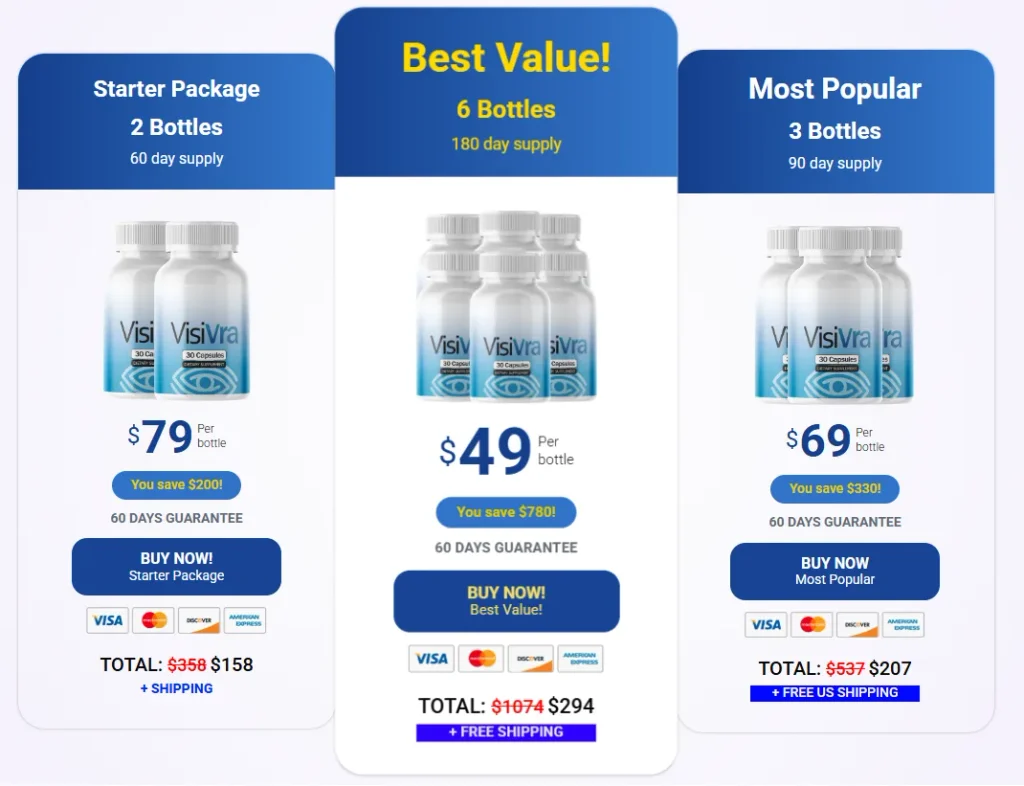
When assessing the Visivra price, consider more than the headline discount.
- Cost per bottle: Check the number of capsules included.
- Cost per day: Divide the total product cost by the number of daily servings.
- Shipping and taxes: Confirm whether these are included.
- Recurring charges: Check whether the order is a one-time purchase or a subscription.
- Refund terms: Read the deadline, eligibility conditions, and return procedure.
- Ingredient value: Compare the actual amounts and quality documentation, not simply the number of ingredients.
A lower cost per bottle is not necessarily better value if the formula is poorly documented or contains amounts that do not meet your needs.
Where to Buy Visivra
If you decide to purchase Visivra, start by verifying the seller’s identity and the product label. The seller’s website may provide the latest product details, ordering terms, and refund policy, but these claims should be checked rather than accepted automatically.
Where to Buy Visivra
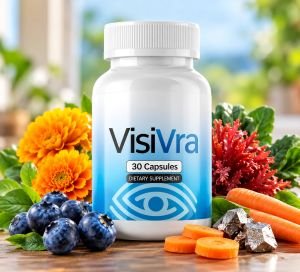
Where to Buy Visivra: Official Website, Pricing & Ordering Details
- Supports normal visual function.
- Promotes eye wellness
- Provides antioxidant nutrients
- Supports retinal health
How to Support Eye Health Alongside Any Supplement
A supplement is only one possible part of a broader approach to eye wellness. Several practical habits can help support everyday eye comfort and overall health.
Take regular screen breaks. Try the 20-20-20 approach: approximately every 20 minutes, look at an object about 20 feet away for 20 seconds.
Eat a varied diet. Include leafy greens, colorful vegetables, fruit, whole grains, and suitable sources of protein. Foods provide a range of nutrients that work together as part of a balanced diet.
Schedule appropriate eye examinations. An eye care professional can detect problems that may not produce obvious early symptoms.
Wear suitable eye protection. Use protective eyewear for activities that could injure your eyes and appropriate sunglasses when outdoors.
Manage health conditions. Conditions such as diabetes can affect eye health, making routine medical care and recommended eye examinations important.
Get persistent symptoms checked. Repeated blurry vision, headaches, discomfort, or difficulty seeing at night should be assessed rather than automatically attributed to age or screen use.
These steps are useful whether or not you choose Visivra.
Frequently Asked Questions About Visivra
1. What is Visivra?
Visivra is a dietary supplement marketed to support visual clarity, eye comfort, and general eye wellness. Its advertised ingredients include lutein, zeaxanthin, bilberry extract, astaxanthin, zinc, and vitamin A.
2. What are the ingredients in Visivra?
The six advertised ingredients are lutein, zeaxanthin, bilberry extract, astaxanthin, zinc, and vitamin A. Check the current product label to confirm the ingredient forms, amounts, and other components.
3. Does Visivra really work for eye health?
The ingredients have different nutritional roles, and some have been studied for eye health. However, reliable evidence proving that the complete Visivra formula improves vision or treats eye conditions has not been established for this review.
4. Is Visivra worth buying?
Visivra may be worth considering if its label, quality information, price, and ingredients suit your needs. However, buyers should not pay a premium based solely on claims about sharper vision or protection from blue light. Compare the product with evidence-based alternatives first.
5. Can Visivra improve blurry vision?
There is insufficient verified evidence to conclude that Visivra corrects blurry vision. Blurriness can result from refractive errors, dry eyes, medication effects, or eye disease. Persistent or sudden blurry vision needs appropriate medical assessment.
6. Can Visivra reduce screen fatigue?
The product is marketed for screen-related eye discomfort, but its effectiveness for digital eye strain has not been established through verified product-specific clinical evidence. Screen breaks, appropriate lighting, and assessment of dry eyes or vision correction may be helpful.
7. What are the possible Visivra side effects?
Possible risks depend on the exact ingredients, doses, individual health, and medication use. Excessive vitamin A or zinc can be harmful, and some herbal ingredients may interact with medicines. Review the label with a healthcare professional when necessary.
8. How long does Visivra take to work?
There is no independently verified timeline showing how long Visivra takes to produce benefits. Results from studies of individual ingredients cannot establish a reliable timeline for this particular supplement.
9. What is the Visivra price?
The current price has not been independently verified for this article. Confirm the total checkout price, package size, shipping, taxes, and refund terms directly with the seller before ordering.
10. Where can I buy Visivra?
Check the product’s verified seller website and confirm the exact domain before purchasing. Review the label, seller contact details, return policy, and payment terms. Do not assume that every website using a similar product name is operated by the same seller.
11. Is Visivra FDA-approved?
Dietary supplements are not FDA-approved for effectiveness before being marketed in the same way as prescription medicines. A claim that a supplement is made in an FDA-registered facility does not establish that the FDA has approved the product or verified its benefits.
12. Can Visivra replace an AREDS2 supplement?
Do not assume that it can. AREDS2 has a specific formulation supported by clinical research for eligible people with AMD. Visivra’s full formula and amounts must be verified, and a qualified eye care professional should determine whether an AREDS2 formulation is appropriate.
References and Scientific Resources
- National Eye Institute (NIH): AREDS/AREDS2 research and AMD information, nei.nih.gov
- NIH Office of Dietary Supplements, Zinc: ods.od.nih.gov/factsheets/Zinc-HealthProfessional
- NIH Office of Dietary Supplements, Vitamin A: ods.od.nih.gov/factsheets/VitaminA-HealthProfessional
- Bilberry overview (NCBI Bookshelf): ncbi.nlm.nih.gov/books/NBK71210
- Astaxanthin research (PubMed Central): pmc.ncbi.nlm.nih.gov/articles/PMC10056084
- American Academy of Ophthalmology, computer use and digital eye strain: aao.org
- FDA, Dietary Supplements: fda.gov/food/dietary-supplements
- Third-party Visivra review roundups consulted for pricing, manufacturer, and refund details, including yourhealthmagazine.net and malwaretips.com (independent caution on ingredient amounts and purchase routes)
These sources discuss ingredients, nutrients, and related research. They should not be interpreted as endorsements of Visivra or proof that the finished product has been clinically tested.
Final Verdict: Is Visivra Worth Trying for Eye Health?
This Visivra review finds that the product’s six advertised ingredients have plausible nutritional relevance, but there is not enough verified product-specific evidence to conclude that the supplement reliably improves visual clarity, reduces digital eye strain, or prevents age-related eye disease.
The most encouraging aspect is the inclusion of nutrients associated with normal vision, particularly lutein, zeaxanthin, zinc, and vitamin A. The main unanswered questions concern exact ingredient quantities, independent quality testing, current pricing, and clinical evidence for the finished formula.
For a consumer considering Visivra, the sensible approach is to check the label, compare the formula with evidence-based alternatives, review the safety considerations, and consult an eye care professional when appropriate.
Medical Disclaimer: This article is intended to provide helpful educational information about eye health and nutritional supplements. Dietary supplements may support overall wellness when used as part of a balanced lifestyle. For personalized guidance, consult a qualified healthcare professional before starting a new supplement, especially if you take medication, are pregnant or breastfeeding, or have an existing health condition. Regular eye examinations and professional advice can help you make informed decisions about maintaining healthy vision.

For more expert-backed health tips, wellness guides, and supplement insights, be sure to read more articles on the Health Line Guide