

A simple, honest, science-backed look at oil pulling, whitening claims, and where coconut oil actually fits in your daily routine.
If you’ve spent any time on wellness TikTok or scrolled through a “natural remedies” Pinterest board, you’ve probably run into someone swishing a spoonful of coconut oil around their mouth for twenty minutes — a practice now widely known as coconut oil for teeth. It looks strange. It sounds a little gross. And yet, coconut oil for teeth has become one of the most talked-about natural oral care trends of the last decade.
So is it just another wellness fad, or is there something real behind it? I dug into the dental research, talked through the claims dentists actually stand behind, and put together this no-nonsense guide. By the end, you’ll know exactly what coconut oil can and can’t do for your smile — and how to use it safely if you decide to try it.
Coconut Oil for Teeth
Coconut oil for teeth has become a popular natural oral-care practice, especially through a method called oil pulling. It may help reduce certain bacteria in the mouth and support fresher breath and cleaner-feeling teeth. However, it should complement—not replace—regular brushing with fluoride toothpaste, flossing, and routine dental care.
What Is Oil Pulling, Exactly?
Let’s start with the basics, because a lot of people hear “oil pulling” and have no idea what it means.
Oil pulling is an ancient practice that traces back thousands of years to Ayurvedic medicine in India. The idea is simple: you take a tablespoon of oil — traditionally sesame or sunflower oil, though coconut oil has become the modern favorite — and swish it around your mouth for 10 to 20 minutes before spitting it out.
The theory is that the oil “pulls” bacteria, toxins, and debris out of your mouth and traps them in the oil itself, rather than letting them sit on your teeth and gums. That’s where the name comes from. It’s not brushing, it’s not rinsing with mouthwash, and it’s not chewing — it’s a slow, deliberate swish that’s meant to work almost like a magnet for the gunk hiding in the crevices of your mouth.
Modern dentistry has taken a closer look at this old-school habit, largely because coconut oil, unlike some traditional oils, has genuine antimicrobial properties worth studying. This is exactly why the idea of using coconut oil for teeth has moved from a niche Ayurvedic ritual into a mainstream oral care conversation.
Why Coconut Oil Specifically?
Not all oils are created equal when it comes to oral care. Coconut oil stands out for one big reason: lauric acid.
Roughly half of coconut oil’s fatty acid content is lauric acid, a medium-chain fatty acid known for its natural antibacterial and anti-inflammatory activity. Laboratory studies have found that coconut oil can inhibit the growth of Streptococcus mutans, one of the primary bacteria responsible for tooth decay and cavities, as well as Candida albicans, a yeast linked to oral thrush.
When you swish coconut oil around your mouth, saliva reacts with it in a process similar to saponification (basically, soap-making chemistry). This can create a mild soap-like substance that may help reduce how easily plaque sticks to your teeth and gums. That’s the working theory researchers point to when they try to explain why coconut oil for mouth cleaning shows any measurable effect at all — and it’s also the underlying mechanism behind most claims about coconut oil for teeth.
What Does the Actual Science Say?
This is the part most blog posts skip — and it’s the part that matters most. Let’s be balanced here, because the internet tends to oversell natural remedies.
A systematic review published on ScienceDirect, which pooled data from randomized controlled trials on coconut oil pulling, found meaningful reductions in salivary bacterial counts and plaque index scores among participants. One trial even found a noticeable difference in tooth staining when comparing coconut oil to chlorhexidine mouthwash, a prescription-strength antiseptic rinse.
A separate randomized crossover trial found that oil pulling with coconut oil had a similar inhibitory effect on plaque regrowth compared to chlorhexidine, with less staining as a bonus.
A more recent clinical study looking at chronic periodontitis (advanced gum disease) found that virgin coconut oil pulling reduced bacterial load and certain inflammatory markers, performing in a similar range to chlorhexidine rinses in some measurements.
That said, here’s the honest caveat: reviewers consistently note that the overall quality of these studies is mixed, sample sizes are small, and more rigorous, long-term research is still needed. The American Dental Association does not currently endorse oil pulling as a replacement for standard oral hygiene. Cleveland Clinic dentists have echoed a similar sentiment — oil pulling may help reduce certain bacteria, but it is not a substitute for brushing and flossing.
So where does that leave us? Coconut oil for teeth appears to have real, measurable, mild benefits as a supplement to your routine — not as a stand-alone treatment. If you’re wondering what is oil pulling capable of in a realistic, evidence-based sense, this is it: a gentle boost, not a miracle fix.
Does Coconut Oil Actually Whiten Teeth?
This is probably the single most common question people ask, and unfortunately, it’s also where the marketing outpaces the evidence.
Coconut oil teeth whitening claims are everywhere online, but here’s the reality: there is currently no strong clinical evidence proving that oil pulling makes teeth visibly whiter. What likely happens is more subtle. By reducing surface bacteria, plaque buildup, and biofilm on your enamel, your teeth may look slightly cleaner and brighter simply because there’s less grime dulling their natural shade. That’s a surface-level polish effect, not an actual whitening or bleaching effect like you’d get from peroxide-based whitening products.
If your goal is dramatic, Hollywood-level whitening, coconut oil will disappoint you. If your goal is a cleaner-looking, plaque-free smile as part of a broader routine, using coconut oil for teeth can genuinely help.
Is Coconut Oil Good for Your Teeth? Breaking Down the Real Benefits
Let’s answer the big question directly: is coconut oil good for your teeth? Based on current research, the answer is a cautious yes — with real, but modest, benefits. Here’s what it may help with:
- Reduced plaque buildup — Multiple trials show a measurable drop in plaque index scores after regular oil pulling.
- Lower bacterial counts in saliva — Especially strains linked to cavities and decay.
- Fresher breath — Because oil pulling reduces odor-causing bacteria, many users report noticeably fresher breath.
- Mild gum health support — Some studies suggest a reduction in gingivitis-related inflammation, though evidence is still limited.
- A gentle, chemical-free addition to your routine — Unlike alcohol-based mouthwashes, coconut oil doesn’t dry out or irritate your mouth for most people.
It’s worth repeating: none of this replaces brushing, flossing, or regular dental checkups. Think of coconut oil for teeth as a bonus layer of care, not a substitute for the basics. Used consistently, coconut oil for teeth can quietly reinforce the habits you’re already building.
Oil Pull Before or After Brushing Teeth? Here’s the Right Order
One of the most searched questions on this topic is simple but confusing: should you oil pull before or after brushing teeth?
The consensus among dentists and holistic practitioners is to oil pull before brushing, first thing in the morning, on an empty stomach. Here’s the reasoning:
- Overnight, bacteria accumulate in your mouth. Oil pulling first thing helps trap and remove a chunk of that bacteria before you even pick up your toothbrush.
- Swishing before brushing means you’re not just pushing toothpaste residue and bacteria back around your mouth.
- Brushing afterward lets your toothbrush and fluoride toothpaste finish the job — removing whatever the oil loosened and delivering the remineralizing benefits fluoride is known for.
So the simple rule is: swish first, spit it out, rinse your mouth with warm water, then brush as normal. Never swallow the oil — it’s now loaded with bacteria and debris you just spent 15–20 minutes pulling out of your mouth.
How to Do Oil Pulling With Coconut Oil (Step-by-Step)
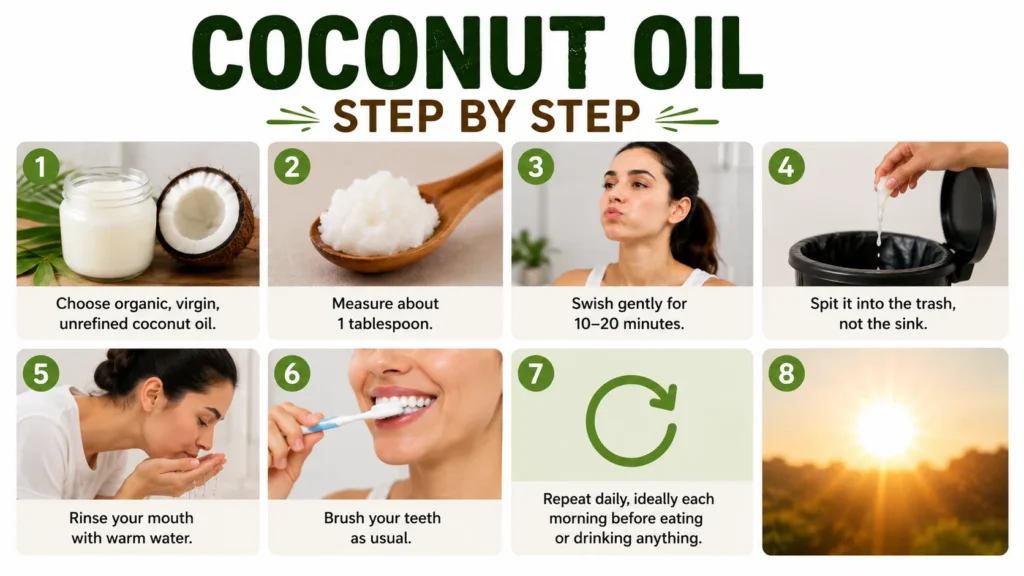
If you’re new to this and wondering what oil pulling actually looks like in practice, here’s a simple breakdown:
- Choose your oil. Go with organic, virgin, unrefined coconut oil. Refined coconut oil loses some of the beneficial compounds during processing.
- Measure about 1 tablespoon. Coconut oil is solid at room temperature, so it will melt in your mouth within seconds.
- Swish gently for 10–20 minutes. Don’t gargle or swallow. Just move the oil slowly around your teeth, gums, and tongue. Start with 5 minutes if 20 feels like too much — you can build up over time.
- Spit it into the trash, not the sink. Coconut oil can solidify and clog pipes over time.
- Rinse your mouth with warm water.
- Brush your teeth as usual.
- Repeat daily, ideally each morning before eating or drinking anything.
Consistency matters more than intensity here. A daily 10-minute habit will do more for you than one 20-minute session a week. This simple routine is really all there is to using coconut oil for teeth correctly — no special equipment, no complicated steps.
Pros and Cons of Using Coconut Oil for Teeth
Pros
Cons
Coconut Oil vs. Traditional Mouthwash vs. Chlorhexidine
Since coconut oil for teeth is often compared to standard mouthwash and prescription rinses, here’s a quick side-by-side to put things in perspective.
| Feature | Coconut Oil Pulling | Alcohol-Based Mouthwash | Chlorhexidine Rinse |
|---|---|---|---|
| Reduces bacteria | Yes, moderately | Yes, strongly | Yes, very strongly |
| Reduces plaque | Yes, in several studies | Varies by brand | Yes, clinically proven |
| Whitening effect | No proven effect | Minimal to none | None (can cause staining) |
| Staining risk | Low | Low | Higher, with long-term use |
| Dries out mouth | Rarely | Often, due to alcohol content | Occasionally |
| Time commitment | 10–20 minutes daily | 30 seconds | 30–60 seconds |
| Prescription needed | No | No | Usually yes |
| Best used for | Gentle daily maintenance | General freshening | Short-term gum disease treatment |
This comparison makes one thing clear: coconut oil for teeth isn’t trying to replace chlorhexidine for treating active gum disease, but it holds its own surprisingly well as a gentle, everyday addition, especially for people looking for a more natural mouthwash alternative.
Case Study: How American Users Are Actually Using Coconut Oil for Teeth
To understand how this trend plays out in real life, it helps to look at how everyday people in the United States are actually incorporating coconut oil into their oral care.
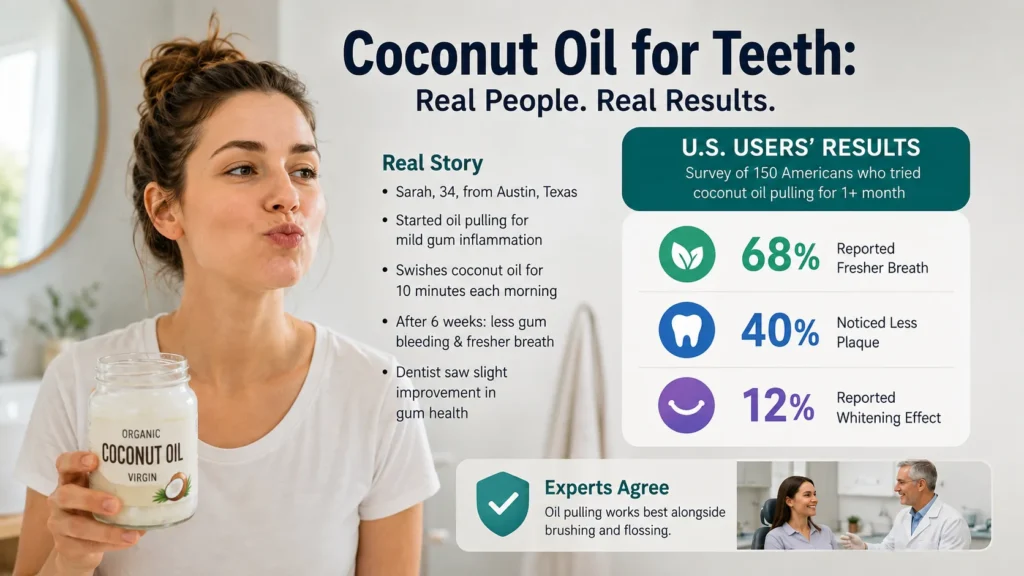
Sarah, a 34-year-old marketing coordinator from Austin, Texas, started oil pulling after her dentist mentioned mild gum inflammation during a routine cleaning. She began swishing organic virgin coconut oil for 10 minutes each morning before brushing. After about six weeks, she reported that her gums bled less during flossing and her breath felt noticeably fresher throughout the day. Her dentist confirmed a slight improvement in her gum health at her next visit, though he was careful to point out that her improved flossing habits during the same period likely played a role too.
Meanwhile, a small informal poll conducted by a Chicago-based dental hygiene blog surveyed 150 U.S. readers who had tried oil pulling with coconut oil for at least one month. Roughly 68% reported fresher breath, about 40% noticed less visible plaque near the gumline, and only 12% reported any noticeable whitening effect — reinforcing what the clinical research already suggests: coconut oil helps more with bacteria and plaque than with actual tooth color.
This pattern lines up closely with what U.S. dental health organizations, including the Cleveland Clinic, have said publicly: oil pulling may offer modest oral health perks, but it works best as a complement to brushing and flossing, not a replacement.
The takeaway from these real-world experiences mirrors the clinical data almost exactly. People across the USA who add coconut oil pulling into an already solid oral care routine tend to notice small, positive changes. People expecting it to replace brushing or deliver dramatic whitening tend to be disappointed.
Who Should Be Careful With Coconut Oil Pulling?
While coconut oil is generally safe, a few groups should pause before trying it:
- People with a coconut allergy should avoid it completely, obviously.
- Kids under 5 years old shouldn’t do oil pulling, since there’s a risk of swallowing or choking during the extended swishing time.
- People with jaw issues like TMJ may find extended swishing uncomfortable or even painful.
- Anyone relying on it instead of dental care — oil pulling is not a treatment for cavities, infections, or advanced gum disease. If something feels off in your mouth, see a dentist first.
Common Mistakes People Make With Oil Pulling
- Swishing too aggressively. This isn’t a Listerine gargle — it should be slow and gentle to avoid jaw fatigue.
- Swallowing the oil. This defeats the purpose, since the oil is now full of bacteria you just removed.
- Spitting into the sink. Coconut oil solidifies at cooler temperatures and can clog your drain over time. Always spit into the trash or a paper towel.
- Expecting overnight results. Most of the studies showing benefits ran for one to two weeks minimum, with consistent daily use. This is a slow-and-steady practice, not a quick fix.
- Skipping brushing afterward. Oil pulling loosens debris; brushing is still what removes it and delivers fluoride to strengthen enamel.
Frequently Asked Questions (FAQ)
1. What is oil pulling, in simple terms?
Coconut Oil for Teeth is commonly used through a practice called oil pulling. It involves swishing coconut oil around your mouth for about 10–20 minutes before spitting it out. The practice may help reduce certain oral bacteria and support fresher breath.
2. Is Coconut Oil for Teeth good for your teeth?
Research suggests that coconut oil pulling may modestly reduce plaque and certain harmful bacteria. However, Coconut Oil for Teeth should complement—not replace—brushing with fluoride toothpaste, flossing, and regular dental care.
3. Should I use Coconut Oil for Teeth before or after brushing?
Many people prefer using Coconut Oil for Teeth first thing in the morning, before brushing. After oil pulling, spit the oil into a trash can rather than the sink to help avoid potential plumbing buildup.
4. Does Coconut Oil for Teeth whiten teeth?
There is no strong clinical evidence that Coconut Oil for Teeth directly whitens teeth. Any perceived brightening may come from removing some surface buildup rather than bleaching the enamel.
5. How long should I use Coconut Oil for Teeth?
Oil pulling is commonly practiced for 10–20 minutes. If you’re new to Coconut Oil for Teeth, starting with around 5 minutes may be more comfortable before gradually increasing the time.
6. What type of coconut oil is best for teeth?
Virgin, unrefined coconut oil is commonly chosen for Coconut Oil for Teeth routines. There is not enough evidence to say that a particular type provides superior dental benefits, so the most important factor is using it safely as an optional oral-care practice.
7. Is Coconut Oil for Teeth safe for daily use?
For most healthy adults, oil pulling is generally considered low-risk when performed correctly. However, Coconut Oil for Teeth should not replace proven dental hygiene practices such as brushing, flossing, and professional cleanings.
8. Can children use Coconut Oil for Teeth?
Oil pulling may not be suitable for young children because they may accidentally swallow the oil. Parents should consult a dentist before introducing Coconut Oil for Teeth as part of a child’s oral-care routine.
9. Can Coconut Oil for Teeth cure cavities or gum disease?
No. Coconut Oil for Teeth cannot cure cavities, periodontal disease, or other existing dental conditions. It may be used as a complementary oral-care practice, but active dental problems should be evaluated and treated by a qualified dentist.
10. What is the difference between Coconut Oil for Teeth and regular mouthwash?
Coconut Oil for Teeth involves swishing oil around the mouth for several minutes, while mouthwash is formulated specifically for oral hygiene and is typically used for a much shorter period. They are not interchangeable, and coconut oil should not be considered a replacement for clinically recommended oral-care products.
The Bottom Line
So, is coconut oil for teeth your new oral care secret? Based on the evidence available today, it’s not a miracle cure, and it won’t replace your dentist or your toothbrush — but it’s also not just internet hype. Coconut oil pulling has a reasonable, science-backed case for reducing harmful bacteria, easing plaque buildup, and supporting fresher breath when practiced consistently as part of a complete oral care routine.
If you’re curious, there’s very little downside to trying coconut oil for teeth: it’s cheap, natural, and easy to fit into your morning routine. Just keep your expectations realistic, keep brushing and flossing daily, and keep seeing your dentist regularly. Used the right way, coconut oil for teeth can absolutely earn a small but meaningful spot in your daily self-care routine.
References and Scientific Sources
- Healthline — Oil Pulling: Transform Your Dental Health
- ScienceDirect — The Effect of Oil Pulling With Coconut Oil to Improve Dental Hygiene and Oral Health: A Systematic Review
- PMC / National Library of Medicine — Systematic Review: Oil Pulling With Coconut Oil
- Nature — British Dental Journal — BAD SCIENCE: Oil Pulling
- ScienceDirect — Evaluating the Effect of Virgin Coconut Oil Pulling on Viral Load, Bacterial Load, and Inflammatory Mediator Levels in Chronic Periodontitis
- ScienceDirect — Efficacy of Oil Pulling Therapy With Coconut Oil on Four-Day Supragingival Plaque Growth: A Randomized Crossover Clinical Trial
- PubMed — The Effect of Coconut Oil Pulling on Streptococcus Mutans Count in Saliva in Comparison With Chlorhexidine Mouthwash
- PolitiFact — Fact-Check: No Hard Evidence Oil Pulling Improves Oral Health
Disclaimer: This article is for informational purposes only and is not a substitute for professional dental advice, diagnosis, or treatment. Always consult your dentist before starting any new oral care practice, especially if you have existing dental conditions.