
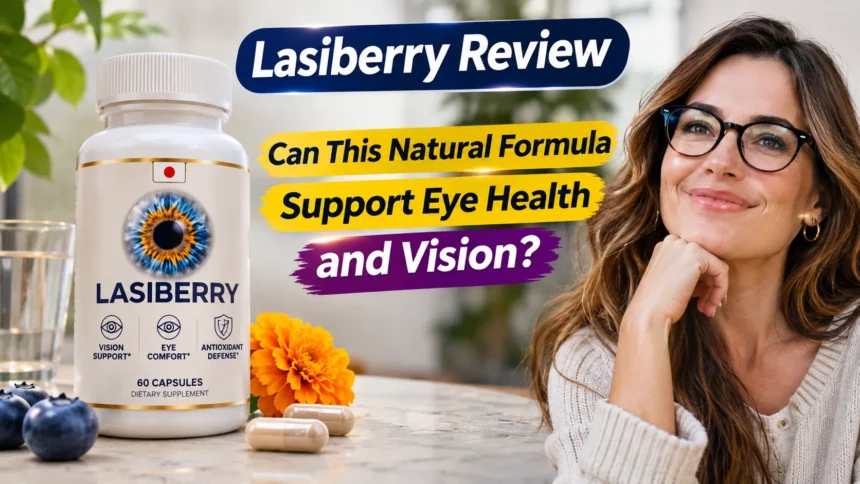
Spending long hours in front of phones, laptops, and television screens can leave your eyes feeling tired, dry, or uncomfortable. Add aging and everyday lifestyle habits to the picture, and it’s easy to understand why more people are paying attention to their eye health. This has also increased interest in natural eye health supplements like Lasiberry.
Lasiberry is a dietary supplement featuring five ingredients, including lutein, zeaxanthin, bilberry extract, eyebright extract, and vitamin A. These ingredients are associated with different aspects of eye nutrition, antioxidant activity, and normal visual function.
But is Lasiberry really worth considering? Can its ingredients support healthy vision, retinal health, and everyday eye wellness? And what should buyers know about its price, customer reviews, and potential benefits before ordering?
In this detailed Lasiberry Review, we’ll take a closer look at its ingredients, advertised benefits, scientific research, safety considerations, customer feedback, and official website. We’ll also separate realistic nutritional support from promotional claims to help you decide whether this supplement fits your eye care routine.
Quick Takeaways
- Lasiberry is a capsule supplement sold online, built around lutein, zeaxanthin, bilberry extract, eyebright extract, and vitamin A.
- Lutein and zeaxanthin have the strongest research behind them. Bilberry and eyebright have much weaker human evidence.
- The official site makes big promises, such as regenerating retinal cells and restoring vision after years of degeneration. No study cited in this review supports that kind of claim.
- Pricing runs from $49 to $79 per bottle depending on the bundle, with a 60-day money-back guarantee.
- Talk to an eye doctor first, especially if your vision has changed.

What Is Lasiberry?
The Lasiberry supplement is marketed as a natural vision support formula for adults who want daily help with eye comfort, visual clarity, and long-term eye protection. According to the Lasiberry official website, it uses five key ingredients that are meant to nourish the retina, filter harmful blue light, and fight oxidative stress.
The directions for Lasiberry are simple: take two capsules a day with a glass of water, ideally at the same time each morning. Each bottle holds 60 capsules, which makes one bottle a 30-day supply.
Here is the first thing worth saying clearly. Lasiberry is a dietary supplement, not a drug. The site itself states that its claims have not been evaluated by the U.S. Food and Drug Administration (FDA) and that the product is not meant to diagnose, treat, cure, or prevent any disease. That is standard for supplements in the United States, and it matters when you read the bigger marketing lines.
Lasiberry Ingredients: What Is Inside the Formula?
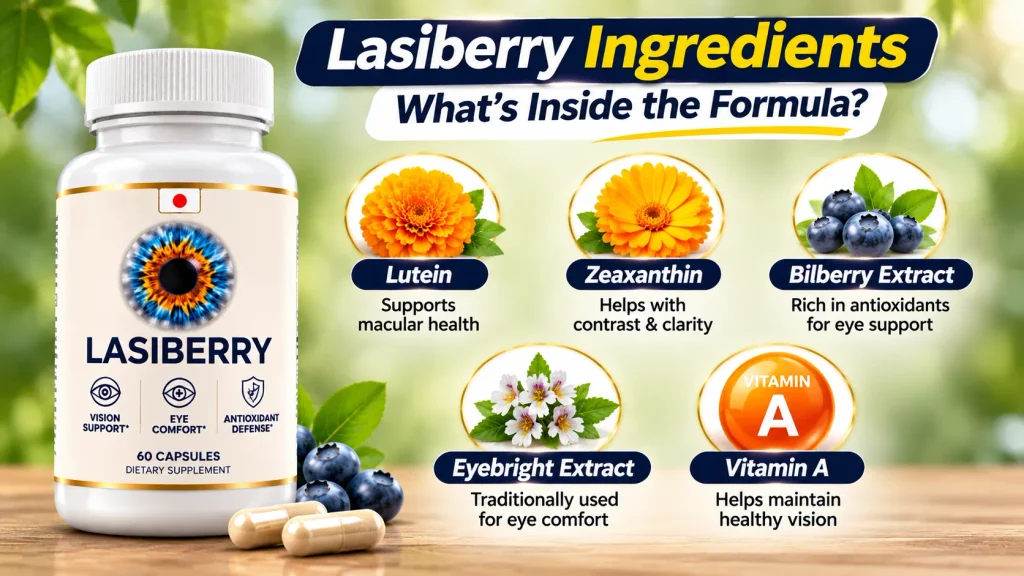
The ingredients are the heart of any supplement, so let’s go through them one at a time. Below, I describe what the brand says and what independent research suggests.
Lutein
Lutein is a carotenoid, a natural plant pigment found in spinach, kale, and egg yolks. Your body cannot make it, so it has to come from food or supplements. Lutein collects in the macula, the small center of the retina that handles sharp, detailed vision. The brand says it filters blue light from screens.
Research backs the idea that lutein is part of the eye’s natural defense. It is one of the main pigments that make up macular pigment, a kind of built-in sunscreen for the retina. This is why lutein shows up in so many eye wellness ingredient lists.
Zeaxanthin
Zeaxanthin is lutein’s close partner. The two work side by side in the center of the retina, and together they support macular health. The Lasiberry website says zeaxanthin improves contrast and helps with night driving. Better contrast sensitivity is a plausible effect, though results in studies are modest and vary from person to person.
Bilberry Extract
Bilberry is a European cousin of the blueberry. It contains anthocyanins, plant compounds that act as antioxidants. The brand says it strengthens the tiny blood vessels feeding the eye and helps with low-light vision.
Here the evidence gets thin. The National Center for Complementary and Integrative Health (NCCIH) says bilberry has not been clearly shown to help any health condition. The famous story about British pilots eating bilberry jam to see better at night during World War II is fun, but it is a story, not proof.
Eyebright Extract
Eyebright is a traditional European herb used for sore, irritated eyes. Lasiberry says it soothes the eye surface and helps with dryness and redness. Traditionally, that is how herbalists have used it. Modern clinical trials, however, are very limited, and most research comes from lab or animal work. So treat eyebright as a gentle traditional ingredient rather than a proven fix.
Vitamin A
Vitamin A is truly essential for vision. It helps the cornea stay healthy and is part of the pigment that lets you see in dim light. A shortage can cause night blindness. The catch is that most people in the United States already get enough through food, and too much preformed vitamin A can be harmful, especially during pregnancy. That is why checking the supplement facts panel matters.
A note on amounts: The official Lasiberry page I reviewed names the five ingredients but does not show the dose of each in a clear panel. That matters, because research on lutein and zeaxanthin uses specific amounts. Before you buy any Lasiberry supplement, look for the full Supplement Facts label and compare it with what studies used.
How Is Lasiberry Supposed to Work?
The brand explains the idea in three steps:
- Filter: Lutein and zeaxanthin absorb high-energy blue light before it can stress the macula.
- Protect: Antioxidant ingredients help neutralize free radicals, which are unstable molecules linked to cell aging.
- Nourish: Bilberry, eyebright, and vitamin A are meant to support circulation, surface comfort, and the light-sensing process.
In plain English, the theory is that your eyes face daily wear from light, screens, pollution, and age, and that a steady supply of the right nutrients for eye health can help the retina cope. That general idea is reasonable. Where it gets shaky is the claim that the formula can regenerate retinal cells or restore vision lost over many years. Retinal cells do not simply regrow because someone takes a capsule, and no supplement is known to reverse serious retinal damage.
Lasiberry Benefits: Promised vs. Realistic
Let’s compare what the brand promises with what is more realistic.
| What the Lasiberry website says | A more realistic view |
|---|---|
| Regenerates retinal cells and restores visual acuity | Not supported by the research reviewed here. Treat this claim with caution. |
| Reduces visual fatigue from screens | Possible. Lutein and zeaxanthin are studied for visual comfort, with modest results. |
| Improves contrast and color clarity | Plausible for some people, mainly through macular pigment support. |
| Helps with night vision | Mixed. Bilberry’s night vision reputation is stronger than its evidence. |
| Soothes dry, red eyes | Eyebright is used traditionally for this. Clinical proof is limited. |
| Long-term protection against daily wear | Reasonable as a goal, especially with a healthy diet and regular eye exams. |
So what can you honestly hope for? If your diet is low in leafy greens and colorful vegetables, a formula with lutein and zeaxanthin may help fill a nutritional gap. That is a quiet, long-term benefit, not an overnight transformation.
What Does Science Say About These Nutrients?
The best evidence for eye antioxidant protection comes from the Age-Related Eye Disease Studies, known as AREDS and AREDS2, run by the National Eye Institute (NEI) at the NIH.
- The NEI reports that taking AREDS or AREDS2 supplements reduces the risk of progression from intermediate to advanced age-related macular degeneration (AMD) by about 25 percent.
- The same studies found these supplements do not prevent AMD from starting and have no effect on cataracts.
- The AREDS2 formula uses 10 mg of lutein and 2 mg of zeaxanthin, along with vitamin C, vitamin E, zinc, and copper.
- A 2022 NIH follow-up reported that the lutein and zeaxanthin version worked better than the older beta-carotene version, and was safer for people who have smoked.
Notice what this means for a Lasiberry review. The strongest science is about a specific formula, in people who already have intermediate AMD. It is not about a general supplement for people with healthy eyes who want sharper sight. Lasiberry also does not publicly claim to match the AREDS2 formula. So while lutein and zeaxanthin have a solid research story, you cannot simply borrow that story for every bottle that contains them.
Lasiberry Reviews: What Are Customers Saying?
The Lasiberry reviews on the official site are glowing. Three testimonials from U.S. customers sit on the page, each with five stars and a “Verified Purchase” tag. They describe less eye strain, easier reading, and better night driving.
When I searched for independent Lasiberry reviews on trusted platforms, I found no verified third-party reviews of this specific product. The results I did find were for other eye supplements, many of them marked as sponsored content. That does not mean Lasiberry is bad. It means the product is new enough, or niche enough, that outside feedback is scarce. Until more independent opinions appear, treat the website testimonials as marketing, not as proof.
Case Study: What Do USA User Testimonials Really Tell Us?
Because the brand focuses on American buyers, I looked closely at the three U.S. testimonials on the official page. Think of this as a small case review, not a clinical trial.
The testimonials: Sarah Thompson from Houston, Texas, describes sharper focus and easier reading of fine print. Robert Anderson from San Diego, California, mentions better night driving and less eye fatigue. Emily Miller from Denver, Colorado, says she wakes up without eye fatigue and with clearer sight.
What stands out:
- All three mention results “within weeks,” yet the brand’s own FAQ says lutein and zeaxanthin need about six months to reach their best levels in the eye. Those two timelines do not quite match.
- All three describe similar problems: screen strain, blurry text, night driving. These are common, everyday complaints that can improve for many reasons, including better sleep, new glasses, or more screen breaks.
- The page’s fine print says testimonials may not reflect typical results, and that some names and personal details have been changed.
- There are no before-and-after eye exam results, no measured visual acuity, and no mention of a doctor’s evaluation.
The takeaway: The USA testimonials show that people feel satisfied, which is worth something. They do not show that the Lasiberry supplement caused any measurable change in eyesight.
Lasiberry Price: How Much Does It Cost?
The Lasiberry price depends on how many bottles you buy. Here is what the official site listed when I reviewed it:
| Package | Supply | Price per bottle | Total | Shipping |
|---|---|---|---|---|
| 2 bottles | 60 days | $79 | $158 | Extra |
| 3 bottles | 90 days | $69 | $207 | Free in the US |
| 6 bottles | 180 days | $49 | $294 | Free in the US |
A few extra details:
- Every order is covered by a 60-day money-back guarantee. The site says you should use the product for at least 30 days before asking for a refund.
- The brand says it is a one-time payment with no auto-ship subscription.
- The 3-bottle and 6-bottle options come with four digital bonuses, including an eye-friendly recipe guide, a digital eye defense plan, and a 10-day clarity challenge.
One small thing I noticed: the crossed-out “regular price” on the page shows slightly different numbers in different spots ($356 and $358 for the two-bottle pack). The discount countdown timer and “stock running out” messages are also classic urgency tactics. Take your time and decide calmly.
Discover Lasiberry & Check Today’s Offer
Lasiberry Official Website and Where to Buy Lasiberry
If you decide to try it, the safest answer to “where to buy Lasiberry” is the Lasiberry official website. Supplements with popular names are often copied by sellers on third-party marketplaces, and you cannot be sure what is inside those bottles or whether the money-back guarantee applies.
Before ordering, I suggest you:
- Confirm you are on the correct web address.
- Save a screenshot of the price and guarantee terms.
- Read the refund policy and contact details.
- Keep your order confirmation email.

Pros and Cons of Lasiberry
| Pros | Cons |
|---|---|
| Contains lutein and zeaxanthin, two of the best-studied nutrients for eye health | Bilberry and eyebright have limited human evidence |
| Simple routine: two capsules a day | Ingredient amounts were not clearly displayed on the page I reviewed |
| 60-day money-back guarantee | Refund requests need at least 30 days of use first |
| No auto-ship subscription, according to the brand | Few or no independent third-party reviews found |
| Free US shipping on larger bundles | Bold claims, such as retinal regeneration, are not backed by evidence |
| Bonus guides on diet and screen habits | Larger bundles require a big upfront cost |
| Fits a general daily eye care routine | Not a replacement for eye exams or medical treatment |
Lasiberry vs. Other Options: A Quick Comparison
How does the Lasiberry eye health supplement compare with other ways to support your eyes? Here is a simple side-by-side look.
| Feature | Lasiberry | AREDS2-style supplement | Plain lutein and zeaxanthin | Food-first approach |
|---|---|---|---|---|
| Main nutrients | Lutein, zeaxanthin, bilberry, eyebright, vitamin A | Vitamins C and E, zinc, copper, lutein, zeaxanthin | Lutein, zeaxanthin | Leafy greens, eggs, colorful produce |
| Backed by a large NIH trial | No | Yes, for intermediate AMD | Partly, as part of AREDS2 | General nutrition research |
| Doses clearly shown | Not on the page reviewed | Yes, on the label | Usually yes | Not applicable |
| Typical cost | $49 to $79 per bottle | Varies by brand | Often lower | Part of your grocery budget |
| Best for | Adults wanting a general vision support formula | People whose eye doctor recommends it | Those filling a diet gap | Everyone |
The honest summary: if your doctor has told you that you have intermediate AMD, ask about an AREDS2 formula rather than choosing a general product. If you are healthy and want a gentle daily boost, a formula like Lasiberry or a simple lutein supplement could be a reasonable choice, as long as it fits your budget and your doctor agrees.
Is Lasiberry Safe? Side Effects and Precautions
The brand says Lasiberry uses high-purity ingredients and is made under strict quality standards. It also suggests that pregnant or nursing women, people under 18, and anyone with a medical condition speak with a healthcare professional first. I agree with that advice. Here are a few extra points:
- Vitamin A: Too much preformed vitamin A can be harmful, particularly in pregnancy.
- Bilberry: It may lower blood sugar, so people with diabetes or those taking diabetes medicine should be careful. It may also interact with blood thinners in theory.
- Allergies: Eyebright belongs to a plant family some people react to. Stop use if you get a rash or swelling.
- Medications: Always tell your doctor and pharmacist about any supplement you take.
Some websites display logos such as “GMP” or “FDA” near supplements. Remember that the FDA does not approve dietary supplements before they go on sale. Look for an actual certificate or third-party testing seal, such as USP or NSF, for real quality proof.
Daily Eye Care Habits That Work Alongside Any Supplement
No capsule can replace healthy habits. Whether or not you try Lasiberry, these steps support healthy vision over the long term:
- Get a dilated eye exam. Many serious eye conditions have no early symptoms.
- Follow the 20-20-20 rule to ease digital eye strain.
- Wear sunglasses that block UV rays outdoors.
- Eat your greens. Spinach, kale, eggs, and colorful vegetables are natural sources of lutein and zeaxanthin.
- Don’t smoke. Smoking is a major risk factor for AMD and cataracts.
- Manage blood sugar and blood pressure, which both affect the tiny vessels in the retina.
- Sleep well, since tired eyes feel worse and look worse.
These habits are the foundation of long-term vision wellness. A supplement, if you choose one, is a small add-on.
Who Should Consider Lasiberry (and Who Should Not)?
Lasiberry might suit you if:
- You are an adult with healthy eyes looking for daily eye care support.
- Your diet is low in leafy greens and colorful produce.
- You spend long hours on screens and want to add a nutrient routine to your habits.
You should talk to a doctor first, or skip it, if:
- Your vision has suddenly changed, blurred, or dimmed. This needs an exam, not a supplement.
- You have been diagnosed with AMD, glaucoma, or diabetic retinopathy.
- You are pregnant, nursing, or under 18.
- You take blood thinners or diabetes medicine.
- You are hoping Lasiberry will be a miracle cure for existing vision loss.
Final Verdict: Is Lasiberry Worth It?
After going through the official website and the research, my honest conclusion is this: Lasiberry looks like a reasonable, if unproven, natural vision support formula built around some respectable ingredients. Lutein and zeaxanthin have real scientific support for macular health. Bilberry and eyebright add a traditional touch but lack strong proof. The price of Lasiberry is fair compared with other premium eye supplements, and the 60-day guarantee lowers the risk.
My main concern is the marketing. Promises about regenerating the retina and restoring years of lost vision go well beyond what current science can back up. Please keep your expectations realistic. If you try Lasiberry, think of it as a nutritional helper for protecting eye health, not a cure. Pair it with regular eye exams, good habits, and your doctor’s advice, and start with a smaller bundle until you know how your body responds.
Frequently Asked Questions About Lasiberry
What is Lasiberry?
Lasiberry is a dietary supplement in capsule form, marketed as a natural eye health supplement. It combines lutein, zeaxanthin, bilberry extract, eyebright extract, and vitamin A.
Does Lasiberry really work?
It may help fill nutrient gaps, and lutein and zeaxanthin are well studied for macular health. However, no independent clinical trial of Lasiberry itself was found, and claims of restoring vision are not supported by the research I reviewed.
How do I take Lasiberry?
The brand recommends two capsules daily with a glass of water, preferably at the same time each day.
How long does it take to see results?
The brand’s own FAQ suggests about six months for the active ingredients to build up in the eyes. Many people will notice little or nothing, since nutrient support is gradual.
Is Lasiberry safe?
It is made with common ingredients, but vitamin A, bilberry, and eyebright can matter for some people. Check with your doctor, especially if you are pregnant, nursing, on medication, or have a medical condition.
What is the Lasiberry price?
Bundles range from $49 to $79 per bottle: two bottles for $158, three for $207, and six for $294, based on the official site at the time of review. Prices can change.
Where can I buy Lasiberry?
The safest place is the Lasiberry official website. Avoid unknown resellers.
Does Lasiberry have a refund policy?
Yes. It offers a 60-day money-back guarantee, and the brand asks that you use it for at least 30 days first. Contact details are listed on the site.
Can Lasiberry replace my eye doctor or prescription glasses?
No. Supplements cannot correct refractive problems or treat eye disease. Regular eye exams are still essential.
Is Lasiberry a subscription?
According to the brand, no. It is a one-time payment with no auto-ship. Read the checkout page carefully to confirm.
References and Scientific Resources
- Lasiberry Official Website
- National Eye Institute (NIH), AREDS and AREDS2 background and results: https://www.nei.nih.gov/research/clinical-trials/age-related-eye-disease-study-areds/areds-background-and-results
- National Eye Institute, nutritional supplements for age-related macular degeneration: https://www.nei.nih.gov/learn-about-eye-health/eye-conditions-and-diseases/age-related-macular-degeneration/nutritional-supplements-age-related-macular-degeneration
- NIH news release, “NIH study confirms benefit of supplements for slowing age-related macular degeneration” (June 2, 2022): https://www.nih.gov/news-events/news-releases/nih-study-confirms-benefit-supplements-slowing-age-related-macular-degeneration
- Chew EY et al., AREDS2 Report #28, JAMA Ophthalmology, 2022
- AREDS2 Research Group, JAMA Ophthalmology, 2013, Volume 131, Issue 4
- PubMed Central review of AREDS2 and lutein/zeaxanthin: https://pmc.ncbi.nlm.nih.gov/articles/PMC4096000
- National Center for Complementary and Integrative Health (NCCIH), Bilberry: https://www.nccih.nih.gov/health/bilberry
- U.S. Food and Drug Administration, Dietary Supplements: https://www.fda.gov/food/dietary-supplements
- American Academy of Ophthalmology, eye health resources: https://www.aao.org
Disclaimer: This article is intended to provide general information about Lasiberry and its potential role in supporting eye health and wellness. The information is based on available product details and research at the time of writing. Individual experiences may vary. For the best approach to your eye care routine, consult a qualified healthcare professional before starting any new supplement. Please visit the official website for the latest product information, pricing, and available offers.
For more expert-backed health tips, wellness guides, and supplement insights, be sure to read more articles on the Health Line Guide