


If you have been searching for a daily supplement that might fit into a healthier routine, you have probably noticed how many products use phrases such as digestive wellness, gut balance, intestinal comfort, and regularity support. DigestFlow is one product positioned in that space, and its marketing is aimed at adults who want a convenient, non-prescription approach to everyday wellness.
But there is an important difference between what a product is marketed for and what its ingredient label and available evidence actually tell us.
That is why this DigestFlow review takes a closer look at the product, its ingredients, the science behind those ingredients, potential advantages and disadvantages, and what a U.S. consumer should consider before buying it.
One important clarification comes first: the information supplied for this article describes DigestFlow as a digestive wellness formula, but a current 2026 product-label report identifies a five-ingredient formula consisting of green coffee bean extract, raspberry ketone, garcinia extract, caffeine anhydrous, and green tea extract. That report also notes that the formula does not contain the probiotics, digestive enzymes, or prebiotic fiber commonly associated with traditional digestive-health supplements.
So, rather than simply repeating promotional language, this DigestFlow review separates the brand’s positioning from what can reasonably be supported by the available evidence.
What Is DigestFlow?
DigestFlow is marketed as a dietary supplement for adults interested in digestive wellness and intestinal health. The brand’s messaging emphasizes daily use and long-term wellness rather than presenting it as a conventional medication.
In simple terms, DigestFlow is intended to be taken as part of a routine rather than as an emergency solution for occasional digestive discomfort.
The current label information reviewed for this DigestFlow review describes one capsule per day and 30 capsules per bottle. The same material reports that the product is manufactured in the United States with globally sourced ingredients.
The brand’s positioning makes DigestFlow sound like a conventional gut-health product. However, the ingredient profile deserves closer attention because the listed ingredients are more commonly associated with metabolic or weight-management supplements than with conventional digestive formulas.
That distinction matters.
A person searching for a digestive supplement might expect ingredients such as:
- Probiotics
- Prebiotic fiber
- Digestive enzymes
- Psyllium or other fiber sources
- Certain herbal ingredients traditionally used for digestive comfort
The current DigestFlow label reviewed for this article does not list those categories. Instead, it lists five botanical or stimulant-related ingredients.
That does not automatically mean DigestFlow is ineffective. It means consumers should evaluate it according to what is actually in the bottle rather than assuming that a product marketed around gut wellness necessarily contains traditional gut-health ingredients.
DigestFlow Ingredients: What Is Actually Listed?
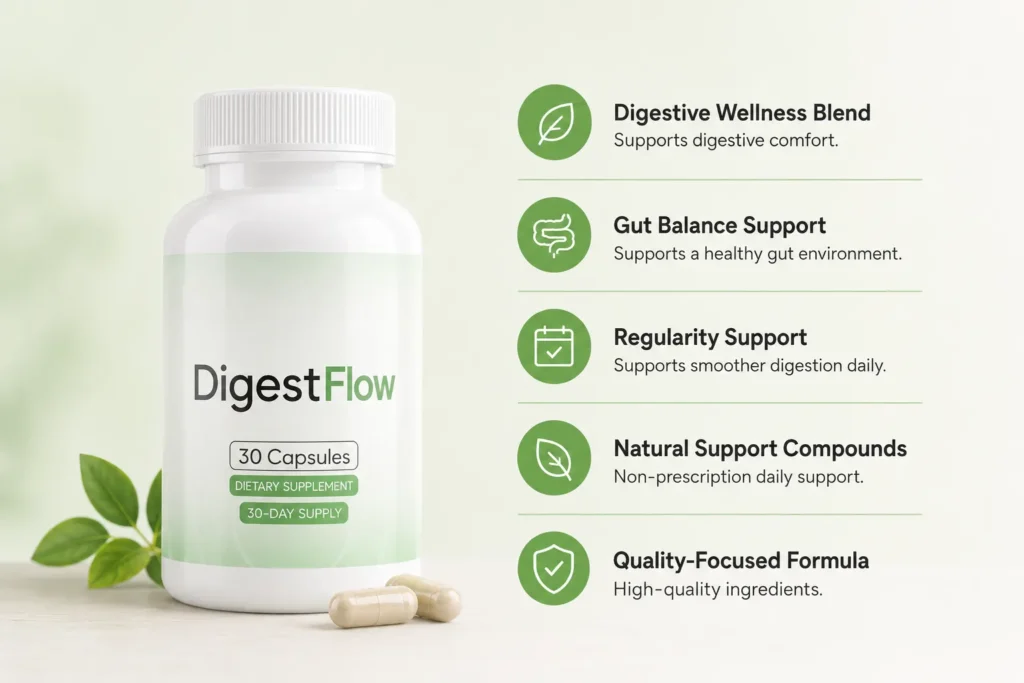
This is probably the most important section of the entire DigestFlow review.
The current product information reviewed in August 2026 lists the following ingredients per one-capsule serving:
| Ingredient | Listed Amount | General Research Area |
|---|---|---|
| Green coffee bean extract | 130 mg | Chlorogenic acids, metabolic/weight research |
| Raspberry ketone | 130 mg | Weight-management research |
| Garcinia extract | 130 mg | HCA, appetite/weight research |
| Caffeine anhydrous | 138 mg | Stimulant, energy expenditure |
| Green tea extract | 130 mg | Catechins, EGCG, metabolic research |
The green coffee bean extract is listed as containing 50% chlorogenic acids. Garcinia is listed as containing 50% HCA, while the green tea extract is described as containing 45% EGCG and less than 3% caffeine.
This is significant because the formula does not look like the typical probiotic-based digestive supplement that many consumers might expect from the word “DigestFlow.”
Digestive Wellness Blend
The supplied product description presents DigestFlow as a digestive wellness blend intended to support intestinal comfort and normal digestive processes.
That is the positioning, but it should not be confused with clinical proof that the finished product improves digestion.
Gut Balance Support
The phrase “gut balance” can mean many things in supplement marketing. Scientifically, gut health involves a complex interaction between diet, intestinal motility, the gut microbiome, immune function, and the nervous system.
A supplement cannot reasonably be evaluated simply because it uses the words “gut balance.”
For example, NIH’s Office of Dietary Supplements explains that probiotics are specific live microorganisms and that their effects depend on the particular genus, species, strain, and amount.
DigestFlow’s current label does not list probiotics.
Regularity Support
Regularity is another important part of digestive wellness. Constipation can involve infrequent bowel movements, hard or dry stools, difficulty passing stool, or a sensation that the bowel has not completely emptied.
However, the established first-line dietary approach to constipation often involves adequate fiber, fluids, physical activity, and other individualized measures. NIDDK notes that adults generally need around 22–34 grams of fiber per day, depending on age and sex.
DigestFlow’s current label does not identify fiber as an active ingredient.
Natural Support Compounds
DigestFlow uses plant-derived ingredients, but “natural” should never be treated as synonymous with “risk-free.”
The National Center for Complementary and Integrative Health specifically advises consumers to investigate both effectiveness and safety when considering dietary supplements. It also notes that supplements can interact with medications and that natural products can still produce adverse effects.
Quality-Focused Formula
The product materials emphasize ingredient quality and manufacturing information. However, consumers should distinguish between manufacturing claims, facility registration, and independent third-party certification.
The current report reviewed for this DigestFlow review did not identify disclosed NSF, USP, or independent GMP certification for the finished product.
That does not prove poor quality. It simply means consumers who specifically want third-party verification should ask the manufacturer for current documentation.
What Does the Science Say About DigestFlow Ingredients?
A major mistake in supplement reviews is taking research on an individual ingredient and presenting it as proof that the finished product works.
That is not how evidence works.
If a study examines green tea extract, for example, it does not automatically prove that DigestFlow produces the same result. Dose, formulation, extraction method, combinations, population, duration, and product quality can all matter.
Green Coffee Bean Extract
Green coffee bean extract contains chlorogenic acids and has been investigated primarily in the context of body weight and metabolic outcomes.
The available evidence is not strong enough to say that green coffee bean extract proves DigestFlow improves digestive health.
This is an important distinction because the ingredient’s research category does not necessarily match the product’s digestive-wellness marketing.
Raspberry Ketone
Raspberry ketone is another ingredient commonly seen in weight-management products.
The evidence for meaningful human benefits is limited compared with ingredients that have been studied more extensively. More importantly for this DigestFlow review, there is no strong basis for treating raspberry ketone as a proven digestive-health ingredient.
Garcinia Cambogia
Garcinia cambogia contains hydroxycitric acid, or HCA.
NCCIH explains that garcinia products have mainly been studied for weight loss and appetite-related purposes. The evidence is inconsistent: some research suggests a modest effect, while other research finds no meaningful benefit.
There is also a safety issue worth taking seriously. NCCIH reports that several cases of liver injury have been reported among people taking garcinia cambogia products. These cases appear to be uncommon but can be severe. NCCIH also notes possible interactions with some medicines affecting the liver or serotonin.
This does not mean DigestFlow has been shown to cause liver injury. No such product-specific conclusion should be made from ingredient-level evidence.
It does mean anyone considering DigestFlow should understand what ingredients are actually present.
Caffeine Anhydrous
Caffeine anhydrous is concentrated caffeine.
The label information reviewed for this DigestFlow review lists 138 mg of caffeine anhydrous per capsule. The green tea extract can contribute a small additional amount because it is also listed as containing less than 3% caffeine.
The FDA says that, for most adults, around 400 mg of caffeine per day is an amount not generally associated with negative effects, although sensitivity varies considerably between individuals. Pregnancy, medications, certain medical conditions, and individual caffeine sensitivity can change what is appropriate.
Therefore, if you drink coffee in the morning, tea during the day, or energy drinks, DigestFlow’s caffeine should be counted as part of your total daily intake.
Green Tea Extract
Green tea extract contains compounds such as catechins and EGCG and has been studied for metabolic and other health outcomes.
NCCIH notes that green tea extract supplements can cause side effects such as nausea, abdominal discomfort, constipation, and increased blood pressure. It also reports that uncommon cases of liver injury have occurred, particularly with concentrated green tea extracts in tablets or capsules.
Again, that is not evidence that DigestFlow itself causes liver problems.
It is a reason to take the ingredient list seriously.
Does DigestFlow Really Support Better Digestion?
This is where the DigestFlow review becomes more nuanced.
The brand positions DigestFlow around digestive wellness, intestinal health, and daily balance. However, the current label identified in the available product information does not provide a traditional probiotic, digestive-enzyme, or fiber-based formula.
The available evidence reviewed for this article also does not establish a finished-product clinical trial showing that DigestFlow improves digestion, constipation, bloating, or gut microbiome health.
That does not prove that DigestFlow cannot help someone.
It means the claim should be treated as a marketing position rather than a clinically established outcome.
For someone specifically looking for digestive support, this distinction is important.
If your main goal is regular bowel movements, NIDDK recommends focusing on established lifestyle factors such as fiber, adequate fluids, and physical activity.
If your main concern is recurring abdominal pain, bloating, diarrhea, or constipation, it is also worth identifying the underlying cause instead of assuming that a supplement is the answer. IBS, for example, involves recurring abdominal pain alongside changes in bowel habits and requires a proper clinical evaluation when symptoms persist.
DigestFlow Pros and Cons
Here is a practical summary for readers who want the short version of this DigestFlow review.
Pros
- Simple one-capsule daily routine
- Contains several researched botanical ingredients
- Clear caffeine amount on the label
- Made for adults as a daily supplement
- Brand positions it for digestive wellness
- 30 servings per bottle
- Convenient capsule format
Cons
- Current label does not contain probiotics
- No digestive enzyme or fiber listed
- Caffeine may be unsuitable for some people
- Ingredient evidence is mainly metabolic/weight-related
- Finished-product digestive clinical evidence is limited
- Garcinia and green tea extract have safety considerations
- Independent third-party certification was not identified in reviewed materials
The biggest advantage of DigestFlow is convenience.
The biggest question mark is whether the formula matches the reason someone is buying it.
DigestFlow vs. a Traditional Digestive Supplement
A comparison can make the difference easier to understand.
| Feature | DigestFlow | Typical Digestive Supplement |
|---|---|---|
| Probiotics | Not listed on current label | Often included |
| Digestive enzymes | Not listed | Often included |
| Prebiotic fiber | Not listed | Sometimes included |
| Caffeine | Yes | Usually no |
| Green tea extract | Yes | Less common |
| Garcinia | Yes | Less common |
| Daily capsule | Yes | Depends on product |
| Main ingredient research area | Metabolic/weight-related | Digestion/gut-related |
This comparison does not mean one category is automatically better.
It means consumers should match the product to their goal.
If you are looking for probiotic support, a product that clearly lists specific probiotic strains may be more directly aligned with that goal. NIH notes that probiotic effects depend on the particular strain and amount rather than simply the word “probiotic” on the label.
If your goal is simply adding a convenient supplement to a broader wellness routine, DigestFlow may be something you choose to investigate further.
A U.S. Case Study: A Realistic Consumer Scenario
To make this DigestFlow review easier to understand, consider a hypothetical U.S. consumer.
Let’s call her Megan, a 42-year-old office worker in Ohio.
Megan frequently eats lunch at her desk, drinks two cups of coffee before noon, rarely exercises during the workweek, and sometimes experiences irregular bowel movements.
She sees an advertisement describing DigestFlow as a daily digestive wellness supplement.
At first, she assumes DigestFlow must contain probiotics or fiber.
Before buying it, however, she checks the label.
She discovers that the formula contains green coffee bean extract, raspberry ketone, garcinia, caffeine anhydrous, and green tea extract.
Megan now has a different decision to make.
Instead of asking only, “Will DigestFlow fix my digestion?” she asks:
- How much caffeine am I already consuming?
- What is my actual digestive problem?
- Am I getting enough dietary fiber?
- Am I drinking enough water?
- Am I taking any medication that could interact with the ingredients?
- Does the ingredient profile match my reason for buying the product?
- Is there clinical evidence on the finished product itself?
That is a much healthier way to evaluate DigestFlow.
If Megan’s primary issue is inadequate fiber and inconsistent meals, changing those habits may be more directly relevant than immediately adding a supplement. NIDDK recommends adequate fiber and fluids for constipation management and prevention.
If her symptoms are persistent, severe, or accompanied by warning signs, she should speak with a healthcare professional rather than relying on DigestFlow.
This case study is illustrative, not a real patient case, and it does not claim that DigestFlow caused or resolved any symptoms.
Digestive Wellness Is More Than a Supplement
One thing I would emphasize in any honest DigestFlow review is that digestion is strongly influenced by everyday behavior.
A supplement cannot compensate for an overall routine that consistently works against digestive health.
Helpful habits can include:
- Eating a varied diet
- Getting enough dietary fiber
- Drinking adequate fluids
- Staying physically active
- Eating slowly and paying attention to portions
- Getting enough sleep
- Limiting foods that personally trigger symptoms
- Keeping track of recurring digestive symptoms
- Discussing persistent problems with a healthcare professional
NIDDK lists fruits, vegetables, legumes, whole grains, and nuts among useful sources of dietary fiber.
For people with IBS, dietary strategies can be more individualized. NIDDK notes that some people may benefit from approaches such as increased fiber, avoiding gluten when appropriate, or a low-FODMAP diet under suitable guidance.
That is why I would not treat DigestFlow as a replacement for a healthy eating pattern.
What About Gluten-Free Foods and Candy?
Some readers researching digestive wellness are also searching questions such as gf candy, is chocolate gluten free, gluten free halloween candy, are trolli sour brite crawlers gluten free, and Are Snickers gluten-free.
These are related to food choices, but they are not the same question as whether DigestFlow supports digestion.
For anyone with celiac disease or medically necessary gluten avoidance, product labels matter.
The FDA says foods labeled “gluten-free” must meet a standard of less than 20 parts per million of gluten.
Is Chocolate Gluten Free?
Plain chocolate can be gluten-free, but not every chocolate product is automatically gluten-free.
Ingredients such as cookies, wafers, malt, or other gluten-containing additions can change the answer. Cross-contact during manufacturing can also matter for people with celiac disease.
The Celiac Disease Foundation recommends checking labels because ingredients and manufacturing practices can change.
Gluten-Free Halloween Candy
Finding gluten-free Halloween candy requires more than looking for candy that appears simple.
The Celiac Disease Foundation maintains a U.S. gluten-free candy guide and specifically warns consumers to check packaging because ingredients and manufacturing practices can change.
Are Trolli Sour Brite Crawlers Gluten Free?
Consumers should check the exact package and current manufacturer information rather than assuming that every gummy candy is gluten-free.
Candy formulations can vary by product, size, flavor, and country.
For people with celiac disease, a current gluten-free label or direct manufacturer confirmation is the safer approach. Beyond Celiac similarly warns that some candies may have no obvious gluten ingredients but may still present cross-contact concerns.
Are Snickers Gluten-Free?
This question is more complicated than simply looking at the word “chocolate.”
Some Snickers products may have no obvious gluten ingredients, but formulations and manufacturing practices can vary. Beyond Celiac specifically recommends checking the label and manufacturer information because ingredients and facilities can change.
The practical lesson is simple: if gluten avoidance is medically necessary, do not rely on an old candy list or a Google snippet.
Check the current package.
Who Might Want to Consider DigestFlow?
Based on the information reviewed, DigestFlow may appeal to adults who:
- Prefer a once-daily capsule
- Are interested in botanical supplement formulas
- Want to investigate a product marketed around digestive wellness
- Understand that its current ingredient profile is not a conventional probiotic or fiber formula
- Are comfortable evaluating the evidence before purchasing
However, DigestFlow may not be the most obvious match for someone whose only goal is a traditional probiotic, prebiotic, fiber, or digestive-enzyme supplement.
That is perhaps the most useful takeaway from this DigestFlow review.
Who Should Be More Cautious?
Extra caution is appropriate for people who:
- Are pregnant or breastfeeding
- Are under 18
- Take prescription medication
- Have a history of liver problems
- Are sensitive to caffeine
- Already consume substantial amounts of caffeine
- Have persistent or unexplained digestive symptoms
The product materials reviewed for this DigestFlow review specifically instruct pregnant or nursing individuals and people under 18 not to use the product and advise consultation with a physician when taking medication or managing a medical condition.
NCCIH also recommends discussing herbal supplements with a healthcare professional because interactions with medicines can occur.
What I Would Check Before Buying DigestFlow
What to Know Before Buying DigestFlow
Before You Buy DigestFlow
- Supports overall digestive wellness
- Designed to support healthy gut function
- Intended for long-term daily wellness support
- May complement a healthy diet and lifestyle
Before purchasing DigestFlow, I would go through this short checklist:
- Read the current Supplement Facts panel.
- Confirm the ingredients and serving size.
- Calculate your total daily caffeine intake.
- Check whether you take medications that could interact with the ingredients.
- Ask the manufacturer about third-party testing if that matters to you.
- Look for current return and refund terms.
- Do not rely solely on testimonials.
- Decide whether your actual goal is digestive support or metabolic/weight-management support.
This process is much more useful than simply asking whether DigestFlow is “good” or “bad.”
DigestFlow Pricing: Packages

DigestFlow Review: Final Verdict
So, does DigestFlow really support better digestion and gut health?
My conclusion is mixed and cautious.
DigestFlow is clearly marketed toward digestive wellness, intestinal balance, and daily support. It is convenient, uses a simple one-capsule routine, and contains several ingredients that have been researched individually.
However, the current ingredient label tells a different story from what many consumers might expect from a conventional gut-health supplement.
The listed formula contains green coffee bean extract, raspberry ketone, garcinia extract, caffeine anhydrous, and green tea extract.
The scientific literature reviewed for this article does not establish that this finished combination improves digestion or gut health.
In particular, the formula does not list probiotics, digestive enzymes, or fiber—the categories many people associate with digestive support.
That does not mean DigestFlow is worthless.
It means the buyer should have realistic expectations.
If digestive wellness is your priority, start by understanding your actual symptoms and looking at the basics: diet, fiber, fluids, movement, sleep, and medical evaluation when appropriate.
If you are considering DigestFlow, evaluate the product based on its actual label, not just its marketing description.
And if you take medication, have a relevant medical condition, are pregnant or breastfeeding, or are unusually sensitive to caffeine, talk with a qualified healthcare professional before using it.
Ultimately, the most responsible DigestFlow review is not one that promises dramatic results. It gives you enough information to decide whether the product’s ingredients, evidence, and safety considerations fit your goals.
Frequently Asked Questions About DigestFlow
What is DigestFlow?
DigestFlow is a dietary supplement marketed for digestive wellness and intestinal health. Current product information reviewed in August 2026 lists green coffee bean extract, raspberry ketone, garcinia extract, caffeine anhydrous, and green tea extract.
Does DigestFlow contain probiotics?
No probiotics are listed on the current Supplement Facts information reviewed for this DigestFlow review. The label instead lists five botanical/stimulant-related ingredients.
Does DigestFlow contain fiber?
Fiber is not listed as an active ingredient in the current label information reviewed for this DigestFlow review. For constipation, NIDDK recommends adequate dietary fiber and fluids as part of standard self-care.
How much caffeine does DigestFlow contain?
The label reviewed lists 138 mg of caffeine anhydrous per capsule, plus a small potential amount from the green tea extract.
Is DigestFlow FDA approved?
DigestFlow is a dietary supplement, not an FDA-approved drug. Dietary supplements are not generally required to undergo FDA premarket approval for safety and effectiveness in the same way prescription drugs do.
Can DigestFlow cause side effects?
Any supplement can potentially cause side effects. The ingredients in DigestFlow include caffeine, garcinia, and concentrated green tea extract, all of which have safety considerations. NCCIH reports uncommon liver injury with concentrated green tea extracts and reports liver injury cases associated with garcinia products.
How long does DigestFlow take to work?
There is not enough independent clinical evidence to provide a reliable timeline for digestive-health results from DigestFlow. The brand materials reportedly recommend consistent use over an extended period, but that should not be interpreted as proof that benefits will occur for every user.
Is DigestFlow worth trying?
That depends on your goal. If you specifically want a conventional probiotic, fiber, or digestive-enzyme formula, DigestFlow’s current label may not match what you are looking for. If you are interested in its particular botanical and caffeine-containing formula, you should evaluate the evidence and safety considerations before deciding.
Scientific Resources and References
For readers who want to go beyond this DigestFlow review, these reputable resources provide evidence-based information on digestive health, dietary supplements, probiotics, caffeine, gluten-free labeling, and related topics:
- National Institute of Diabetes and Digestive and Kidney Diseases (NIDDK) — Information on digestive diseases, constipation, IBS, nutrition, and gut health.
- NIH Office of Dietary Supplements (ODS) — Evidence-based information about probiotics, dietary supplements, strains, and potential health effects.
- National Center for Complementary and Integrative Health (NCCIH) — Research and safety information on garcinia cambogia and herbal supplements.
- U.S. Food and Drug Administration (FDA) — Official U.S. guidance on dietary supplements, caffeine, food labeling, and gluten-free labeling.
- Celiac Disease Foundation — Resources on gluten-free foods, candy, and managing a gluten-free diet.
- Beyond Celiac — Practical resources about gluten-free foods, labeling, and avoiding gluten exposure.
- DigestFlow Product Information — Use the manufacturer’s current product page and Supplement Facts label to verify the latest ingredients, serving size, pricing, and purchasing information before making a decision.
Important Information for Readers
This article is intended for general consumer education and is not medical advice. The product claims discussed above are attributed to available brand/product materials rather than presented as independently proven facts. Ingredient-level evidence should not be interpreted as proof that the finished DigestFlow product produces the same results.
Product formulas, prices, labels, manufacturing practices, and policies can change. Always check the current package and manufacturer information before purchasing or using any dietary supplement.
If you have persistent abdominal pain, blood in your stool, unexplained weight loss, vomiting, fever, difficulty swallowing, or other concerning symptoms, seek medical evaluation rather than relying on a supplement. NIDDK identifies several such symptoms as reasons to seek professional care.
For more expert-backed health tips, wellness guides, and supplement insights, be sure to read more articles on : Health Line Guide