


You went to bed feeling fine. You wake up and can barely turn your head without wincing. Sound familiar? Neck pain from sleeping is one of those everyday problems that nobody talks about until it happens to them—and then suddenly it’s all they can think about while trying to check their blind spot in traffic or look up at a shelf.
The good news is that most morning neck pain isn’t dangerous. It’s often related to your sleep position, pillow height, mattress support, daytime posture, or muscle tension. Sleeping in an awkward position or using too many or too few pillows can contribute to neck pain.
In some cases, other factors may also deserve attention. Food allergies, for example, aren’t a typical cause of neck pain from sleeping, but an allergic reaction can cause swelling around the face, neck, or throat. If neck discomfort occurs together with swelling, hives, wheezing, trouble breathing, or difficulty swallowing—especially shortly after eating a particular food—it should not simply be assumed to be a sleep-related problem. Severe allergic reactions require immediate medical attention.
In this guide, we’ll walk through exactly why neck pain from sleeping happens, what it can mean when it shows up on one side, how to get relief, and how to reduce the chances of it coming back night after night.
Why Does Neck Pain From Sleeping Happen?
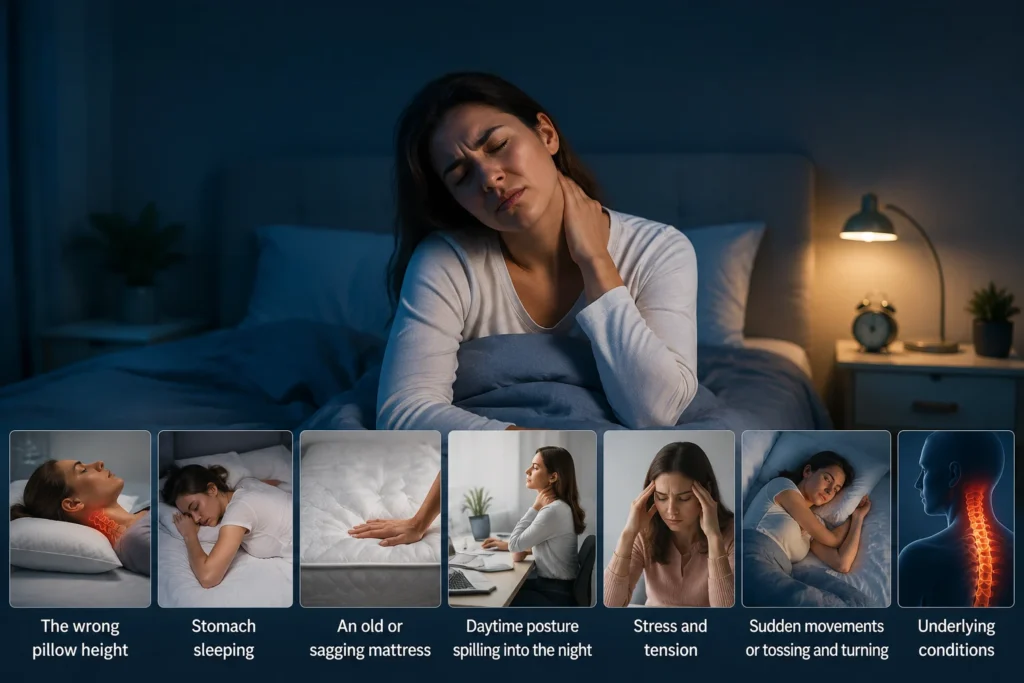
Your neck (doctors call it the cervical spine) is a stack of seven small bones cushioned by discs, wrapped in muscles, ligaments, and nerves. It’s built to support the weight of your head — roughly 10 to 12 pounds — while still letting you turn, tilt, and nod all day long. That flexibility is great for daily life, but it also means your neck is sensitive to hours of poor positioning while you’re asleep and not moving.
When you understand the real neck pain causes, the fixes usually become obvious. Here are the most common culprits behind neck pain from sleeping:
- The wrong pillow height. A pillow that’s too flat lets your head tip backward. One that’s too thick pushes your chin toward your chest. Either way, your neck spends seven or eight hours bent out of its natural line.
- Stomach sleeping. This position forces you to twist your head to one side for hours at a stretch, which strains the muscles and joints on that side of your neck.
- An old or sagging mattress. If your mattress doesn’t support your spine evenly, your whole body — including your neck — compensates by curving unnaturally.
- Daytime posture spilling into the night. Hours hunched over a phone or laptop (sometimes called “tech neck”) tighten the muscles around your neck and shoulders before you even lie down.
- Stress and tension. Anxiety and mental strain cause many people to unconsciously clench their jaw and shoulders, which carries over into how tightly the neck muscles hold through the night.
- Sudden movements or tossing and turning. A restless night full of shifting positions can strain muscles the same way an awkward gym stretch might.
- Underlying conditions. Osteoarthritis, degenerative disc disease, a pinched nerve, or an old whiplash injury can all make the neck more vulnerable to overnight pain, especially on an unsupportive pillow.
Most muscle-related neck pain from sleeping settles down within a few days to two weeks. If it lingers longer than that, or keeps returning, it’s worth digging deeper into the cause rather than just pushing through it.
Left Side Neck Pain: What It Usually Means
A lot of people notice their left side neck pain happens on the same nights they slept curled toward that side, or with their arm tucked awkwardly under the pillow. In most cases, one-sided neck pain simply comes down to which side you slept on and how your shoulder and pillow lined up with your spine.
That said, a few other things can point to left-sided discomfort specifically:
- Sleeping with your phone or a stack of pillows propping your head at an angle
- A pinched nerve on that side, which can send pain down into the shoulder or arm
- Muscle imbalance from carrying a bag, holding a baby, or working at a desk that isn’t centered
- In rare cases, left-sided neck and jaw discomfort together with chest tightness, shortness of breath, or sweating can be a warning sign of a heart-related issue — this needs emergency care, not a new pillow
If your left side neck pain is mild, comes and goes with your sleep position, and eases with gentle movement, it’s almost always muscular. If it comes with numbness, weakness, or symptoms elsewhere in the body, that’s a signal to get checked out rather than wait it out.
When It’s Severe Neck and Shoulder Pain
Sometimes what starts as simple stiffness turns into something bigger. Severe neck and shoulder pain — the kind that makes it hard to lift your arm, turn your head, or even find a comfortable position to sit in — is different from ordinary morning tightness.
A few things tend to separate “severe” from “annoying”:
- Pain that radiates down into the shoulder blade or arm
- Tingling, numbness, or a pins-and-needles feeling in the hand or fingers
- Weakness when gripping objects
- Pain that doesn’t improve with rest, heat, or over-the-counter pain relief after several days
- Pain following an accident, fall, or forceful movement
Severe neck and shoulder pain that includes any of the nerve-related symptoms above (tingling, numbness, weakness) can point to a pinched nerve or disc issue and generally deserves a proper medical evaluation rather than home remedies alone.
Pain in the Back of the Neck: A Closer Look
Pain in back of neck is one of the most common complaints doctors hear, and it usually traces back to the muscles that run along the base of the skull down to the shoulder blades. These muscles work overtime when your head sits too far forward — whether that’s from a bad pillow at night or hours of scrolling during the day.
Common triggers for pain at the back of the neck include:
- Sleeping on your stomach with your neck rotated
- A pillow that pushes your chin down toward your chest
- Tension headaches that start at the base of the skull and spread forward
- Poor posture while sitting or driving, which carries into your sleep tension
- Grinding your teeth at night, which tightens muscles connecting the jaw and upper neck
Gentle stretching, warmth, and correcting your pillow height are usually enough to calm this type of pain within a few days.
Best Sleeping Position for Neck Pain
If there’s one change that makes the biggest difference, it’s fixing your position. Research and physical therapists consistently point to the same conclusion: the best sleeping position for neck pain is either sleeping on your back or on your side, with stomach sleeping being the position to avoid.
Here’s how the three main positions compare:
| Sleeping Position | Effect on the Neck | Recommended? |
|---|---|---|
| Back | Keeps the head, neck, and spine in a straight, neutral line when paired with a low, supportive pillow | Yes — often considered the gold standard |
| Side | Neutral and safe when the pillow fills the gap between the ear and shoulder so the spine stays level | Yes — a solid second choice |
| Stomach | Forces the head to rotate sharply to one side for hours, twisting the cervical spine | No — the position most linked to morning neck pain |
A simple way to check your alignment: lie in your usual position and see whether your nose, chin, and breastbone line up straight. If your head tips down, up, or to one side, your pillow height needs adjusting. Getting this one detail right is often the single fastest way to reduce neck pain from sleeping for good.
Pros and Cons of Common Neck Pain Remedies
Not every remedy works the same way for everyone. Here’s a quick side-by-side look at popular ways people try to relieve neck pain from sleeping:
| Remedy | Pros | Cons |
|---|---|---|
| Adjusting pillow height/type | Cheap, fast to test, addresses the root cause for many people | May take a few nights of trial and error to get right |
| Heat therapy | Relaxes tight muscles, easy to do at home, soothing | Doesn’t fix structural or nerve-related causes |
| Ice packs | Reduces inflammation after a sudden strain | Less helpful for chronic stiffness |
| Over-the-counter pain relievers | Fast, effective short-term relief | Not a long-term fix; overuse has side effects |
| Gentle stretching/exercise | Builds long-term neck strength and flexibility | Requires consistency to see results |
| New mattress | Supports the whole spine, not just the neck | Bigger investment; results aren’t instant |
| Physical therapy | Targets the actual cause, teaches lasting habits | Costs more, requires appointments |
| Massage | Immediate tension relief, relaxing | Temporary; doesn’t address sleep posture |
Quick Relief Tips for Neck Pain From Sleeping
When neck pain from sleeping strikes and you wake up with a stiff, sore neck, here’s what actually helps in the moment:
- Sit up slowly and avoid sudden twisting or bending
- Apply a warm compress or heating pad for 10–15 minutes to loosen tight muscles
- Follow with an ice pack if the area feels inflamed or swollen
- Do gentle range-of-motion movements — slow nods and side-to-side turns, never forced
- Try a short, easy stretch: gently tilt your ear toward your shoulder and hold for 15–20 seconds on each side
- Take an over-the-counter anti-inflammatory if needed and appropriate for you
- Stay hydrated — dehydrated muscles cramp and tighten more easily
- Avoid heavy lifting or strenuous activity until the stiffness eases
Prevention Guide: Stopping Neck Pain From Sleeping Before It Starts

Prevention beats treatment every time. These habits go a long way toward keeping neck pain from sleeping from becoming a nightly routine:
- Choose the right pillow for your position. Back sleepers generally need a lower, contoured pillow; side sleepers need a taller one that fills the shoulder-to-ear gap.
- Replace pillows every 1–2 years. Old pillows lose their shape and stop supporting your neck properly.
- Check your mattress. If it’s sagging, lumpy, or over 7–10 years old, it may be contributing to the problem.
- Watch your daytime posture. Less “tech neck” during the day means less tension carried into bed.
- Stretch before bed. A few minutes of gentle neck and shoulder stretches can release built-up tension.
- Manage stress. Breathing exercises, short walks, or a wind-down routine can reduce the muscle clenching that often causes overnight stiffness.
- Avoid falling asleep on the couch or in a chair. These spots rarely offer real neck support.
- Train yourself out of stomach sleeping. It takes time, but placing a pillow along your side can discourage rolling onto your stomach.
Case Study: A US Office Worker’s Journey to Better Sleep
To see how these changes play out in real life, consider a common scenario reported by patients in the United States. A 34-year-old marketing coordinator from Austin, Texas, spent most of her workday at a laptop and had been waking up with neck pain from sleeping almost every morning for nearly two months. Her pain was concentrated on the left side and often spread into her shoulder by mid-morning.
After describing her symptoms to a physical therapist, a few issues stood out immediately: she was a stomach sleeper, her pillow was several years old and had flattened out, and she spent long stretches looking down at her phone before bed. Her plan of action was simple:
- She switched to side sleeping using a firmer, contoured pillow sized to her shoulder width.
- She replaced her flattened pillow and added a slim pillow between her knees for spinal balance.
- She started doing a two-minute neck and shoulder stretch routine each night before bed.
- She set a “phone down” time 30 minutes before sleep to reduce tech neck strain.
Within about three weeks, her morning stiffness dropped noticeably, and the shoulder pain that used to show up by mid-morning stopped appearing altogether. Her experience lines up with what researchers and clinicians widely report: sleep position and pillow support are two of the most fixable contributors to chronic neck pain from sleeping, and small, consistent changes tend to outperform any single quick fix.
(This case study reflects a common, generalized pattern seen in clinical and patient-reported accounts rather than one specific individual, and is shared for illustrative purposes.)
Frequently Asked Questions
1. Why do I keep getting neck pain from sleeping even with a good pillow?
Even a quality pillow can cause neck pain from sleeping if it doesn’t match your sleep position or has started to lose its shape. Mattress support, sleep posture, and daytime habits all play a role too, so the pillow alone isn’t always the full answer.
2. Is it normal to wake up with neck pain every day?
Occasional stiffness is common, but daily neck pain from sleeping isn’t something to just accept. It’s usually a sign that your pillow, mattress, or sleep position needs adjusting — and if changes don’t help, it’s worth talking to a doctor.
3. Can stress really cause neck pain while sleeping?
Yes. Stress often causes people to unconsciously tense their shoulders and jaw, and that tension can carry into the neck muscles overnight, leading to soreness by morning.
4. What’s the best sleeping position for neck pain?
Back sleeping with a low, supportive pillow, or side sleeping with a pillow that fills the gap between your ear and shoulder, are generally considered the safest positions. Stomach sleeping is the one most linked to morning neck pain.
5. When should I see a doctor for neck pain?
See a doctor if the pain is severe, doesn’t improve after a week or two, keeps coming back, follows an injury, or comes with numbness, tingling, weakness, fever, or pain spreading down an arm.
6. Can a mattress really affect neck pain?
Yes. A mattress that’s too soft or worn out can throw off your entire spinal alignment, which puts extra strain on your neck even if your pillow is perfect.
7. How long does neck pain from sleeping usually last?
Muscle-related neck pain from sleeping typically improves within a week or two with rest, gentle movement, and better sleep support. Pain that lasts longer may point to an underlying issue that needs evaluation.
When to See a Doctor
Most cases of neck pain from sleeping are manageable at home, but persistent neck pain from sleeping deserves attention rather than being ignored. Seek medical care if you experience:
- Pain following a fall, accident, or forceful injury
- Numbness, tingling, or weakness in the arms or hands
- Pain accompanied by fever, headache, or difficulty swallowing
- Pain that radiates down one arm
- Symptoms that don’t improve after a couple of weeks of self-care
These can indicate a pinched nerve, disc issue, or another condition that benefits from a professional diagnosis rather than guesswork.
Final Thoughts
Neck pain from sleeping is frustrating, but it’s rarely a mystery once you look at the full picture: your pillow, your mattress, your position, your posture, and your stress levels all work together while you sleep. Small, consistent adjustments — like switching sleep positions, replacing an old pillow, or building in a nightly stretch — often make a bigger difference than any single “quick fix.” And if the pain is severe, persistent, or comes with nerve symptoms, don’t wait it out; a healthcare provider can help you get to the real cause and find lasting relief.
References & Further Reading
- Mayo Clinic — Neck pain: Symptoms and causes
- Mayo Clinic — Neck pain: Symptom causes
- Cleveland Clinic — Best Sleeping Positions for Pain
- Sleep Foundation — How to Choose the Best Sleeping Position for Neck Pain
- Healthline — Waking Up with Neck Pain: Causes, Treatment, and Prevention
- GoodRx Health — How to Sleep With Neck Pain
- WebMD — Pillows for Neck Pain
- National Center for Biotechnology Information (NCBI/PMC) — Sleep disturbance is associated with neck pain: a 3-year longitudinal study
This article is for general educational purposes only and is not a substitute for professional medical advice, diagnosis, or treatment. Always consult a qualified healthcare provider about persistent or severe neck pain.