

Have you ever walked into a room and forgotten why you went there? Or struggled to remember someone’s name, even though you have known them for years? These small moments can happen to anyone, but they may become more noticeable as we get older.
Memory plays an important role in everyday life. It helps us recognize familiar faces, remember conversations, learn new skills, make decisions, and maintain independence. However, as the brain ages, some changes in memory and thinking abilities are normal.
This raises an important question: Why does memory decline with age, and is there anything we can do about it?
The good news is that occasional forgetfulness does not automatically mean something is seriously wrong. Normal aging can affect how quickly the brain processes information and retrieves memories. However, medical conditions, lifestyle habits, sleep problems, and nutritional deficiencies may also contribute to memory difficulties.
Understanding the difference between normal age-related memory changes and more serious cognitive problems is essential. It can help people recognize warning signs, adopt healthier habits, and seek medical advice when necessary.
In this guide, we will explore the causes of memory decline, common symptoms, the differences between normal forgetfulness and dementia, foods that support brain health, and practical ways to maintain cognitive function as you age.
Quick Summary (Key Takeaways)
- Some memory decline with age is a normal part of the brain aging process.
- Normal forgetfulness is annoying but does not stop you from living your life. Dementia does.
- Sleep, exercise, food, blood pressure, hearing, and social life all shape brain health and aging.
- Large US trials show that healthy lifestyle habits can protect cognitive function in seniors.
- If memory problems start affecting daily life, see a doctor early.
What Is Memory Decline With Age?
Memory decline with age is the gradual change in how well the brain stores, holds, and pulls up information as we get older. It usually shows up as slower recall, more tip-of-the-tongue moments, and a harder time multitasking.
The key word is gradual. Researchers at the National Institute on Aging (NIA) describe mild forgetfulness as a typical part of getting older. It is not the same thing as a disease. Think of it like a car that still runs well at 80,000 miles but needs a little more attention than it did when new.
The terms you will see used interchangeably include memory loss with age, age-related memory loss, and age-related cognitive decline. They all point to the same basic idea: the brain changes with time, and some thinking skills shift along with it.
Why Does Memory Decline With Age?
This is the big question, and the honest answer is that why memory gets worse with age comes down to several things happening at once. No single switch gets flipped at 60 or 70. Here is what scientists understand so far.
The brain physically changes
As we age, certain brain regions shrink slightly. Two of them matter most for memory. The hippocampus helps form new memories, and the prefrontal cortex helps with focus, planning, and pulling information back out. When these areas lose some volume and connections, memory retention gets a little harder.
The tiny connections between brain cells, called synapses, also become less efficient. The brain does not stop working. It just sends signals a bit more slowly.
Blood flow slows down
Your brain uses a large share of your body’s oxygen and fuel. With age, blood vessels can stiffen or narrow. Less blood flow means brain cells get less of what they need. This is one reason heart health and brain function and aging are so closely linked.
Chemical messengers change
Neurotransmitters and hormones help brain cells talk to each other. Their levels and balance shift as we age. That can show up as declining memory and concentration, especially when you are tired or stressed.
Processing speed slows
Many people think their memory is failing when the real issue is speed. The brain simply takes longer to take in new information. Given a little extra time, many older adults remember just fine. This is a major part of memory changes as you age.
Common Causes of Memory Decline
Normal brain aging is only part of the picture. Many causes of memory decline are things you can do something about. Knowing the causes of forgetfulness helps you tell what is fixable from what is not.
Causes you cannot control
- Age itself. The brain aging process is the biggest single factor.
- Genetics. Having a family history of Alzheimer’s disease raises risk. A gene variant called APOE-e4 is a known risk factor.
- Natural brain changes. Slower signaling and some loss of brain volume come with time.
Causes you can often influence
- Poor sleep. Sleep is when the brain files away the day’s memories. Chronic short or broken sleep, including untreated sleep apnea, weakens short-term memory.
- High blood pressure, diabetes, and high cholesterol. These damage blood vessels in the brain over time.
- Chronic stress and anxiety. Long-term stress hormones can harm the hippocampus.
- Depression. Low mood often looks like memory trouble because it drains attention and motivation.
- Hearing loss. The 2024 Lancet Commission on dementia named untreated hearing loss as one of the biggest modifiable risk factors.
- Lack of physical activity. A sedentary life means less blood flow and fewer brain-supporting chemicals.
- Heavy alcohol use and smoking. Both are tied to faster cognitive decline.
- Medications. Some drugs, including certain sleep aids, allergy medicines, and bladder medications, can cloud thinking. Always ask your pharmacist.
- Vitamin B12 deficiency and thyroid problems. These are treatable, and memory often improves once they are corrected.
- Social isolation. Fewer conversations means less mental exercise.
The 2024 Lancet Commission estimated that around 45 percent of dementia cases worldwide could potentially be delayed or prevented by addressing 14 modifiable risk factors. That is a hopeful number. It says the story is not written entirely by your genes.
Signs of Age-Related Memory Loss
So what does memory decline with age actually look like day to day? These are the typical signs of age-related memory loss that fall within the normal range:
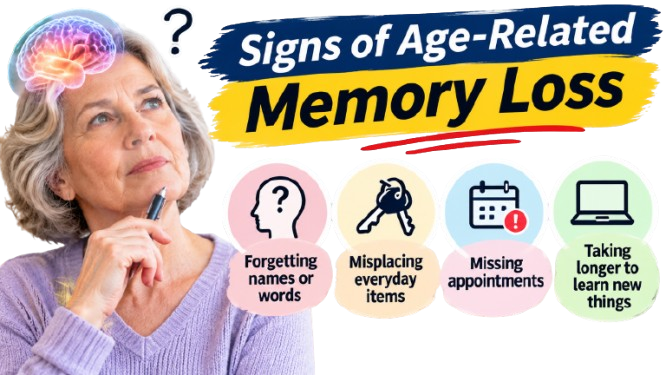
- Forgetting a name or word, then remembering it later
- Occasionally misplacing glasses, keys, or your phone
- Missing a monthly bill payment once in a while
- Walking into a room and forgetting why
- Taking longer to learn new technology or a new route
- Needing reminders for appointments
- Feeling less mental clarity in older adults when tired or distracted
Short-term vs. long-term memory
People often ask whether all memory fades equally. It does not.
Short-term memory problems are usually the first thing people notice. Holding a phone number in your head, remembering what you just read, or following a fast conversation can get harder.
Long-term memory changes tend to be gentler. Childhood events, skills like riding a bike, and well-learned facts usually stay put. Vocabulary and general knowledge often keep growing well into your 70s.
What Age Does Memory Start Declining?
Most researchers say subtle changes can begin in your 30s and 40s, but they are tiny and rarely noticeable. Many people first notice memory decline with age in their 50s and 60s, when word-finding pauses and slower recall become more obvious. The pace is different for everyone. Lifestyle, education, health conditions, and genetics all change the timeline.
Normal Forgetfulness vs. Serious Memory Problems
This is the section most readers worry about. How do you know whether your memory decline with age is normal or something more serious, such as mild cognitive impairment (MCI) or dementia?
Here is a simple comparison, based on guidance from the NIA and the Alzheimer’s Association.
| Situation | Normal Age-Related Forgetfulness | Possible Sign of Dementia |
|---|---|---|
| Forgetting words | Occasionally struggles to find a word | Frequently stops mid-sentence, cannot follow or join a conversation |
| Misplacing items | Loses keys, then retraces steps and finds them | Puts items in odd places, cannot retrace steps, accuses others of theft |
| Appointments | Forgets one, remembers later | Forgets recent events or asks the same question again and again |
| Money and bills | Makes an occasional error | Struggles to manage a budget or follow a monthly bill routine |
| Getting around | Briefly unsure of an unfamiliar place | Gets lost in familiar places, such as the neighborhood |
| Judgment | Makes a bad choice now and then | Shows poor judgment, such as giving away large sums of money |
| Daily life | Independent, may need a reminder | Needs help with routine tasks such as cooking or dressing |
| Mood and personality | Gets irritated when routines change | Marked changes in personality, withdrawal, confusion, suspicion |
The simplest rule of thumb is this: normal forgetfulness is a nuisance. Dementia is a disruption. If memory changes are getting in the way of work, relationships, or safety, it is time to get checked.
What about mild cognitive impairment?
MCI sits between normal aging and dementia. A person with MCI notices memory or thinking changes that are worse than expected for their age, but they can still handle everyday life. Not everyone with MCI develops dementia, and some people even improve, particularly when the cause is treatable.
How Does Aging Affect Brain Function?
To see the bigger picture of age-related brain changes, it helps to look at what slows down and what holds steady.
| Brain Skill | Typical Change With Age |
|---|---|
| Processing speed | Slows gradually |
| Working memory (holding info briefly) | Declines slightly |
| Multitasking and attention | Becomes harder |
| Word retrieval | More tip-of-the-tongue moments |
| Vocabulary and general knowledge | Stable or improving |
| Emotional regulation | Often improves |
| Wisdom and judgment | Often strong |
| Long-term memory of old events | Mostly stable |
In other words, memory decline with age is not a total collapse. It is a shift. Older adults often make up for slower speed with experience, perspective, and better emotional balance. Brain function and aging is a mix of small losses and real strengths.
U.S. Case Study: What the U.S. POINTER Trial Taught Us
Can lifestyle changes really help protect memory as people get older? The U.S. POINTER trial provides encouraging scientific evidence about the connection between healthy habits and cognitive function.
The U.S. Study to Protect Brain Health Through Lifestyle Intervention to Reduce Risk, known as U.S. POINTER, was led by researchers working with the Alzheimer’s Association. The two-year study involved 2,111 adults aged 60–79 who were at increased risk of cognitive decline. Its findings were published in the Journal of the American Medical Association (JAMA) on July 28, 2025.
What the groups did:
- Structured group: Followed an organized lifestyle program that included regular aerobic exercise, strength and flexibility activities, a MIND-style diet, computer-based brain training, social engagement, and regular health monitoring. Participants also attended 38 facilitated group meetings over two years.
- Self-guided group: Received general health guidance and encouragement to make lifestyle improvements. Participants attended six group meetings and had more freedom to manage their own routines.
What happened: Both groups showed improvements in overall cognitive performance. However, the structured group experienced a statistically greater improvement than the self-guided group. This suggests that regular guidance, social support, and accountability may help people maintain healthier routines.
What it means for you: You do not need to change your entire lifestyle overnight to support brain health. Start with manageable habits such as walking regularly, eating nutritious meals, getting enough sleep, staying socially active, and practicing mentally stimulating activities. If maintaining consistency is difficult, joining a walking group or community class may help.
Important note: U.S. POINTER demonstrated improvements in cognitive test performance over two years. It did not prove that lifestyle changes prevent dementia or Alzheimer’s disease. Longer-term research is needed to understand their effects on dementia risk.
Another U.S. Study: What the ACTIVE Trial Revealed About Brain Training
The Advanced Cognitive Training for Independent and Vital Elderly (ACTIVE) trial was another important American research project. It included approximately 2,800 adults aged 65 and older across six U.S. locations.
Researchers examined whether different types of brain training could help maintain cognitive abilities.
Participants completed exercises focused on memory, reasoning, and processing speed. The 10-year follow-up found that improvements in reasoning and processing-speed abilities remained detectable among trained participants, although memory-training benefits were not maintained in the same way.
What does this mean? Activities such as reading, solving puzzles, learning new skills, and playing strategy games can provide opportunities for mental stimulation. Regular learning may help support cognitive health as people age.
Important note: The ACTIVE trial studied specific cognitive training programs. Its findings do not mean that everyday puzzles or brain games can prevent dementia.
How to Prevent Memory Decline
No one can promise to stop memory decline with age completely. But the evidence says you can slow it, lower your risk, and often feel sharper. Here is how to prevent memory loss in practical terms.
1. Move your body most days
Exercise is probably the single best-supported habit for healthy brain aging. Aim for about 150 minutes of moderate activity each week, such as brisk walking, swimming, cycling, or dancing, plus two days of strength work. Even a 20-minute daily walk counts.
2. Protect your sleep
Aim for seven to nine hours. Keep a regular bedtime, keep the bedroom dark and cool, and cut back on late caffeine and screens. If you snore loudly or wake up exhausted, ask your doctor about sleep apnea.
3. Control blood pressure, blood sugar, and cholesterol
What is good for your heart is good for your head. Get regular checkups and take prescribed medicines as directed.
4. Treat hearing and vision problems
Untreated hearing loss forces the brain to work harder just to understand speech and is linked with faster decline. Hearing aids and updated glasses can lighten that load.
5. Keep learning
Pick up a language, learn an instrument, take a class, try a new hobby. The goal is to challenge your brain, not just keep it busy. Doing crosswords you already find easy helps less than learning something unfamiliar.
6. Stay social
Conversation, volunteering, clubs, and family time all exercise your attention and memory. Loneliness is a real risk factor for cognitive decline.
7. Manage stress
Try meditation, deep breathing, gardening, prayer, or time in nature. Lower stress protects the hippocampus.
8. Limit alcohol and avoid smoking
If you smoke, quitting at any age is worthwhile for your brain as well as your lungs.
Foods That Support Brain Health
People often ask about foods that support memory in older adults. No single food is magic, but overall eating patterns matter. The two best-studied are the Mediterranean diet and the MIND diet, which blends Mediterranean and DASH approaches.

Brain-friendly foods to eat more often:
- Leafy greens such as spinach, kale, and collards
- Berries, especially blueberries and strawberries
- Fatty fish such as salmon, sardines, and trout, which provide omega-3 fats
- Nuts, especially walnuts and almonds
- Olive oil as your main cooking fat
- Whole grains such as oats, brown rice, and quinoa
- Beans and lentils
- Eggs and other sources of choline and B vitamins
Foods to limit:
- Sugary drinks and sweets
- Fried and fast food
- Processed meats
- Heavy butter and other saturated fats
Supplements are a different story. Ginkgo biloba and many memory pills sold online have not been shown to prevent or reverse memory decline with age in good-quality studies. If you are low in B12 or vitamin D, a doctor can test you and advise. Do not start supplements on your own without checking, especially if you take other medicines.
Daily Habits for Better Memory
If you are looking for memory improvement in older adults that fits into a regular day, these small habits add up:
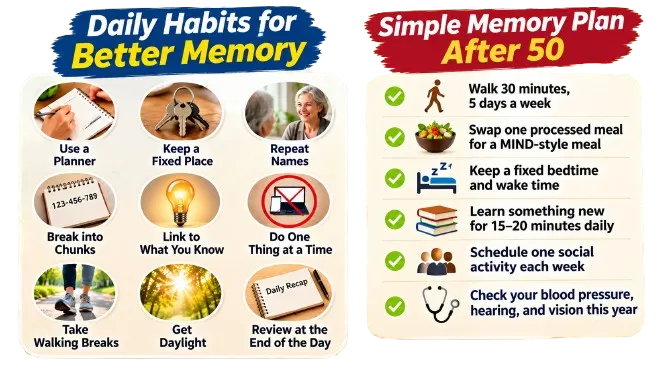
- Use a planner or phone reminders. This is not cheating. It frees up mental energy.
- Keep a “launch pad.” Always put keys, wallet, and glasses in the same spot.
- Say it out loud. When you meet someone, repeat their name in conversation.
- Break information into chunks. Phone numbers are easier as groups of three or four digits.
- Link new information to something you know. Association is how memory works.
- Do one thing at a time. Multitasking weakens encoding of new memories.
- Take walking breaks. Short bursts of movement can sharpen focus.
- Get daylight. It helps regulate sleep and mood.
- Review at the end of the day. A quick recap of the day’s events strengthens memory retention.
How to improve memory naturally after 50
If you are in your 50s or beyond, here is a simple starter plan:
- Walk briskly for 30 minutes, five days a week.
- Swap one processed meal each day for a MIND-style meal.
- Set a fixed bedtime and wake time.
- Learn something new for 15 to 20 minutes daily.
- Schedule one social activity every week.
- Get your blood pressure, hearing, and vision checked this year.
This is a realistic way to address memory decline with age without overhauling your whole life.
Pros and Cons: Common Approaches to Protecting Memory
Not every approach is equally helpful. Here is an honest look at the most popular options.
| Approach | Pros | Cons |
|---|---|---|
| Regular exercise | Strong evidence, improves mood and sleep, free or low cost | Needs consistency, may need doctor’s okay if you have health conditions |
| MIND/Mediterranean diet | Heart and brain benefits, supports overall health | Takes planning, fresh food can cost more |
| Brain training apps | Fun, convenient, some speed-training benefits shown in ACTIVE | Gains may not carry over to everyday tasks, quality of apps varies |
| Social activities | Free, boosts mood, reduces loneliness | Can be harder with limited mobility or transport |
| Good sleep habits | Improves memory consolidation | Some causes, such as apnea, need medical treatment |
| Memory supplements | Easy to take | Little proof they work, can interact with medicines, not tightly regulated |
| Medical checkups | Catch treatable causes early | Requires time and appointments |
| Hearing aids | Reduce mental strain, improve connection with others | Cost, adjustment period |
Comparison: Normal Aging vs. Healthy-Lifestyle Aging
Here is another way to picture how daily choices can influence memory decline with age:
| Factor | Less Supportive Lifestyle | Brain-Supportive Lifestyle |
|---|---|---|
| Activity | Mostly sitting | Regular aerobic and strength exercise |
| Diet | High in sugar and processed food | MIND or Mediterranean pattern |
| Sleep | Short or irregular | Seven to nine hours, steady schedule |
| Social life | Isolated | Regular friends, family, and groups |
| Mental activity | Same routine for years | New skills and challenges |
| Health care | Skipped checkups | Blood pressure, hearing, and vision monitored |
| Likely effect on the brain | Faster age-related cognitive decline | Better support for cognitive health in seniors |
Lifestyle will not erase risk, but it tilts the odds in your favor.
When to See a Doctor
Please do not wait if you notice any of the following:
- Memory problems that interfere with work, hobbies, or daily tasks
- Repeating questions or stories again and again within a short time
- Getting lost in familiar places
- Trouble following a recipe, paying bills, or managing medications
- Confusion about time, place, or people
- Sudden changes in personality, mood, or judgment
- Family or friends expressing concern
- Sudden memory loss, which needs urgent care and may signal a stroke or another emergency
A doctor can screen for treatable causes such as thyroid problems, B12 deficiency, depression, medication side effects, and sleep disorders. They may use a short cognitive test and order bloodwork or brain imaging. Early evaluation matters even if the answer turns out to be nothing serious, because it brings peace of mind and a baseline for future comparison.
If you are a family member, bring it up kindly. Something like, “I’ve noticed a few changes, and I’d feel better if we got it checked together,” often works better than a direct challenge.
The Emotional Side of Memory Decline
Let’s be honest. Memory decline with age can feel scary, and many people hide it out of embarrassment. Try to remember that forgetfulness is usually not a character flaw or a sign you are “losing it.” Talking openly with family, friends, or a doctor tends to reduce stress, and lower stress helps memory. If anxiety about your memory is taking over, say so at your next appointment. Anxiety itself can make forgetfulness feel worse.
Frequently Asked Questions (FAQ)
Why does memory decline with age?
Memory decline with age happens because of gradual changes in the brain. The hippocampus and prefrontal cortex lose some volume, blood flow decreases, brain chemicals shift, and processing speed slows. Health conditions, poor sleep, stress, and lifestyle also play a role.
Is memory loss normal as you get older?
Mild memory loss is normal. Occasionally forgetting names, misplacing things, or taking longer to recall information is common. Memory loss that disrupts daily life is not typical and should be checked.
What causes memory problems in older adults?
Causes include normal brain aging, poor sleep, high blood pressure, diabetes, depression, stress, hearing loss, medication side effects, vitamin deficiencies, thyroid problems, and conditions such as mild cognitive impairment and dementia.
What age does memory start declining?
Subtle changes can start in midlife, but most people notice memory decline with age in their 50s, 60s, or later. The timing varies widely from person to person.
What is the difference between normal forgetfulness and dementia?
Normal forgetfulness is occasional and does not stop you from managing daily life. Dementia involves persistent and worsening memory loss along with trouble with thinking, language, judgment, or daily tasks.
How can I prevent age-related memory decline?
Exercise regularly, eat a MIND or Mediterranean-style diet, sleep well, manage blood pressure and blood sugar, treat hearing loss, stay socially connected, keep learning, and limit alcohol. No method guarantees prevention, but together these habits lower risk.
How can I improve memory naturally after 50?
Start with brisk walking, better sleep, brain-healthy food, new learning, and regular social time. Use memory aids like calendars and routines. Check medications and health conditions with your doctor.
Do brain games really work?
Some do, to a limited degree. The ACTIVE trial found long-lasting benefits for processing-speed training, but gains do not always transfer to everyday life. Brain games work best as one part of a broader plan.
Which foods are best for memory in older adults?
Leafy greens, berries, nuts, fatty fish, olive oil, whole grains, and beans are all associated with better brain health in the research behind the MIND and Mediterranean diets.
Can memory improve after it has started to decline?
Often, yes, especially when the cause is treatable. Better sleep, depression treatment, correcting vitamin deficiencies, and adjusting medications can all bring noticeable improvement.
Final Thoughts
Memory decline with age is a natural part of life, but it does not have to control your life. Some changes are simply the price of getting older. Others, like poor sleep, untreated hearing loss, high blood pressure, and isolation, are things you can address today. The U.S. POINTER trial gave Americans a real piece of good news: a mix of exercise, smart eating, mental challenge, social connection, and health monitoring can protect thinking skills.
You do not need to do everything at once. Pick one habit, such as a daily walk or an earlier bedtime, and build from there. And if something feels off, talk to a doctor. Acting early is always better than worrying quietly.
References and Scientific Sources
- National Institute on Aging (NIA). Memory, Forgetfulness, and Aging: What’s Normal and What’s Not? https://www.nia.nih.gov
- Alzheimer’s Association. U.S. POINTER Study Results. https://alz.org/us-pointer/study-results
- Baker LD, et al. Effects of Structured vs Self-Guided Multidomain Lifestyle Interventions for Global Cognitive Function: The U.S. POINTER Randomized Clinical Trial. JAMA, July 28, 2025. https://jamanetwork.com
- UC Davis Health. U.S. POINTER Study shows lifestyle program improves cognition in older adults. https://health.ucdavis.edu
- Livingston G, et al. Dementia prevention, intervention, and care: 2024 report of the Lancet Standing Commission. The Lancet. https://www.thelancet.com
- Alzheimer’s Association. Alzheimer’s Disease Facts and Figures. https://www.alz.org/alzheimers-dementia/facts-figures
- Centers for Disease Control and Prevention (CDC). Subjective Cognitive Decline and Brain Health. https://www.cdc.gov/aging
- National Institutes of Health, MedlinePlus. Age-related memory changes. https://medlineplus.gov
- Mayo Clinic. Memory loss: When to seek help. https://www.mayoclinic.org
- Harvard Health Publishing. Memory and aging resources. https://www.health.harvard.edu
- Rebok GW, et al. Ten-year effects of the ACTIVE cognitive training trial. Journal of the American Geriatrics Society, 2014. https://pubmed.ncbi.nlm.nih.gov
- Morris MC, et al. MIND diet associated with reduced incidence of Alzheimer’s disease. Alzheimer’s & Dementia, 2015. https://pubmed.ncbi.nlm.nih.gov
Medical Disclaimer: This article is intended to provide helpful, research-informed information about memory, brain health, and healthy aging. It is designed to support awareness and informed lifestyle choices. For personalized guidance, diagnosis, or treatment, consult a qualified healthcare professional who understands your individual health needs.
For more expert-backed health tips, wellness guides, and supplement insights, be sure to read more articles on the Health Line Guide