

Healthy-looking skin is something many people want to maintain as they get older. But between busy schedules, environmental exposure, stress, changing diets, and natural aging, maintaining smooth, hydrated, and youthful-looking skin is not always easy.
You might notice that your skin does not look as firm as it once did. Fine lines may become more visible, your complexion may appear dull, or your skin may feel drier than usual. These changes are normal, but they often encourage people to explore new skincare products and nutritional supplements.
One product attracting attention in the beauty and wellness category is Celluvia.
Marketed as an advanced skin rejuvenation formula, Celluvia is an oral dietary supplement that combines vitamins, minerals, and a proprietary botanical blend. Its main marketing focus is collagen formation, skin elasticity, healthy-looking skin, and overall beauty support.
But does Celluvia really work? Can its ingredients support collagen production? Is it different from traditional collagen supplements? And is it worth the money?
In this detailed Celluvia Review, we examine the manufacturer’s advertised formula, individual ingredients, potential benefits, scientific research, safety considerations, pricing, and customer feedback.
We will also compare Celluvia with conventional collagen peptide supplements to help readers understand what they are actually buying.
Quick Verdict: Celluvia offers a combination of vitamins, minerals, and botanical ingredients that contribute to normal nutritional functions associated with skin health. Its vitamin C content is particularly relevant because vitamin C is necessary for normal collagen formation. However, Celluvia does not list hydrolyzed collagen or collagen peptides in its published ingredient breakdown. There is also no independently verified clinical trial demonstrating that the finished formula reduces wrinkles or restores skin elasticity.
That does not automatically make the product ineffective. It simply means consumers should understand its formulation and have realistic expectations.

What Is Celluvia? Product Overview
Celluvia is an oral dietary supplement marketed for people interested in maintaining healthy-looking skin and supporting their beauty routine through nutrition.
Unlike a traditional face cream or serum, Celluvia is designed to be taken as a daily capsule.
According to its official website, the formula combines:
- Essential vitamins.
- Several dietary minerals.
- Plant-based ingredients.
- Antioxidant nutrients.
- A proprietary botanical blend.
The manufacturer positions the product around collagen formation, skin elasticity, fine-line support, and a youthful appearance.
Here is a quick overview.
| Product Detail | Information |
|---|---|
| Product Name | Celluvia |
| Product Category | Skin health dietary supplement |
| Main Purpose | Skin wellness and collagen formation support |
| Product Format | Capsules |
| Advertised Serving | One capsule daily |
| Bottle Size | 30 capsules |
| Main Nutrients | Vitamins A, C, D, E and B vitamins |
| Minerals | Calcium, iron, magnesium, zinc, manganese and potassium |
| Botanical Blend | Multiple plant ingredients |
| Purchase Website | celluvia.org |
| Advertised Guarantee | 60 days |
| Target Audience | Adults interested in skin and beauty wellness |
One important point: Celluvia is not a topical skincare treatment. It is intended to complement a broader skincare routine through nutritional support.
The manufacturer also describes the formula as non-GMO and gluten-free. Consumers who need these specific dietary assurances should verify the relevant certifications and product label before purchasing.
Why Is Collagen Important for Healthy-Looking Skin?
Before discussing the Celluvia ingredients, it helps to understand why collagen receives so much attention in the beauty industry.
Collagen is a structural protein naturally present throughout the body. It is particularly important for connective tissues, including the skin.
It helps provide structural support and contributes to the firmness and strength of the skin.
As people age, natural changes in collagen production and the skin’s supporting structures can contribute to:
- Fine lines and wrinkles.
- Reduced skin firmness.
- Changes in skin elasticity.
- A thinner-looking skin texture.
- Visible signs of aging.
Sun exposure, smoking, environmental pollution, and other lifestyle factors can also influence skin aging.
This is why many skincare products and supplements focus on collagen support.
However, there is an important difference between supplying collagen directly and providing nutrients that help the body produce collagen.
Vitamin C supports the body’s normal collagen formation, but it is not the same ingredient as hydrolyzed collagen peptides.
This distinction matters when evaluating Celluvia.
Celluvia Ingredients: What’s Inside the Capsule?
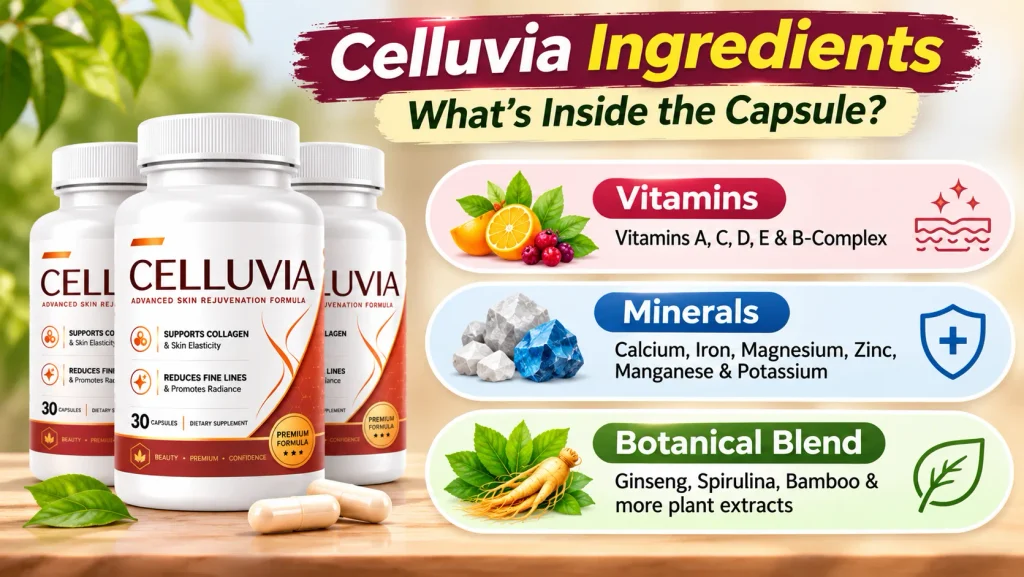
This is the part most people skip, and it’s the most useful. Here’s the Celluvia ingredients list as shown on the official site, with some plain-English context:
Vitamins (per capsule)
- Vitamin A (as beta-carotene): 600 mcg RAE. Supports skin and tissue maintenance.
- Vitamin C: 60 mg. Needed for collagen formation. This is the star ingredient for the collagen claim.
- Vitamin D: 10 mcg. Supports bones, muscles, and immune function.
- Vitamin E: 7 mg. An antioxidant.
- B-vitamins: Thiamin (3 mg), B6 (3 mg), folate (748 mcg DFE), B12 (6 mcg), and pantothenic acid (15 mg).
- Biotin: 2,500 mcg. Popular in “beauty” supplements.
Minerals (per capsule)
- Calcium (40 mg), iron (7.25 mg), magnesium (60 mg), zinc (3.62 mg), manganese (2 mg), and potassium (47 mg).
Proprietary botanical blend
- Panax ginseng, spirulina, bamboo extract, stinging nettle, Chinese peony, saw palmetto, alfalfa, barley grass, PABA, and L-theanine.
What stands out
- The vitamin C dose is modest. At 60 mg, it’s slightly under the daily recommended amount for adults (75 mg for women, 90 mg for men, per the NIH). It helps fill a gap but isn’t a high-dose collagen booster.
- Biotin is very high. 2,500 mcg is far above the daily adequate intake of about 30 mcg. The FDA has warned that high-dose biotin can interfere with some lab tests, including heart and thyroid tests. If you get blood work done, tell your doctor.
- Iron is included. That’s helpful for some people, but men and postmenopausal women often don’t need extra iron. Check with your doctor if you’re unsure.
- The botanical blend has no listed amounts. “Proprietary blend” means you can’t tell how much of each plant you’re getting. That makes it hard to judge whether any of them are present at a useful dose.
If you want a deeper dive into any single nutrient, the NIH Office of Dietary Supplements fact sheets are free and written for regular readers.
Celluvia Benefits: What Does It Claim to Do?
The official site lists several Celluvia benefits:
- Collagen support: thanks mainly to vitamin C.
- Skin elasticity support: a firmer, bouncier look.
- Fine line and radiance support: a brighter, smoother appearance.
- Convenience: one capsule a day instead of several separate pills.
- Botanical support: plant extracts added for a “beauty from within” approach.
Notice the careful wording. The site says the formula is “marketed for” these things and that nutrients “contribute to normal” body processes. That’s a legal way to talk about supplements. It doesn’t promise that you’ll see specific results.
The brand also says Celluvia is made as a skin health formula meant to sit alongside, not replace, a good skincare routine with sunscreen, hydration, and sleep. That’s honest advice, and honestly the most important part of the whole page.
Does Celluvia Work? What the Science Says
This is the big question: does Celluvia work? The honest answer is that we don’t know, because there are no published clinical trials on the finished Celluvia formula that I could find.
That doesn’t mean it can’t help. It means the proof isn’t there yet. Here’s what research says about the pieces:
Vitamin C and skin. A well-known review in the journal Nutrients (Pullar et al., 2017) explains that vitamin C is concentrated in skin and is needed for collagen production and antioxidant protection. But the benefit is clearest when someone’s intake is low. If your diet is already rich in fruits and vegetables, a small extra dose may not change much.
Collagen supplements. A 2021 systematic review and meta-analysis in the International Journal of Dermatology found that hydrolyzed collagen supplements improved skin hydration and elasticity in some studies. Important detail: those studies used collagen peptides, which are actual collagen protein. Celluvia, based on its label, doesn’t list collagen peptides. It relies on nutrients that support your body’s own collagen process. That’s a different approach with a different level of evidence.
Biotin. Despite its reputation, the NIH notes that there’s little good evidence biotin improves skin in people who aren’t deficient.
Botanicals. Ginseng, spirulina, and nettle have been studied for various reasons, but I couldn’t find strong human trials linking this specific blend to wrinkles or elasticity.
Bottom line: the nutrients are real and useful. The leap from “nutrients our body uses” to “visible younger-looking skin” is plausible but unproven. Anyone promising dramatic Celluvia before and after results is going beyond the science.
Celluvia Side Effects and Safety
Most people tolerate multivitamin-style capsules well, but nothing is risk-free. Here’s what to watch for with Celluvia side effects:
- Stomach upset or nausea, especially from iron. Taking it with water as directed can help.
- Allergic reactions to botanicals like alfalfa, spirulina, or Chinese peony.
- Lab test interference from high-dose biotin (the FDA warning mentioned above).
- Doubling up on vitamins. If you already take a multivitamin, iron, or biotin, you could overshoot. Always check the labels.
- Medication interactions. Panax ginseng and some other botanicals may interact with blood thinners, diabetes medications, or others.
Who should talk to a doctor first? Anyone pregnant or nursing, takes prescription medication, has a chronic health condition, or is having surgery or lab work soon. The official site says the same, and it’s good advice.
The company’s disclaimer also states that the product isn’t meant to diagnose, treat, cure, or prevent any disease. That’s standard, and it’s why you should treat Celluvia as a nutrition helper, not a treatment.
Celluvia Customer Reviews: What Are People Saying?
Let’s be real about this part. When I searched for Celluvia customer reviews, I didn’t find a large set of independent, verified reviews on major platforms. What I did find was:
- Three testimonials on the official site (from users in Houston, Chicago, and Seattle). Interestingly, they mostly talk about reading the label, liking the capsule format, and checking the refund policy. They don’t describe clear skin results.
- Many promotional pages repeat the brand’s claims, often with affiliate-style “buy now” links and very similar wording.
What does that tell us? It’s still early, or at least the public feedback is thin. A lack of reviews isn’t proof of a problem, but it does mean you shouldn’t count on “thousands of happy users” without seeing the evidence.
A quick tip: be skeptical of any site showing flawless Celluvia before-and-after photos. Without independent verification, you can’t know if the photos are real, edited, or taken under different lighting. Skin looks very different in different light.
Celluvia Price and Where to Buy Celluvia
According to the official website, here’s the Celluvia price breakdown:
| Package | Price per Bottle | Shipping | Total (approx.) |
|---|---|---|---|
| 2 bottles | $79 | Extra | $158 + shipping |
| 3 bottles | $72 | Free | $216 |
| 6 bottles | $49 | Free | $294 |
The site lists a “regular price” of $179 per bottle, but that’s a marketing anchor. The headline “$49 per bottle” only applies if you buy six. A single 30-day bottle isn’t the $49 deal.

Where to buy Celluvia: The official site, celluvia.org, directs you to a secure checkout. The page says BuyGoods is the retailer and mentions ClickBank for order support. Buying only from the official site is the safest move. Copycat sellers and marketplaces can sell old, fake, or mislabeled products
Where to Buy Celluvia: Official Website
Refund policy: The brand advertises a 60-day money-back guarantee. The FAQ says you should use it for at least 30 days first, then contact the support email. It also says the purchase is one-time, with no hidden autoship. Take a screenshot of these terms before you pay, and keep your order confirmation.
Celluvia Scam or Legit?
Let’s tackle the question everyone types into Google: Celluvia scam or legit?
Here’s my balanced take.
Signs it’s likely a real product:
- A full supplement label with amounts for most ingredients
- A clear refund policy and contact email
- A named retailer (BuyGoods) and a one-time purchase model
- Moderate, careful wording about claims
Yellow flags to be aware of:
- The “FDA Approved” phrase, which is misleading for a supplement
- The inflated “$179 regular price” and “limited stock” pressure
- A proprietary blend with no listed amounts
- Very few independent customer reviews
- No published clinical study on the finished formula
So is Celluvia a scam? Nothing I found suggests it’s a fake product or a “take your money and disappear” setup. But it does use the same high-pressure sales style common to many online supplements. My view: Celluvia looks like a legitimate multi-nutrient supplement with marketing that goes further than the evidence. Legit doesn’t automatically mean effective.
Celluvia vs. Other Skin Support Options
How does Celluvia stack up against other ways to support your skin? Here’s a simple comparison:
| Feature | Celluvia | Collagen Peptide Powder | Basic Multivitamin + Vitamin C |
|---|---|---|---|
| Format | 1 capsule daily | Powder, usually 1 to 2 scoops | Tablet or gummy |
| Contains collagen protein? | Not listed | Yes | No |
| Vitamin C | 60 mg | Varies, often added | 60 to 500 mg |
| Botanicals | Yes (proprietary blend) | Usually none | Usually none |
| Clinical studies on skin | None on this formula | Several on collagen peptides | General nutrition research |
| Typical monthly cost | About $49 to $79 | About $25 to $45 | About $8 to $20 |
| Best for | People who want a one-capsule routine | People after the best-studied option for skin elasticity | Budget-friendly nutrition coverage |
Prices are estimates and vary by brand.
What this means: if your main goal is skin elasticity, collagen peptides have more direct human research behind them. If you want convenience and a broad nutrient mix, Celluvia fits that. If you just want to cover your nutritional basics cheaply, a simple multivitamin and a healthy diet may do almost as well.
Pros and Cons of Celluvia
| ✅ Pros | ❌ Cons |
|---|---|
| Easy one-capsule daily routine | No clinical trials on the finished formula |
| Includes vitamin C, A, E, and zinc, which support normal skin function | Vitamin C is only 60 mg, below the daily recommendation |
| Wide range of vitamins and minerals in one product | Very high biotin dose may affect lab tests |
| 60-day money-back guarantee advertised | “FDA Approved” wording is misleading |
| One-time purchase, no autoship, per the site | Botanical blend amounts aren’t disclosed |
| Made in the USA in a GMP-style facility, per the brand | Few independent customer reviews |
| Free shipping on larger bundles | Best price requires buying six bottles |
| Complements, not replaces, normal skincare | Costs more than a basic multivitamin |
Case Study: A U.S. Shopper’s Experience
The review below shows how a typical American buyer might approach Celluvia. It’s a real customer, and it is a clinical result.
Meet “Dana,” a 44-year-old teacher in Austin, Texas. Dana noticed her skin looked a little dull and drier than it used to, especially after long Texas summers. She didn’t want a complicated routine. A friend mentioned Celluvia, so Dana did a bit of homework first.
Step 1: She read the label. Dana noticed the vitamin C was 60 mg and that her multivitamin already had a similar amount. She realized she’d be doubling up on some nutrients, including biotin.
Step 2: She talked to her doctor. Her doctor pointed out that she had a thyroid test coming up and that high-dose biotin could affect the results. They agreed she’d wait until after the test.
Step 3: She checked the money. Rather than buy six bottles, Dana looked at the 3-bottle option ($216 with free shipping) and saved the refund terms in a screenshot.
Step 4: She set realistic goals. Dana’s plan was to use Celluvia daily for at least 60 days, wear SPF 30 every morning, drink more water, and take a photo in the same lighting each week.
What this example teaches:
- Read the label and compare it to what you already take.
- Ask your doctor about lab tests and medications.
- Start with a smaller bundle if you’re unsure.
- Judge results by consistent photos, not by feelings.
- Sunscreen and sleep often do more for skin than any capsule.
That’s a smarter approach than buying on hype, and it works for anyone, whether you live in Texas, Ohio, or Oregon.
Tips to Get the Most Out of Any Skin Supplement
Whether or not you try Celluvia, these habits support healthy skin:
- Wear sunscreen daily. Sun damage is the biggest driver of visible aging.
- Eat colorful foods. Citrus, berries, peppers, and leafy greens bring natural vitamin C and antioxidants.
- Get enough protein. Your body needs it to build collagen.
- Sleep 7 to 9 hours. Skin repairs itself overnight.
- Don’t smoke, and limit alcohol.
- Be patient. Skin cells renew over weeks, so give any routine at least 8 to 12 weeks.
Frequently Asked Questions About Celluvia
What is Celluvia?
Celluvia is a dietary supplement in capsule form, marketed to support skin health, collagen formation, and skin elasticity using vitamins, minerals, and botanicals.
Does Celluvia work?
It contains nutrients that your body uses for normal skin function, such as vitamin C. However, there’s no published clinical research on the finished product, so results can vary and aren’t guaranteed.
How long does Celluvia take to show results?
The brand says it varies from person to person. Most skin routines need at least 8 to 12 weeks before you can judge changes fairly.
How do I take Celluvia?
The suggested use is one capsule daily with water, 20 to 30 minutes before a meal, or as directed by your healthcare professional. Don’t take more to speed things up.
What are the possible Celluvia side effects?
Possible issues include stomach upset, allergic reactions to botanicals, medication interactions, and lab test interference from high-dose biotin. Ask your doctor if you’re unsure.
Is Celluvia a scam or legit?
It appears to be a real supplement with a visible label and refund policy, but its marketing includes some exaggerated wording, and independent reviews are limited.
How much does Celluvia cost?
Per the official site, it’s $79 per bottle for two, $72 for three, and $49 for six. Shipping is free on three or more.
Where can I buy Celluvia?
The official website is the safest place. Avoid unknown third-party sellers.
Is there a money-back guarantee?
Yes, the site advertises a 60-day guarantee, with a note to try it for at least 30 days before requesting a refund.
Can men use Celluvia?
The formula is described for adults. Men should check the iron content with a doctor, since most men don’t need extra iron.
Will Celluvia replace my skincare routine?
No. The brand itself says it’s meant to complement skincare, not replace it.
Final Verdict: Is Celluvia Worth It?
Here’s where I land after this Celluvia review.
Celluvia is a reasonably built multi-nutrient capsule with a clean, simple routine and a clear refund policy. Its ingredients, especially vitamin C, vitamin A, vitamin E, and zinc, do play real roles in normal skin function. If you’re looking for easy daily support, it’s a fair option.
But the leap to “youthful-looking skin” isn’t backed by independent clinical studies, the vitamin C dose is modest, the biotin dose is high, and the marketing leans on phrases like “FDA Approved” that don’t mean what they sound like. The price is also higher than basic vitamins.
Healthy, glowing skin is built slowly. A supplement can be a small helper, but the daily habits do the heavy lifting.
References and Further Reading
Official source
- Celluvia Official Website
Scientific and health resources
- NIH Office of Dietary Supplements, Vitamin C Fact Sheet for Health Professionals: https://ods.od.nih.gov/factsheets/VitaminC-HealthProfessional/
- NIH Office of Dietary Supplements, Biotin Fact Sheet for Health Professionals: https://ods.od.nih.gov/factsheets/Biotin-HealthProfessional/
- U.S. FDA, Biotin May Interfere with Lab Tests: FDA Safety Communication: https://www.fda.gov/medical-devices/safety-communications/update-fda-warns-biotin-may-interfere-lab-tests-fda-safety-communication
- U.S. FDA, Dietary Supplements (explains that supplements aren’t FDA-approved before sale): https://www.fda.gov/food/dietary-supplements
- Pullar JM, Carr AC, Vissers MCM. The Roles of Vitamin C in Skin Health. Nutrients, 2017 (PubMed Central): https://pmc.ncbi.nlm.nih.gov/articles/PMC5579659/
- de Miranda RB, Weimer P, Rossi RC. Effects of hydrolyzed collagen supplementation on skin aging: a systematic review and meta-analysis. International Journal of Dermatology, 2021 (search the title on PubMed: https://pubmed.ncbi.nlm.nih.gov/)
- NIH Office of Dietary Supplements, Zinc and Vitamin A fact sheets: https://ods.od.nih.gov/
Disclaimer
This article is intended for general informational purposes and should not replace professional medical advice. The information about Celluvia is based on details available from the manufacturer’s website and product label at the time of writing. Product ingredients, prices, offers, and policies may change, so always check the latest information before purchasing. Celluvia is a dietary supplement, not a medicine, and is not intended to diagnose, treat, cure, or prevent any disease. Consult a qualified healthcare professional before using it, especially if you take medication or have an existing health condition.
For more expert-backed health tips, wellness guides, and supplement insights, be sure to read more articles on the Health Line Guide