

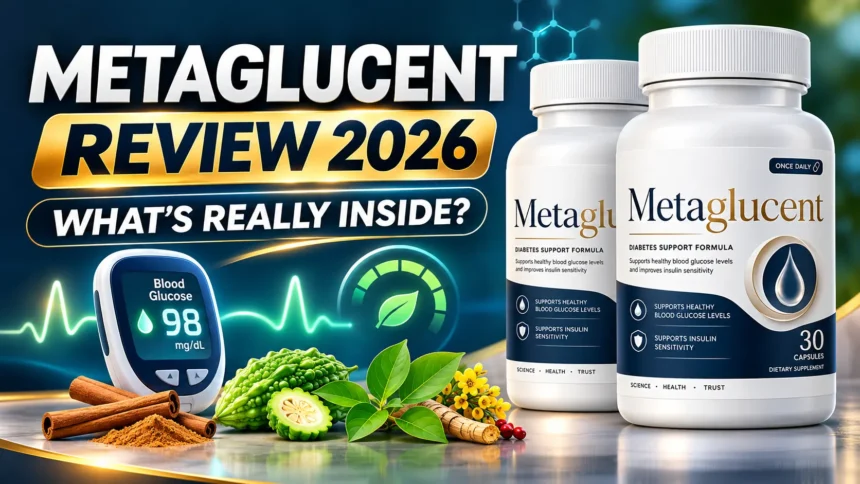
Can a single daily capsule containing berberine, cinnamon, Gymnema, and other plant extracts make a meaningful difference to metabolic wellness? Or is Metaglucent simply another supplement with an impressive ingredient list?
That’s the question worth asking before spending money.
Blood sugar health has become an important topic for American adults, especially those trying to improve their eating habits, maintain a healthy weight, or become more proactive about long-term wellness. While balanced meals, regular movement, and proper medical care remain essential, many people are also exploring nutritional supplements.
Metaglucent is one product attracting interest in this category.
It combines botanical ingredients traditionally associated with glucose metabolism, cardiovascular wellness, and nutritional support. Its formula includes familiar names such as berberine, cinnamon, bitter melon, and chromium.
At first glance, that sounds promising.
But a long ingredient list doesn’t automatically mean a supplement delivers noticeable results. The quantity of each ingredient, the quality of supporting research, and potential interactions all matter.
This Metaglucent Review takes a closer look at what the product actually offers, what its label reveals, how its ingredients compare with scientific research, and whether its pricing makes sense.
We’ll also explore the questions that buyers sometimes overlook, including the difference between a proprietary blend and a fully disclosed formula.

Metaglucent at a Glance: The Important Details
Before examining the ingredients, here’s a quick overview of the product.
| Product Feature | Details |
|---|---|
| Product name | Metaglucent |
| Supplement type | Daily metabolic wellness formula |
| Primary purpose | Support healthy glucose metabolism |
| Additional focus | Healthy blood pressure and cholesterol support |
| Format | Vegetable capsules |
| Serving size | One capsule |
| Bottle quantity | 30 capsules |
| Botanical ingredients | 13 |
| Additional nutrients | Vitamin C, vitamin D, magnesium, chromium |
| Botanical blend | 528 mg proprietary blend |
| Starting package | $158 for two bottles |
| Lowest advertised bottle price | $49 in six-bottle package |
| Refund policy | Advertised 60-day guarantee |
| Official website | visit us |
Quick assessment: Metaglucent combines several ingredients that have attracted scientific interest in metabolic health. However, the product’s proprietary blend does not reveal individual botanical quantities, and research on the complete formula is not established.
Why Are People Looking at Metaglucent?
Healthy glucose metabolism is an important part of overall well-being.
Every time you eat carbohydrates, your digestive system breaks many of them down into glucose. This glucose enters the bloodstream and provides energy for cells throughout the body.
Insulin, a hormone produced by the pancreas, helps regulate how glucose moves from the blood into cells.
Several lifestyle factors influence this process, including physical activity, nutrition, sleep, body composition, and certain medical conditions.
This helps explain why people search for products described as blood sugar support supplements.
Some consumers want to maintain healthy metabolic function as they age. Others are interested in improving their daily nutrition or learning more about plant-based wellness ingredients.
Metaglucent fits into this broader category.
Its manufacturer positions the supplement as a convenient way to combine multiple botanical extracts and nutrients in one daily capsule.
However, it’s important to distinguish general wellness support from the medical management of diabetes.
A supplement cannot replace glucose monitoring, professional medical advice, prescribed medication, or proven lifestyle interventions.
The First Thing We Checked Wasn’t the Marketing — It Was the Label
One of the easiest mistakes when evaluating supplements is focusing on the advertised benefits before reading the Supplement Facts panel.
The label often tells a more useful story.
Metaglucent contains four nutrients with individually disclosed amounts:
- Vitamin C: 90 mg
- Vitamin D3: 25 mcg
- Magnesium: 20 mg
- Chromium: 100 mcg
Alongside these nutrients is a 528 mg proprietary botanical blend containing thirteen ingredients.
That brings the total to seventeen listed active ingredients.
Here’s why this matters.
When a manufacturer uses a proprietary blend, it generally discloses the combined weight of the ingredients rather than the individual amount of every component.
That means consumers can identify the botanicals but cannot determine exactly how much of each is present.
For example, berberine appears on the ingredient list, but its individual dosage isn’t disclosed.
The same applies to cinnamon, Gymnema, bitter melon, and banaba.
This doesn’t automatically make the formula ineffective. It does, however, make it harder to compare the product with doses used in published clinical studies.
The most important question isn’t simply whether Metaglucent contains a popular ingredient. It’s whether the formula contains a meaningful, appropriately studied amount.
What’s Actually Inside Metaglucent? An Ingredient Investigation
Rather than treating every ingredient as equally important, it makes sense to examine the formula according to the type of support each component is intended to provide.
The Glucose-Focused Botanical Group
This group contains several of the most recognizable ingredients in the product.
Berberine HCl
Berberine is a naturally occurring plant compound found in several botanical species.
Researchers have investigated its relationship with glucose metabolism, insulin signaling, and lipid metabolism.
Some clinical studies have reported promising findings, particularly in adults with metabolic conditions.
However, the quality of research varies, and berberine can interact with medications.
Because the amount of berberine in Metaglucent isn’t separately disclosed, results from standalone berberine studies cannot be assumed to apply to this formula.
Gymnema Sylvestre Leaf
Gymnema sylvestre is a plant traditionally used in Ayurvedic herbal practices.
Its leaves contain compounds called gymnemic acids.
Scientists have investigated Gymnema for its potential relationship with glucose metabolism and sweet taste perception.
Some preliminary findings are interesting, but larger, well-designed human studies are needed.
Cinnamon Bark
Cinnamon is probably the most familiar ingredient in the formula.
Beyond its culinary use, cinnamon has been investigated for its possible relationship with glucose metabolism.
Some studies suggest potential effects on fasting glucose measurements, while others report limited or inconsistent benefits.
The type of cinnamon, extract preparation, and dosage can influence research findings.
Metaglucent lists cassia cinnamon bark, making ingredient quantity and safety considerations relevant.
Bitter Melon Fruit Extract
Bitter melon is a traditional food and botanical used in several parts of Asia, Africa, and the Caribbean.
It contains naturally occurring compounds that have been studied for their possible metabolic activity.
However, human research remains inconsistent.
Bitter melon should not be treated as an established alternative to diabetes medication.
Banaba Leaf Extract
Banaba leaves contain plant compounds such as corosolic acid.
Researchers have investigated these compounds for their possible relationship with glucose metabolism.
The available evidence is preliminary, and the amount included in the Metaglucent formula is not separately disclosed.
The Cardiovascular and Antioxidant Group
The second group includes ingredients more commonly associated with antioxidant activity, circulation, and cardiovascular wellness.
Olive Leaf Extract
Olive leaves contain polyphenols, including oleuropein.
These compounds have been studied for antioxidant activity and possible effects on cardiovascular markers.
Although some research is promising, results from individual extracts cannot establish that a multi-ingredient supplement improves blood pressure.
Pine Bark Extract
Pine bark contains compounds called proanthocyanidins.
Certain standardized pine bark extracts have been studied for vascular function and antioxidant properties.
However, different extracts may have different compositions.
Cocoa Bean Extract
Cocoa contains naturally occurring flavanols.
Some research has investigated cocoa flavanols in connection with blood vessel function.
The concentration of flavanols depends on how the extract is prepared, and the product does not disclose its individual cocoa extract amount.
Guggul Resin Extract
Guggul has a history of use in traditional Ayurvedic medicine.
It has been investigated for its relationship with lipid metabolism.
Human research findings are inconsistent, and guggul may interact with certain medications.
Butcher’s Broom Root
Butcher’s broom is traditionally associated with venous and circulatory wellness.
It is less directly connected to glucose metabolism than ingredients such as berberine or cinnamon.
Its inclusion broadens the botanical profile but does not establish a measurable blood sugar benefit.
The General Botanical Wellness Group
Three additional ingredients contribute to the broader formula.
Turmeric Rhizome
Turmeric contains naturally occurring curcuminoids.
These compounds have attracted scientific interest for their antioxidant and inflammatory signaling effects.
However, turmeric preparations vary significantly in concentration and absorption.
Eleuthero Root
Eleuthero, sometimes called Siberian ginseng, is traditionally used in herbal wellness practices.
Researchers have investigated it in connection with fatigue, resilience, and physical performance.
Evidence supporting specific metabolic outcomes remains limited.
Juniper Berry
Juniper berries have a long history of culinary and traditional herbal use.
Although they contain several biologically active plant compounds, reliable human evidence for glucose support is limited.
Together, these thirteen botanicals create a broad herbal glucose support formula. But the number of ingredients should not be mistaken for proof of effectiveness.

Four Nutrients With Clear Dosages: What Do They Contribute?
Unlike the proprietary botanical blend, Metaglucent provides exact amounts for its four added nutrients.
| Nutrient | Amount | What It Contributes |
|---|---|---|
| Vitamin C | 90 mg | Antioxidant function and normal immune support |
| Vitamin D3 | 25 mcg | Bone health, calcium absorption, immune function |
| Magnesium | 20 mg | Normal muscle, nerve, and energy metabolism |
| Chromium | 100 mcg | A trace mineral studied in relation to nutrient metabolism |
Vitamin C and Cellular Protection
Vitamin C helps protect cells from oxidative stress and supports several normal biological functions.
The 90 mg amount represents 100% of the Daily Value shown on the product label.
Vitamin D and Metabolic Health
Vitamin D is best known for its role in calcium absorption and bone health.
Researchers have also explored relationships between vitamin D status and metabolic health.
However, supplementation does not consistently improve glucose outcomes in people who already have adequate vitamin D levels.
Magnesium and Everyday Function
Magnesium is involved in numerous enzymatic reactions.
It supports normal muscle and nerve function and contributes to energy metabolism.
The 20 mg amount in Metaglucent represents approximately 5% of the Daily Value.
Therefore, the product should not be considered a substantial source of magnesium.
Chromium and Glucose Metabolism
Chromium is frequently marketed in blood sugar balance formulas.
Some studies have investigated chromium supplementation for glucose-related outcomes.
However, results remain inconsistent, and routine supplementation has not been established as an effective treatment for diabetes.
Chromium may also interact with insulin and other glucose-lowering medications.
Can Metaglucent Really Support Healthy Blood Sugar?
This is the central question behind the entire review.
The answer requires separating three different things:
- What the manufacturer intends the formula to support.
- What research says about individual ingredients.
- What has been demonstrated for the finished product.
These are not interchangeable.
The manufacturer describes Metaglucent as a supplement intended to support healthy glucose metabolism.
Scientific research has explored several of its individual ingredients.
However, evidence involving berberine, cinnamon, or chromium does not automatically demonstrate that the complete Metaglucent formula improves blood sugar measurements.
The proprietary blend creates another limitation because its botanical doses are not individually disclosed.
For consumers, this means the product has a plausible ingredient rationale but lacks sufficient product-specific evidence to establish a clinical benefit.
What Would Stronger Evidence Look Like?
Ideally, a manufacturer would publish a randomized, placebo-controlled human trial involving the finished product.
Such a study would evaluate a clearly defined population and measure outcomes such as fasting glucose or HbA1c.
It would also document adverse events and disclose the study duration.
Without that type of evidence, claims about guaranteed improvements, rapid results, or specific changes in blood sugar should be treated cautiously.
Metaglucent Benefits: Separating Possibilities From Proven Outcomes
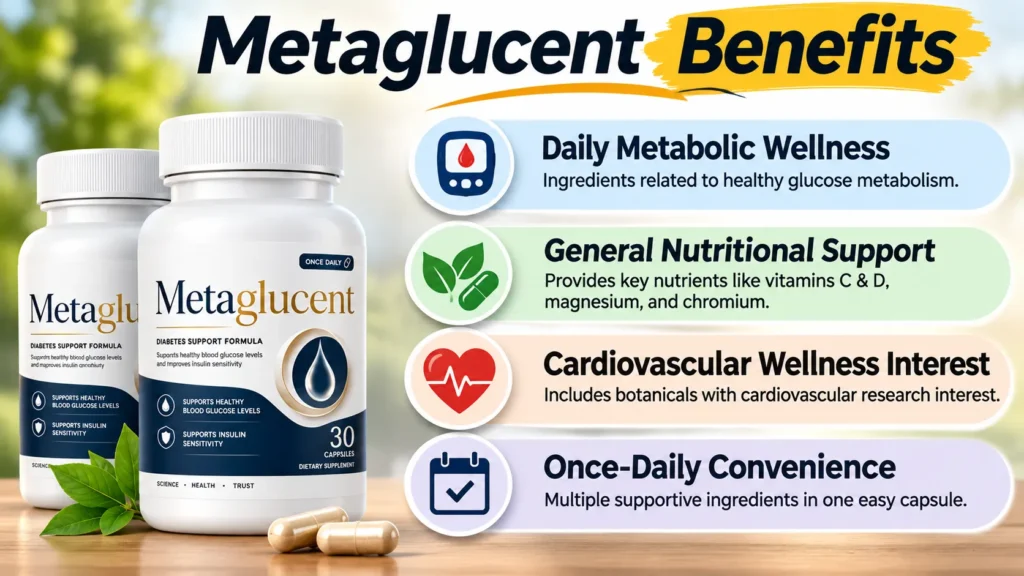
The potential benefits can be grouped into four main areas.
1. Daily Metabolic Wellness
The formula combines ingredients traditionally used or studied in relation to glucose and nutrient metabolism.
This is the main reason someone might consider the supplement.
However, its effect on actual glucose measurements has not been established.
2. General Nutritional Support
Vitamin C, vitamin D, magnesium, and chromium provide nutritional components with recognized biological roles.
This is a concrete feature of the label.
The practical benefit will depend partly on an individual’s dietary intake and nutritional status.
3. Broader Cardiovascular Wellness Interest
Olive leaf, cocoa, pine bark, and guggul are among the ingredients that have attracted cardiovascular research interest.
That does not establish that the complete formula lowers blood pressure or cholesterol.
4. Once-Daily Convenience
The product provides multiple ingredients in a single capsule.
This may appeal to adults who prefer a simple supplement routine.
Convenience is a legitimate product feature, although it does not guarantee effectiveness.
What Does Independent Science Say?
A supplement review becomes more useful when it compares marketing language with independent scientific guidance.
The National Center for Complementary and Integrative Health explains that research involving supplements for diabetes has produced mixed findings.
Some ingredients have shown potential in individual studies, but evidence is not strong enough to recommend most supplements as replacements for established diabetes treatment.
The NIH Office of Dietary Supplements also describes inconsistent evidence involving chromium supplementation and glucose control.
Cinnamon research presents a similar challenge: some studies report possible improvements, while others show little or no meaningful benefit.
The broader lesson is straightforward.
An ingredient can be biologically interesting without being clinically proven in every formulation.
And a product can contain several researched ingredients without the complete formula being clinically validated.
Evidence Snapshot
| Ingredient | Scientific Interest | Main Limitation |
|---|---|---|
| Berberine | Glucose and lipid metabolism | Variable studies; unknown product dose |
| Gymnema | Glucose metabolism and sweet taste | Limited high-quality human evidence |
| Cinnamon | Fasting glucose and insulin sensitivity | Inconsistent findings |
| Bitter melon | Glucose-related pathways | Limited and mixed human results |
| Banaba | Corosolic acid and glucose metabolism | Preliminary research |
| Chromium | Nutrient and glucose metabolism | Mixed clinical findings |
| Magnesium | Normal metabolic function | Small amount in this formula |
Scientific conclusion: The ingredient list provides reasons for further investigation, not proof that Metaglucent delivers a particular health outcome.
The Safety Question: Could Metaglucent Cause Side Effects?
Natural ingredients can still produce unwanted effects.
That is especially important when a formula combines multiple botanical extracts.
Potential concerns include digestive discomfort, nausea, diarrhea, constipation, or reactions to specific ingredients.
Berberine is associated with gastrointestinal side effects in some users.
Certain botanicals may also affect how medications are processed.
Chromium deserves particular attention because it may increase the risk of low blood sugar when combined with insulin or certain diabetes medications.
Why Medication Interactions Matter
Imagine someone who already takes medication to manage blood glucose.
Adding a supplement containing glucose-active ingredients without medical guidance could create additional risks.
The same principle applies to people taking medication for blood pressure, cholesterol, or other chronic conditions.
Before starting Metaglucent, a healthcare professional should review the full ingredient list and existing medications.
Pregnant or breastfeeding individuals should avoid starting this type of multi-herb supplement without medical advice.
People with kidney or liver disease also need individualized guidance.
The safest approach is not to assume that a product is harmless simply because its ingredients come from plants.
A U.S. Buyer Scenario: How One Person Might Evaluate the Formula
The following case study is for review and educational. It is a real Metaglucent customer testimonial or evidence of product results.
Michael, a fictional 49-year-old office worker living in Denver, Colorado.
Michael has a demanding work schedule and spends much of his day sitting.
Recently, he has become more interested in maintaining healthy metabolic habits.
He starts walking after dinner, preparing more meals at home, and paying closer attention to nutrition labels.
While researching metabolic wellness supplements, he discovers Metaglucent.
The combination of berberine, cinnamon, and chromium catches his attention.
However, instead of purchasing immediately, he decides to investigate the product.
His First Question: What Am I Actually Getting?
Michael checks the Supplement Facts panel.
He notices that four nutrients have clearly listed amounts, while the thirteen botanicals share a 528 mg proprietary blend.
He realizes that he cannot determine the exact amount of berberine or Gymnema in each capsule.
This becomes an important part of his decision.
His Second Question: Is It Appropriate for Me?
Michael reviews the ingredient list with a healthcare professional.
They consider his current medications, medical history, and any potential ingredient interactions.
This step matters more than relying on promotional testimonials.
His Third Question: What Should I Expect?
Michael understands that a supplement cannot replace balanced meals, regular activity, sleep, or medical monitoring.
He also learns that there is no established timeline for measurable results from the finished product.
The Lesson From This Scenario
The purpose of this example is not to suggest that Michael experienced a health improvement.
Instead, it demonstrates a sensible purchasing process.
A careful consumer looks at ingredient transparency, research quality, safety, pricing, and personal health needs before deciding whether a supplement is appropriate.
Metaglucent vs. Regular Berberine Supplements: What’s the Difference?
One useful comparison is between Metaglucent and a typical standalone berberine product.
| Feature | Metaglucent | Standalone Berberine |
|---|---|---|
| Formula | Multi-ingredient blend | Primarily berberine |
| Botanical variety | 13 botanicals | Usually one main botanical compound |
| Berberine amount | Not separately disclosed | Often individually listed |
| Additional vitamins | Four nutrients | Depends on brand |
| Convenience | One capsule daily | Depends on product |
| Research comparison | Difficult because of undisclosed doses | Easier when dose and formulation are specified |
| Medication interactions | Possible | Possible |
A standalone berberine supplement is not automatically safer or more effective.
However, a clearly disclosed ingredient amount can make research comparisons easier.
Metaglucent may appeal to someone interested in a broad formula, while a single-ingredient product may appeal to someone prioritizing dose transparency.
Neither approach should replace medical treatment.
What About Metaglucent Customer Reviews?
Customer reviews are often one of the first things buyers search for.
But not every testimonial deserves equal weight.
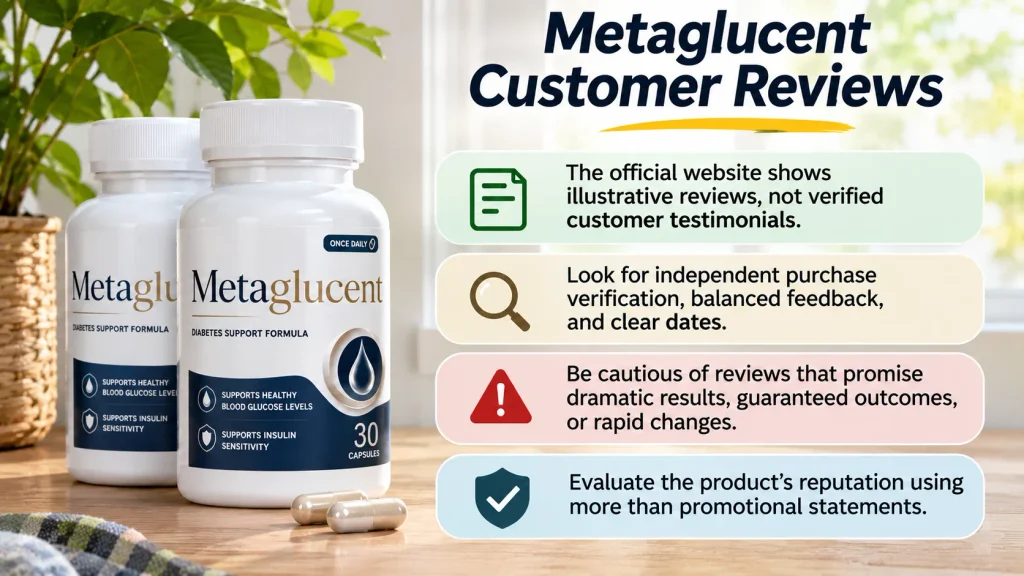
The official Metaglucent website displays illustrative reviews representing common customer feedback themes.
Importantly, the website identifies these as illustrative rather than independently verified customer testimonials.
That means they should not be presented as confirmed accounts from real purchasers.
This distinction matters because testimonials can create strong impressions even when they do not provide clinical evidence.
When researching Metaglucent customer reviews, look for independent purchase verification, balanced feedback, clear dates, and transparent disclosure of commercial relationships.
Be cautious with reviews promising dramatic glucose improvements, guaranteed outcomes, or rapid changes without supporting medical evidence.
A supplement’s reputation should be evaluated using more than promotional statements.
Metaglucent Price: Is the Multi-Bottle Offer Worth It?
The official website currently advertises three purchasing packages.
| Package | Total Cost | Cost Per Bottle | Shipping |
|---|---|---|---|
| 2 bottles | $158 | $79 | Additional charge |
| 3 bottles | $207 | $69 | Free |
| 6 bottles | $294 | $49 | Free |
Each bottle contains 30 capsules.
The six-bottle package offers the lowest advertised price per bottle.
At $49 per bottle, the approximate daily product cost is $1.63, excluding any additional expenses.
However, the lowest unit price does not always represent the best personal purchasing decision.
Someone who has not used the product before may prefer to avoid committing to a six-month supply.
The higher upfront expense and the product’s evidence limitations should both be considered.
Understanding the 60-Day Guarantee
The manufacturer advertises a 60-day money-back guarantee.
Before purchasing, review the actual return terms.
Check whether the policy covers opened bottles, whether return shipping is required, and how the refund request must be submitted.
A refund policy may reduce some financial risk, but it does not establish that a supplement is effective.
Metaglucent Pros and Cons: A Practical Buyer Assessment
| Advantages | Limitations |
|---|---|
| Convenient once-daily format | Individual botanical amounts are undisclosed |
| Includes several familiar metabolic wellness ingredients | Finished formula lacks established clinical efficacy |
| Vitamin and mineral amounts are clearly listed | Ingredient-level evidence cannot be applied directly |
| Contains 30 capsules per bottle | Potential medication interactions |
| Multi-bottle pricing options | Larger packages require higher upfront spending |
| Advertised 60-day guarantee | Official testimonials are illustrative, not independently verified |
The most appealing feature is the convenience of a broad formula.
The biggest drawback is the limited ability to assess whether the botanical ingredients are present in quantities comparable to those used in research.
Five Things to Check Before Ordering
Before making a purchase, consider these five questions.
1. Have you reviewed the entire Supplement Facts panel?
Ingredient names are only part of the picture. Amounts and formulations matter.
2. Are you currently taking prescription medication?
A healthcare professional should check for possible interactions, especially with diabetes medications.
3. Are you expecting a guaranteed result?
No reliable evidence establishes that the finished product produces a specific glucose reduction.
4. Have you compared the total cost?
Review the price per bottle, shipping charges, and refund conditions.
5. Does the product fit your overall wellness plan?
Nutrition, physical activity, sleep, and appropriate medical care remain the foundation of metabolic health.
Is Metaglucent Worth Trying in 2026?
Metaglucent has several features that make it worth examining.
Its formula contains familiar botanical ingredients, and its once-daily format is convenient.
The manufacturer also provides a Supplement Facts panel, suggested usage instructions, and package pricing.
Those are useful details for consumers.
However, a fair review must also acknowledge what remains uncertain.
The botanical blend does not disclose individual ingredient quantities.
There is insufficient product-specific clinical evidence to establish measurable blood sugar benefits.
And some ingredients may interact with medications.
For an adult interested in general metabolic wellness, the product may be something to discuss with a qualified healthcare professional.
For someone expecting a proven diabetes treatment, it is not an appropriate substitute.
Where Can You Buy Metaglucent?
The manufacturer’s website is the primary source for current product information and advertised packages.
Official website: ORDER NOW
Before ordering, confirm the latest price, shipping charges, return conditions, and product label.
Also review the checkout details carefully to understand the total amount being charged.
Avoid relying on unsupported claims from third-party advertisements or unfamiliar sellers.
Final Verdict: The Formula Is Interesting, but the Evidence Matters More
After examining the label, ingredient research, safety considerations, and purchasing details, Metaglucent appears to be a broad metabolic wellness supplement rather than a clinically established blood sugar treatment.
Its biggest strengths are the variety of ingredients, simple capsule format, and clearly disclosed amounts of four nutrients.
Its biggest limitation is the 528 mg proprietary botanical blend.
Without individual botanical amounts, it is difficult to assess how closely the formula matches published research.
That doesn’t automatically make the product ineffective.
It simply means consumers should avoid assuming that every scientifically interesting ingredient will produce a meaningful result in this particular combination.
Bottom line: Metaglucent may appeal to adults exploring daily nutritional support, but purchasing decisions should be based on realistic expectations, ingredient transparency, and professional health guidance—not promises of dramatic results.
Frequently Asked Questions
Is Metaglucent a legitimate supplement?
Metaglucent is marketed through a product website that provides ingredient information, usage instructions, pricing, and a refund policy. However, these details alone do not independently verify manufacturing quality, clinical effectiveness, or customer satisfaction.
Does Metaglucent really help blood sugar?
Some individual ingredients have been studied for glucose-related effects. However, there is insufficient evidence to establish that the complete Metaglucent formula improves blood sugar measurements.
What are the main ingredients in Metaglucent?
The formula contains thirteen botanicals, including berberine, Gymnema, cinnamon, bitter melon, banaba, olive leaf, and turmeric. It also contains vitamin C, vitamin D, magnesium, and chromium.
How much berberine is in Metaglucent?
The label lists berberine HCl within a 528 mg proprietary botanical blend. Its individual amount is not disclosed.
Are there any Metaglucent side effects?
Potential side effects depend on individual sensitivity and ingredient interactions. Digestive discomfort and medication interactions are important considerations. Seek professional guidance before use.
Can Metaglucent replace metformin?
No. Metaglucent is a dietary supplement, not a replacement for metformin or any other prescribed diabetes medication.
How many capsules should I take?
The manufacturer’s suggested serving is one capsule daily, preferably with a meal and water, unless a healthcare professional advises otherwise.
How long does Metaglucent take to work?
There is no established clinical timeline for measurable benefits from the finished formula. Avoid relying on claims that promise specific results within a fixed number of days.
Is Metaglucent FDA approved?
Dietary supplements are not approved by the FDA for safety and effectiveness before marketing in the same way as prescription drugs. Metaglucent is not an FDA-approved diabetes treatment.
How much does Metaglucent cost?
The official website advertises a two-bottle package for $158, three bottles for $207, and six bottles for $294. Prices may change.
Does Metaglucent come with a refund guarantee?
The manufacturer advertises a 60-day money-back guarantee. Consumers should review the current terms before purchasing.
Who should avoid taking Metaglucent without medical guidance?
People taking glucose-lowering medications, pregnant or breastfeeding individuals, and those with liver, kidney, or other significant medical conditions should obtain professional advice before considering the formula.
Scientific References and Source Websites
The following sources provide information about the product and the scientific evidence surrounding its ingredients.
- Metaglucent Official Website: Supplement Facts, ingredients, directions, package pricing, and refund information.
- National Center for Complementary and Integrative Health (NCCIH): Diabetes and Dietary Supplements: What You Need to Know. https://www.nccih.nih.gov/health/diabetes-and-dietary-supplements-what-you-need-to-know
- NIH Office of Dietary Supplements: Chromium: Health Professional Fact Sheet. https://ods.od.nih.gov/factsheets/Chromium-HealthProfessional/
- NCCIH: Cinnamon: Usefulness and Safety. https://www.nccih.nih.gov/health/cinnamon
- PubMed: Berberine and Glucose Metabolism Research. https://pubmed.ncbi.nlm.nih.gov/?term=berberine+glucose+metabolism
- National Institute of Diabetes and Digestive and Kidney Diseases (NIDDK): Diabetes Health Information. https://www.niddk.nih.gov/health-information/diabetes
- U.S. Food and Drug Administration: Dietary Supplements. https://www.fda.gov/food/dietary-supplements
Medical Disclaimer
This article is intended for educational and informational purposes. Metaglucent is a dietary supplement designed to support general wellness and healthy blood sugar management. Individual experiences may vary, and results are not guaranteed. For personalized guidance, consult a qualified healthcare professional before adding Metaglucent to your routine, especially if you have diabetes, take prescription medications, or have an existing health condition. Continue following your healthcare provider’s recommendations and prescribed treatment. Prices, availability, and product policies may change, so check the official website for the latest details.
For more expert-backed health tips, wellness guides, and supplement insights, be sure to read more articles on the Health Line Guide