

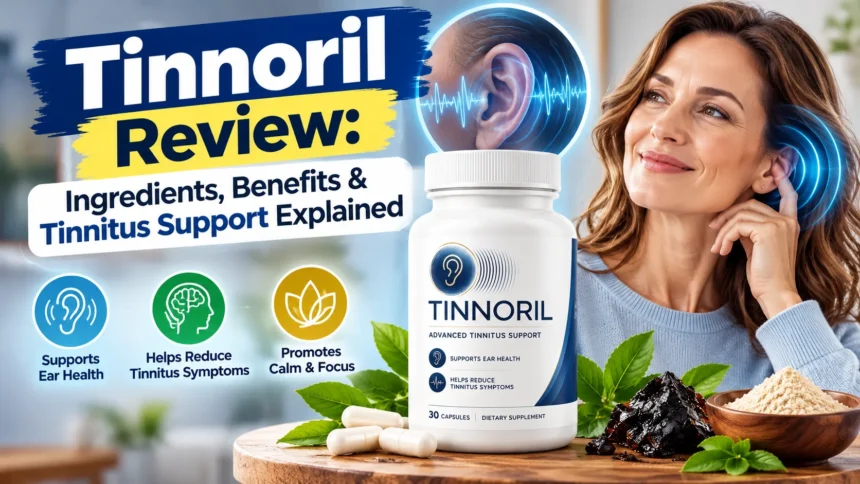
Tinnitus can be frustrating, especially when ringing, buzzing, humming, or hissing seems to follow you throughout the day. For some people, it affects concentration, sleep, and the ability to relax in a quiet room. Understandably, people experiencing these symptoms look for practical ways to manage them.
In this Tinnoril Review, we examine the product’s advertised ingredients, potential benefits, safety considerations, and the evidence behind its hearing-health claims. We also look at what consumers should consider before deciding whether to buy Tinnoril.
Tinnoril is described in the supplied product information as a liquid, sublingual supplement containing six ingredients: L-arginine, GABA, Alpha-GPC, Mucuna pruriens (L-Dopa bean), L-tyrosine, and shilajit (also called moomiyo). The product is marketed for tinnitus support and hearing comfort.
However, an ingredient’s biological role does not establish that a finished supplement can reduce tinnitus or improve hearing. The exact formula, ingredient amounts, product quality, and clinical evidence all matter. This review separates advertised benefits from what research can reasonably support.
Editorial note: This article is educational, not medical advice. Product details below are based on the information provided for this review; current prices, serving directions, manufacturing standards, and the authenticity of customer testimonials should be verified before purchase.

What Is Tinnoril?
Tinnoril is presented as a liquid dietary supplement intended to support hearing wellness and help people manage concerns associated with tinnitus. Its marketing emphasizes a sublingual delivery format, meaning the liquid is intended to be placed under the tongue according to the product’s directions.
Unlike hearing aids, sound therapy devices, or clinical tinnitus treatments, Tinnoril is a supplement. It should not be considered a replacement for an evaluation by an audiologist or healthcare professional.
Tinnitus is a symptom rather than a single disease. It may be associated with hearing loss, loud-noise exposure, earwax buildup, certain medications, or other medical conditions. Because the underlying causes differ, a supplement that is marketed for general wellness cannot be assumed to address every person’s symptoms.
Tinnoril at a Glance
| Feature | Details |
|---|---|
| Product name | Tinnoril |
| Product type | Liquid dietary supplement, as described in supplied information |
| Intended audience | Adults interested in tinnitus and hearing-health support |
| Delivery format | Marketed as sublingual liquid |
| Listed ingredients | L-arginine, GABA, Alpha-GPC, Mucuna pruriens, L-tyrosine, and shilajit |
| Main advertised purpose | Tinnitus support and hearing comfort |
| Clinical effectiveness | Not established by the ingredient list alone |
| Important consideration | Check the complete label, doses, safety information, and seller details |
What Is Tinnitus, and Why Does It Matter?
Tinnitus is the perception of sound when no corresponding external sound source is present. People describe it in different ways, including ringing, buzzing, clicking, humming, or a high-pitched tone.
For some, it is occasional and mild. For others, it can interfere with sleep, conversations, work, or emotional well-being.
Tinnitus can have several possible causes, including:
- Hearing loss associated with aging or noise exposure.
- Earwax blockage or certain ear conditions.
- Exposure to loud music, machinery, or other intense sounds.
- Medication side effects.
- Jaw-joint problems or head and neck injuries.
- Conditions affecting the ear or, less commonly, blood vessels or the nervous system.
This variety is important when assessing a tinnitus support supplement. There is no single nutritional ingredient known to resolve all forms of tinnitus, and evidence about a compound’s general effects does not prove that it treats the condition.
People with persistent tinnitus should consider a hearing assessment. Seek urgent medical care for tinnitus accompanied by sudden hearing loss, and prompt medical assessment for new tinnitus that pulses in time with the heartbeat, occurs with significant dizziness, or develops alongside other concerning symptoms.
Tinnoril Ingredients: What Is Inside the Formula?
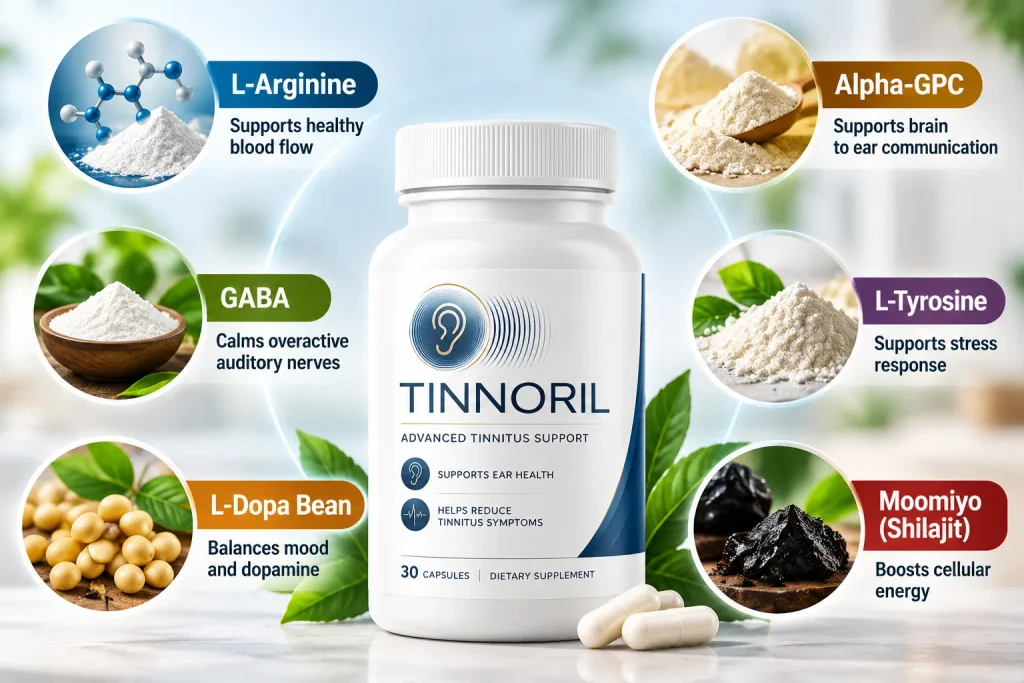
According to the supplied product description, Tinnoril contains six ingredients associated with circulation, neurotransmitter activity, or general wellness. The important question is whether research supports using these ingredients specifically for tinnitus.
1. L-Arginine
L-arginine is an amino acid that the body uses to produce nitric oxide, a molecule involved in relaxing blood vessels and regulating circulation.
Advertised role in Tinnoril: Supporting healthy blood flow and inner-ear wellness.
What research tells us: L-arginine has a recognized role in nitric oxide production, but this does not establish that taking it as a supplement improves blood flow to the inner ear enough to reduce tinnitus. Direct evidence for Tinnoril’s effectiveness is not provided in the product information.
Safety consideration: L-arginine can interact with certain medicines, including some blood-pressure drugs and medicines that affect blood vessels. People with relevant health conditions should seek professional advice before using it.
2. GABA (Gamma-Aminobutyric Acid)
GABA is a neurotransmitter that helps regulate inhibitory signaling in the central nervous system. The product description suggests that GABA may support relaxation and help with the perception of unwanted sounds.
Advertised role in Tinnoril: Supporting calmness and a balanced nervous system.
What research tells us: The brain’s inhibitory signaling is relevant to how auditory information is processed. However, that does not prove that oral or sublingual GABA can reliably change tinnitus symptoms. Evidence that this ingredient treats tinnitus remains insufficient.
Safety consideration: The effects of GABA supplements and their interactions with medicines are not fully established. Discuss use with a healthcare professional if you take medication or have a medical condition.
3. Alpha-GPC
Alpha-GPC is a choline-containing compound involved in supplying choline, which the body uses to produce acetylcholine. Acetylcholine plays a role in nervous-system function.
Advertised role in Tinnoril: Supporting cognitive function and communication within the nervous system.
What research tells us: Alpha-GPC has been investigated for certain cognitive outcomes, but evidence in those areas cannot be transferred automatically to tinnitus treatment. The supplied product description does not establish that Alpha-GPC reduces ringing or improves hearing.
Safety consideration: Potential side effects and interactions depend on the person, dosage, and other medications. Check the product’s exact dose and discuss it with a qualified professional.
4. Mucuna Pruriens (L-Dopa Bean)
Mucuna pruriens is a tropical plant whose seeds naturally contain levodopa, commonly called L-DOPA. This compound is a precursor to dopamine.
Advertised role in Tinnoril: Supporting mood, motivation, and emotional wellness.
What research tells us: The presence of a dopamine precursor does not demonstrate that the ingredient can help the brain filter out tinnitus sounds. There is not enough evidence in the supplied information to conclude that Mucuna pruriens treats tinnitus.
Safety consideration: Because L-DOPA can affect dopamine pathways, this ingredient deserves particular caution. It may interact with medications and can cause adverse effects. Do not assume that a plant-derived ingredient is automatically safe.
5. L-Tyrosine
L-tyrosine is an amino acid used by the body to produce several substances, including dopamine and norepinephrine.
Advertised role in Tinnoril: Supporting alertness, focus, and the body’s response to stress.
What research tells us: L-tyrosine has been studied in relation to cognition under certain stressful conditions. That research does not establish it as a tinnitus treatment, and no product-specific clinical results were supplied for Tinnoril.
Safety consideration: People taking thyroid medication, medicines that affect blood pressure, or certain psychiatric medications should consult a healthcare professional before using L-tyrosine.
6. Moomiyo (Shilajit)
Shilajit is a naturally occurring mineral-rich substance used in some traditional wellness practices. Its composition can vary depending on its source and processing.
Advertised role in Tinnoril: Supporting cellular energy and general wellness.
What research tells us: Some shilajit compounds have been investigated for biological effects, but strong clinical evidence that shilajit reduces tinnitus is lacking. Claims about improved inner-ear function should not be treated as proven benefits.
Safety consideration: Product purity is important. Poorly purified shilajit may contain heavy metals or other contaminants. Look for credible, independent testing and a complete ingredient label.
Tinnoril Ingredients Summary
| Ingredient | General biological role | Proven to treat tinnitus? |
|---|---|---|
| L-Arginine | Nitric oxide production and blood-vessel function | No established proof |
| GABA | Inhibitory neurotransmitter activity | No established proof |
| Alpha-GPC | Choline source involved in acetylcholine production | No established proof |
| Mucuna pruriens | Natural source of L-DOPA | No established proof |
| L-Tyrosine | Precursor for certain neurotransmitters | No established proof |
| Shilajit | Mineral-containing substance studied for general wellness | No established proof |
The key takeaway is that these ingredients have different biological functions, but none of these descriptions proves that the complete Tinnoril Supplement reduces ear ringing. Reliable clinical trials on the finished product would be needed to support that claim.
Tinnoril Benefits: What Can Consumers Reasonably Expect?
Tinnoril is marketed as a tinnitus support supplement, with claims involving hearing comfort, circulation, and nervous-system function. It is useful to separate the product’s advertised benefits from benefits that have been demonstrated in clinical studies.
Potential points of interest include:
- Liquid format: Some people may prefer a liquid to capsules or tablets.
- Convenience: A ready-to-use product may be easy to incorporate into a daily routine, provided its directions are clear.
- Ingredient transparency: The six named ingredients give consumers a starting point for researching the formula, although exact amounts are also important.
- General wellness interest: Some ingredients participate in normal physiological processes, such as neurotransmitter production or blood-vessel function.
These are practical or ingredient-related considerations, not evidence of tinnitus relief.
Can Tinnoril Quiet Ringing in the Ears?
At present, the supplied product information does not establish that Tinnoril can reliably quiet ringing, buzzing, or hissing. The US National Institute on Deafness and Other Communication Disorders (NIDCD) explains that no dietary supplement has been proven effective for tinnitus.
Anyone considering Tinnoril should therefore avoid assuming that it will eliminate tinnitus, restore lost hearing, or produce results within a specific number of days.
Can Tinnoril Improve Hearing Clarity?
Tinnitus and hearing loss can occur together, but they are not the same thing. Hearing clarity depends on several factors, including the health of the ear, the auditory nerve, and the brain’s processing of sound.
There is no product-specific clinical evidence provided here showing that Tinnoril improves hearing thresholds or reverses hearing loss. If speech sounds muffled or conversations are becoming difficult, a hearing assessment is more informative than relying on a supplement.
Can It Help With Sleep and Concentration?
Tinnitus can make it harder to sleep or focus, particularly in quiet environments. Some people find that gentle background sound, relaxation techniques, or professional tinnitus support makes symptoms easier to manage.
Tinnoril’s marketing refers to relaxation and nervous-system support, but there is not enough evidence to conclude that the product improves sleep or concentration in people with tinnitus. If ringing is affecting daily life, evidence-based management strategies are worth discussing with a healthcare professional.
Does Tinnoril Work? Reviewing the Evidence
The most important question in any Tinnoril Review is whether the product itself has been tested in people with tinnitus.
There are three different levels of evidence to consider:
- Ingredient research: A compound has been studied for a biological function or a health outcome.
- Clinical research for tinnitus: A compound has been tested specifically for tinnitus symptoms in well-designed human studies.
- Product-specific research: The exact finished formula has been evaluated in appropriately designed clinical trials.
The supplied product description discusses the first category, but it does not provide enough information to confirm the second or third. A scientific explanation of how an ingredient works is not a substitute for evidence that the finished supplement benefits people with tinnitus.
The NIDCD states that commonly advertised vitamins, herbs, and dietary supplements have not been proven effective for tinnitus.
For consumers asking, “Does Tinnoril work?”, the most accurate answer is that its effectiveness for tinnitus has not been established by the information available for this review.
That does not prove that every user will experience no effect. It means the size, consistency, and likelihood of any benefit cannot be responsibly predicted.
Tinnoril vs. Other Tinnitus Support Options
When comparing Tinnoril with other approaches, it helps to look beyond ingredient lists. Different options serve different purposes, and their evidence levels vary.
| Option | Main purpose | Evidence and limitations |
|---|---|---|
| Tinnoril Supplement | Marketed for tinnitus and hearing wellness | Product-specific effectiveness has not been established in the information reviewed |
| Hearing aids | Improve hearing when hearing loss is present | Can make tinnitus less noticeable for some people with hearing loss |
| Sound therapy | Provide background sound or mask tinnitus | May help some people manage symptoms, particularly in quiet settings |
| Cognitive behavioral therapy (CBT) | Reduce distress associated with tinnitus | Recommended for helping people manage the emotional and daily-life impact |
| Medical assessment | Identify possible causes, including earwax, hearing loss, or medication effects | Helps guide appropriate treatment based on the underlying cause |
The NIDCD describes hearing aids, sound-based approaches, and behavioral therapies as options for managing tinnitus.
This comparison does not mean that every person needs the same intervention. The most suitable option depends on symptoms, hearing status, medical history, and individual needs.
Tinnoril Pros and Cons
Before deciding whether to buy Tinnoril, consider both the practical features of the product and the unanswered questions about its effectiveness.
| Pros | Cons |
|---|---|
| Liquid format may suit people who dislike swallowing pills | Clinical effectiveness for tinnitus is not established |
| Six ingredients are named in the supplied description | Individual ingredient amounts need to be verified |
| Marketed for people interested in hearing wellness | Claims about quieter ringing and clearer hearing require stronger evidence |
| Convenient format for a supplement routine | Ingredient interactions and side effects are possible |
| Provides a starting point for ingredient research | Product quality and independent testing should be verified |
The main advantage is convenience for people who prefer a liquid formula. The biggest limitation is the lack of verified product-specific clinical evidence demonstrating tinnitus relief.
Tinnoril Side Effects and Safety Considerations
Natural ingredients can still have biological effects, interact with medications, or be unsuitable for certain people. Tinnoril should not be assumed to be safe for everyone simply because it is marketed as natural.
Potential concerns depend on the exact ingredients, their quantities, the user’s medical history, and other substances they take.
Before using Tinnoril, consider the following precautions:
- Prescription medications: Ask a healthcare professional to review possible interactions, especially if you take medicines affecting blood pressure, circulation, dopamine pathways, or the nervous system.
- Existing health conditions: People with cardiovascular, kidney, liver, thyroid, or other ongoing conditions should seek individualized advice.
- Pregnancy or breastfeeding: Do not use the supplement without professional guidance.
- Allergies: Check the complete ingredient list and other ingredients on the label.
- Product quality: Look for independent testing that identifies the tested product and verifies relevant quality measures.
The supplied information does not establish a complete, independently verified safety profile for Tinnoril. It is therefore not possible to give a reliable product-specific side-effect rate.
If you develop an unexpected reaction after taking a supplement, stop using it and seek appropriate medical advice. Severe symptoms require urgent care.
Tinnoril Customer Reviews: What Should Buyers Look For?
Online Tinnoril Reviews may describe experiences with ringing, sleep, concentration, or hearing comfort. Personal experiences can be useful for understanding what customers say, but testimonials do not establish that a product caused an improvement.
The product website at official website displays positive testimonials and a customer rating. Those are claims presented by the seller, not independent proof of effectiveness.
Before relying on Tinnoril Customer Reviews, consider these questions:
- Are reviews linked to verifiable purchases?
- Are negative and mixed experiences shown as well as positive ones?
- Does the reviewer describe their medical context and other treatments?
- Are outcomes independently verified, or are they self-reported?
- Is there clinical research on the finished formula to support the advertised results?
A review saying that ringing improved after several weeks is an account of one person’s experience. Tinnitus symptoms can fluctuate, and changes may occur for reasons unrelated to a supplement. Testimonials should therefore be considered alongside scientific evidence, not instead of it.
A US Consumer Case Study: How to Evaluate a Tinnitus Supplement
The following is a review, a real patient case study, or a verified Tinnoril customer experience.
Imagine a 55-year-old adult in Ohio who notices persistent ringing after years of working around loud machinery. The ringing is particularly distracting at night and sometimes makes conversations difficult.
After seeing an online advertisement for Tinnoril, the person considers ordering it because the liquid format seems convenient and the product claims to support hearing comfort.
A sensible decision-making process would involve several steps:
Step 1: Arrange a hearing assessment. The person contacts a healthcare professional or audiologist to discuss the ringing and check for hearing loss or another identifiable cause.
Step 2: Review the evidence. The person checks whether Tinnoril has published clinical trials on its complete formula rather than relying only on explanations of individual ingredients.
Step 3: Check the label and safety profile. They confirm the quantities of the ingredients, review possible interactions, and ask a healthcare professional about any personal risks.
Step 4: Compare alternatives. If hearing loss is identified, they discuss whether hearing aids may help. They also ask about sound therapy and tinnitus-focused counseling if the ringing affects sleep or concentration.
Step 5: Make an informed choice. Rather than assuming a supplement will work, they weigh the cost, evidence, safety information, and available management options.
This review shows how a US consumer can approach a tinnitus support supplement without relying entirely on marketing claims. It does not establish that Tinnoril is effective or that the same steps will lead to the same outcome for everyone.
Tinnoril Official Website: Where to Buy
People searching for the Tinnoril Official Website should verify the exact web address before placing an order. The supplied product information points to the official website, but buyers should independently confirm the seller, product label, and terms of purchase.
Tinnoril Official Website
Tinnoril Official Website: Explore Pricing, Ingredients & Ordering Details
- Hearing Wellness Support
- Nervous System Support
- Convenient Liquid Formula
- Daily Wellness Support
One important caution: online pages using similar Tinnoril names may describe different formulations. For example, the supplied liquid product page lists L-arginine, GABA, Alpha-GPC, Mucuna pruriens, L-tyrosine, and shilajit, while another similarly named page describes a capsule formula with different ingredients.
Before you buy Tinnoril, check:
- The full ingredient list and quantities per serving.
- Directions for use and warnings.
- The seller’s contact information and return policy.
- Shipping costs, taxes, and the total checkout price.
- Whether any claimed third-party testing can be independently verified.
- Whether recurring billing or subscription terms apply.
Tinnoril Price
The current Tinnoril Price and any bundle discounts should be confirmed directly with the seller at checkout. Prices, promotions, and shipping terms may change, and the information reviewed here is not sufficient to establish a verified current price.
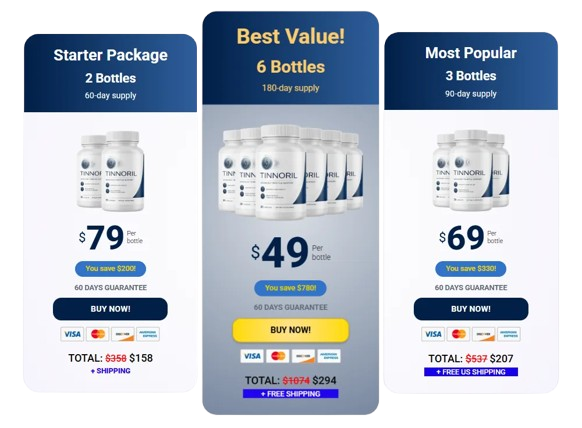
Compare the total cost rather than focusing only on a claimed discount or the price per bottle. A larger bundle is not automatically better value if the product’s effectiveness and suitability remain uncertain.
Frequently Asked Questions About Tinnoril
1. What is Tinnoril?
Tinnoril is described as a liquid dietary supplement marketed for tinnitus support and hearing wellness. The supplied formula lists six ingredients: L-arginine, GABA, Alpha-GPC, Mucuna pruriens, L-tyrosine, and shilajit.
2. Does Tinnoril work for tinnitus?
Its effectiveness has not been established by the product information reviewed here. The presence of ingredients with known biological functions does not prove that the finished formula reduces tinnitus.
3. What are the advertised Tinnoril Benefits?
The product is marketed for tinnitus support, hearing comfort, circulation, relaxation, and general wellness. These are advertised benefits, not guaranteed or independently established clinical outcomes.
4. What are the Tinnoril Ingredients?
The supplied description names L-arginine, GABA, Alpha-GPC, Mucuna pruriens (L-Dopa bean), L-tyrosine, and moomiyo (shilajit). Check the current product label for ingredient amounts and other ingredients.
5. Is Tinnoril a medication?
It is presented as a dietary supplement, not as a prescription medicine or a proven cure for tinnitus. It should not replace professional diagnosis or treatment.
6. Are there Tinnoril Side Effects?
A complete product-specific side-effect profile has not been established in the information reviewed. Possible concerns include ingredient interactions, allergies, and individual sensitivity. Consult a healthcare professional before use if you take medication or have an existing medical condition.
7. How long does Tinnoril take to work?
There is not enough reliable clinical evidence to establish a timeframe for results. Be cautious of claims promising tinnitus relief within a specific number of days or weeks.
8. Is Tinnoril suitable for everyone?
No supplement is suitable for everyone. People who are pregnant or breastfeeding, take medication, have medical conditions, or have ingredient allergies should seek professional advice before using it.
9. Where can I buy Tinnoril?
The supplied product information identifies the official website as a product website. Verify the exact URL, seller identity, product label, price, and return terms before ordering.
10. Are Tinnoril Customer Reviews enough to prove it works?
No. Customer testimonials report personal experiences but cannot establish cause and effect. Well-designed clinical studies of the finished formula would provide stronger evidence.
11. Can Tinnoril restore hearing loss?
There is no verified evidence in the information reviewed showing that Tinnoril restores hearing loss. Anyone noticing reduced hearing should arrange an assessment rather than relying on a supplement.
12. What should I do if tinnitus suddenly appears?
Sudden hearing loss accompanied by tinnitus requires urgent medical assessment. New pulsatile tinnitus, significant dizziness, or tinnitus with neurological symptoms also needs prompt evaluation.
Final Verdict: Is Tinnoril Worth Considering?
This Tinnoril Review finds that the product offers a liquid supplement format and lists six ingredients associated with different biological functions. However, the information available does not establish that the complete formula can reliably reduce tinnitus, improve hearing clarity, or restore hearing loss.
For consumers, the most important considerations are the lack of verified product-specific clinical evidence, the need to confirm ingredient quantities and quality testing, and the possibility of medication interactions.
If you are considering Tinnoril, review its label carefully, check the seller’s details, and discuss potential risks with a healthcare professional. Evidence-based tinnitus management options—including hearing assessment, sound therapy, hearing aids when appropriate, and cognitive behavioral therapy—may be more useful depending on your individual situation.
The goal is not simply to find a product advertised for quieter ears. It is to make an informed decision based on credible evidence, personal safety, and the cause and impact of your symptoms.
Scientific References and Trusted Sources
The following sources provide background on tinnitus, its assessment, and evidence-based management. They are not proof that Tinnoril itself has been clinically tested.
- National Institute on Deafness and Other Communication Disorders (NIDCD): What Is Tinnitus?. Covers causes, symptoms, diagnosis, and management options.
- American Academy of Otolaryngology–Head and Neck Surgery Foundation (AAO-HNSF): Tinnitus Clinical Practice Guideline Fact Sheet. Guidance on hearing assessment and management.
- National Health Service (NHS): Tinnitus. Symptoms and when to seek medical help.
- National Institute for Health and Care Excellence (NICE): Tinnitus: Assessment and Management (NG155). Clinical recommendations for tinnitus care.
- PubMed: Search published tinnitus and dietary supplement research. Scientific papers and reviews on tinnitus and dietary supplements.
Additional trusted resources
- American Tinnitus Association (ATA): ata.org
- CDC, Hearing Loss: cdc.gov/hearing-loss
- NIH Office of Dietary Supplements: ods.od.nih.gov
- FDA, Dietary Supplements: fda.gov/food/dietary-supplements
- NCCIH: nccih.nih.gov
Medical Disclaimer
Your health and well-being are important. This article is intended to provide helpful information about Tinnoril so you can make informed decisions about your wellness. Individual experiences may vary, and the product’s benefits have not been independently verified. Tinnoril is a dietary supplement, not a substitute for professional medical care, and it is not intended to diagnose, treat, cure, or prevent any disease. For personalized guidance, consult a qualified healthcare professional before use, especially if you take medication, have a medical condition, or are pregnant or breastfeeding. Always prioritize your hearing health and seek professional advice for persistent or sudden changes in hearing.

For more expert-backed health tips, wellness guides, and supplement insights, be sure to read more articles on the Health Line Guide