

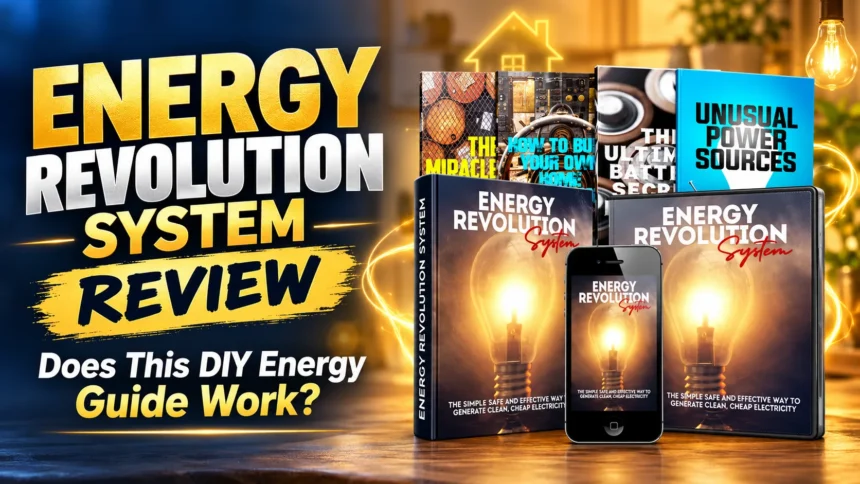
Rising electricity bills have become a real concern for many American households. From running air conditioners during summer to heating homes in winter, keeping a house comfortable can be expensive. As a result, more people are exploring alternative energy solutions, home electricity-saving methods, and do-it-yourself projects that promise greater control over household power costs.
The Energy Revolution System is marketed as a DIY energy guide designed to help people explore home-based electricity generation using affordable materials and step-by-step instructions. The promotional website presents it as a beginner-friendly project inspired by Nikola Tesla’s electrical research and claims that users may reduce their electricity bills by up to 80%.
But how realistic are these claims? Is this guide a useful educational resource, or should buyers approach it with caution?
In this Energy Revolution System Review, we examine what the program claims to offer, how its proposed technology relates to established electrical science, its potential advantages and disadvantages, its price considerations, and the alternatives available to American homeowners.
We will also look at a hypothetical U.S. household example, compare the guide with established energy solutions, and answer frequently asked questions to help readers make a more informed decision.
Quick verdict: The Energy Revolution System may appeal to DIY enthusiasts who enjoy learning about electrical circuits. However, the advertised electricity savings and power-generation claims should not be treated as proven results without independent performance testing.

What Is the Energy Revolution System?
The Energy Revolution System is promoted as a digital DIY energy guide that explains how to assemble a home energy-related device. According to its promotional material, the program is intended for people who want to learn about electricity generation, reduce dependence on utility companies, and explore an affordable alternative to conventional home energy equipment.
The seller connects the concept with Nikola Tesla’s work on electromagnetic coils and electrical engineering. It also promotes the project as accessible to beginners who may not have advanced technical experience.
Unlike a conventional solar panel kit or a portable power station, a digital guide generally provides instructions rather than a complete, ready-to-use energy system. Buyers should therefore check exactly what is included before purchasing and determine whether they will need to buy tools, wiring, electronic components, batteries, or other equipment separately.
The Energy Revolution System is advertised around several main ideas:
- DIY construction using commonly available materials.
- Step-by-step instructions and diagrams.
- Learning about coils and electromagnetic principles.
- Exploring ways to manage household electricity costs.
- Developing practical knowledge of electrical projects.
These features may be appealing to hobbyists. However, an educational guide’s value depends on the accuracy of its instructions, the quality of its supporting evidence, and whether the proposed device performs as described.
A crucial distinction is that learning how electrical circuits work is not the same as building a generator that can supply a substantial portion of a home’s electricity needs.
How Does the Energy Revolution System Work?
The promotional material describes the Energy Revolution System as a Tesla-inspired DIY generator. Its marketing references electromagnetic principles and coil-based designs.
To understand this concept, it helps to separate established science from claims that still require verification.
1. Electromagnetic induction
Electromagnetic induction is a well-established scientific principle. When the magnetic flux through a conductor changes, it can induce a voltage. If the circuit is closed, an electrical current may flow.
This principle is used in conventional generators, transformers, and many electrical devices.
However, electromagnetic induction does not mean that a coil can produce unlimited electricity without an energy source. A working generator needs an input of energy, such as mechanical rotation, moving water, wind, or another source. Solar photovoltaic panels use a different process, converting light into electricity.
2. Coil design and Tesla’s research
Nikola Tesla investigated numerous electrical technologies, including coils and high-frequency electrical circuits. His historical work is relevant to the development of electrical engineering.
Nevertheless, the existence of a historical patent or a recognized electrical principle does not establish that a modern commercial DIY guide will deliver the performance advertised by its seller.
A particular coil arrangement may influence inductance, capacitance, resistance, and circuit behavior. Its practical usefulness still depends on the complete design, energy input, components, operating conditions, and measured output.
3. Energy input and output
One of the most important questions in this Energy Revolution System Review is where the device obtains the energy it is supposed to deliver.
Under the law of conservation of energy, a system cannot continuously deliver more energy than it receives from all its sources. Real electrical equipment also experiences losses caused by resistance, heat, conversion inefficiencies, and other factors.
A device may store energy, transfer it, convert it from one form to another, or use an external energy source. But a claim that a small coil-based device can continuously power household appliances without a sufficient energy input requires exceptionally strong, independently verifiable evidence.
4. Actual power output matters
A device’s voltage reading alone does not establish how much useful power it can supply. Buyers should look for independently measured voltage, current, wattage, operating duration, and total energy delivered under a defined load.
For example, powering a small LED for a short time is very different from running a refrigerator, electric heater, or central air-conditioning system.
The Energy Revolution System’s advertised capabilities should therefore be evaluated against actual measurements rather than general descriptions of electromagnetic technology.
For further background, readers can consult the U.S. Department of Energy’s resources at Energy.gov and the National Renewable Energy Laboratory.
Energy Revolution System Official Website: What to Know Before You Click
Many online reviews of the Energy Revolution System aim to help readers understand the product and decide whether it suits their needs. Some reviews include affiliate links or promotional offers, while others focus on explaining the guide’s features, potential benefits, and purchasing options. To make an informed decision, readers should compare available information, review the product details carefully, and check the official website for the latest pricing and offers.
Here is how to be safe when looking for the Energy Revolution System official website:
- Don’t trust a link just because a review page says “official.” Review sites earn commissions when you click.
- Check the checkout page for a clear refund policy, company name, and support email before you enter card details.
- Look up the payment processor shown at checkout, and read the terms yourself.
- Use a credit card instead of a debit card, since credit cards usually give you stronger dispute rights.
- Screenshot the sales page and guarantee, in case terms change later.
I’m not linking to a specific checkout page here. I couldn’t independently verify who operates the product’s seller page, and I’d rather you verify it than take my word for it.
Energy Revolution System Price
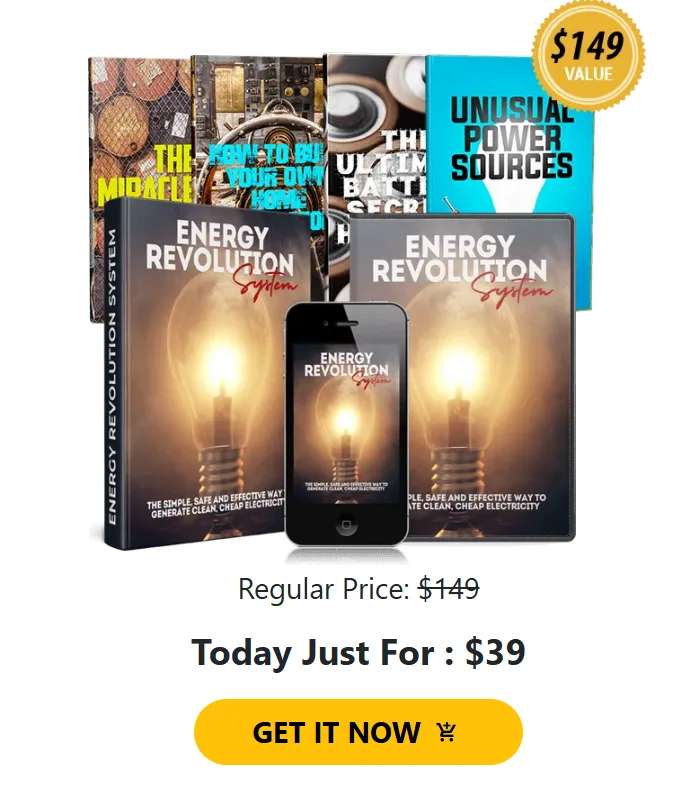
Pricing varies by source, which is common with digital offers that use upsells and rotating “discounts.” One review reports a one-time cost of about $39 for the guide, and says the parts for the build came in under about $100. Another notes an affordable entry price without giving a firm figure.
What to expect:
- Base guide: a low one-time fee (reported around $39, but confirm at checkout)
- Parts: copper wire, magnets, and basic electronics, possibly $50 to $100 depending on what you already own
- Bonuses and add-ons: some reviews mention extras such as a solar companion guide, which may be bundled or sold separately
- Hidden costs: your time, tools, and any extra components you buy while troubleshooting
At that price point, the financial risk is small. The bigger risk is opportunity cost: spending weeks on a project that cannot cover your electric bill when proven options exist.
How the Energy Revolution System Claims to Work
According to the promotional material, the build works roughly like this:
- A small initial energy “kick” starts motion in the device.
- Magnets and coils are arranged so that, supposedly, the motion becomes self-sustaining.
- The resulting current can power small devices, with some reviews showing an LED lighting up.
One promotional write-up claims the system can sustain itself once it is in motion, as a closed-loop system.
This is the point where I have to be straightforward with you.
The Physics Problem
A device that puts out more usable energy than it takes in, or runs forever with no ongoing input, would be a perpetual motion machine. The first and second laws of thermodynamics rule this out. Energy is conserved, and every real device loses some of it as heat, friction, and electrical resistance. That is why no physicist or engineer has ever produced a verified self-powering generator, and why patent offices are famously skeptical of such claims.
A coil-and-magnet device can absolutely generate small amounts of electricity while something is moving it. That is how every generator works, and it’s the foundation of Faraday’s law of induction.
Energy Revolution System Electricity Savings: Doing the Math
Let’s put numbers on the Energy Revolution System electricity savings question using U.S. data.
According to the U.S. Energy Information Administration, U.S. residential customers pay an average of about 18.2 cents per kilowatt-hour in 2026. A separate analysis of EIA data puts the typical household at around 886 kWh per month, roughly $179 a month at the March 2026 average rate.
Now compare that with what a small DIY coil device might realistically deliver:
| Output of your DIY device | Energy per month (running 24/7) | Value at 18.2¢/kWh |
|---|---|---|
| 1 watt (an LED glowing) | ~0.7 kWh | ~$0.13 |
| 5 watts | ~3.6 kWh | ~$0.66 |
| 100 watts (a bright lightbulb) | 72 kWh | ~$13 |
| What a typical U.S. home uses | ~886 kWh | ~$161+ |
Even if the device produced a continuous 100 watts, which is far beyond what hobby coil projects achieve, it would cover only about 8% of an average home’s usage. At the 1 to 5 watt levels typical of demonstrations, you would save pennies.
That doesn’t mean saving on your bill is impossible. It just means this isn’t the tool for it.
Energy Revolution System Benefits
To be fair, the product does have some upsides when you view it for what it actually is.
Energy Revolution System benefits (realistic version):
- Hands-on STEM learning. Building a coil circuit teaches electromagnetism, wiring, and basic electronics.
- Low financial commitment. The guide itself is inexpensive.
- Preparedness mindset. It nudges people to think about outages and resilience.
- Beginner-friendly format. Digital delivery, diagrams, and videos make it easy to start.
- Instant access. No shipping, no waiting.
The benefits turn into misleading claims only when the guide is presented as a way to cancel your electric bill or go off-grid.
Energy Revolution System DIY Generator: What You’d Actually Build
The Energy Revolution System DIY generator is typically described as a compact project using coils, magnets, and a small circuit. The common reference point is Nikola Tesla’s research into coils and resonance. One review specifically mentions a Tesla-inspired bifilar coil setup.
Here’s what you should realistically expect from a project like this:
- Output: milliwatts to a few watts at best
- Use cases: lighting an LED, charging a tiny battery in ideal conditions, demonstrating induction
- Not suitable for: running a refrigerator, AC unit, furnace blower, medical equipment, or anything safety-critical
- Safety: working with coils, capacitors, and batteries carries burn, shock, and fire risk. Follow basic electrical safety and never connect an experimental device to your home’s wiring.
That last point is important. Never tie a homemade generator into your home electrical panel. It can back-feed power onto utility lines and endanger line workers, and it’s illegal in most jurisdictions without proper equipment and permits.
Energy Revolution System Reviews: What Real Users Say
Searching for Energy Revolution System reviews turns up two very different pictures.
The glowing reviews. Promotional pages claim things like a 4.9 out of 5 rating from over 1,000 reviews. Those figures come from marketing pages that earn commissions, so I would not rely on them as independent proof.
The cautious reviews. Some write-ups are more measured. They stress that complaints often come from mismatched expectations and DIY skill gaps, and that hobbyists tend to like the guide more than people hoping to cut their bill. Another says the system should be viewed as an educational experiment rather than a certified replacement for commercial energy systems.
My reading is that the happiest buyers are people who wanted a weekend electronics project. The unhappiest are those who expected free power.
For independent feedback, check the Better Business Bureau, Trustpilot, Reddit communities like r/AskElectronics or r/offgrid, and your credit card issuer’s dispute process, because none of those are paid by the seller.
Energy Revolution System Scam or Legit?
This is the question most people really want answered, so let me give a direct response.
Is it a scam? I can’t prove the seller will fail to deliver the files. Many digital guides are delivered as described. But the central marketing promise, a self-sustaining generator that meaningfully lowers or erases your electric bill, is not supported by physics, and the Federal Trade Commission has long taken action against deceptive earnings and savings claims.
Red Flags to Watch For
- “Free energy” or “forgotten technology” language
- Claims that “big utilities don’t want you to know”
- Countdown timers and “only a few copies left” pressure
- Reviews on pages full of buy buttons
- Vague company identity and support information
- Results shown only as a glowing LED
Green Flags (If Any Apply)
- A clear, honored refund policy
- Transparent seller identity
- Realistic descriptions of output
- Safety warnings in the guide
If you do buy, treat it like a $39 science kit, keep your receipt, and ask for a refund within the guarantee window if it isn’t what you expected.
Does the Energy Revolution System Work?
Does the Energy Revolution System work? It depends on what “work” means.
- Does it help you learn about coils and magnets? Probably, yes.
- Does it light a small LED? Likely, with the right inputs.
- Does it lower your electric bill in a noticeable way? Almost certainly not.
- Does it provide reliable backup power in an outage? No. A real battery station or generator is far more dependable.
Case Study: A U.S. Homeowner Weighs the Options
Meet Dana, a homeowner in a suburb of Columbus, Ohio. Her home uses about 900 kWh a month. She’s frustrated by rising bills and sees an ad for a DIY energy guide promising to “slash your power bill.”
Scenario A: Dana buys the guide and builds the device.
She spends about $40 on the guide and $70 on parts, and a few weekends building. Her coil setup lights an LED and charges a small battery slowly. Measured output: roughly 2 watts when she assists it with a motor. That’s about 1.4 kWh per month, worth around $0.26 at 18.2¢/kWh. Her bill is unchanged for practical purposes. She gets a fun project, but no meaningful savings.
Scenario B: Dana spends the same ~$110 on efficiency.
She swaps ten 60-watt equivalent bulbs for 9-watt LEDs. Assuming five hours of use a day, each swap saves roughly 7.65 kWh a month, or about $1.39 per bulb and about $14 per month across ten bulbs. That’s more than 50 times the savings from Scenario A, and it’s reliable.
Scenario C: Dana pursues a long-term upgrade.
She gets quotes for rooftop solar, checks federal and state incentives, and compares them against a portable power station for outages. These cost far more but are proven and can offset a large share of her bill.
Takeaway: For U.S. households, real savings come from efficiency first, then proven generation. A DIY coil is a hobby, not a strategy.
Comparison: Energy Revolution System vs. Proven Alternatives
| Option | Typical Upfront Cost | Realistic Output | Reduces Monthly Bill? | Good for Outages? | Evidence Base |
|---|---|---|---|---|---|
| Energy Revolution System (DIY guide) | ~$40 plus ~$50 to $100 in parts | Milliwatts to a few watts | No, negligible | No | Marketing claims only |
| LED and efficiency upgrades | $20 to $500 | Saves kWh directly | Yes | No | Strong (DOE) |
| Portable power station | $300 to $2,000+ | 300 to 2,000+ Wh stored | Slightly, if paired with solar | Yes | Established |
| Portable gas or inverter generator | $500 to $2,500 | 2 to 7+ kW | No, it adds fuel cost | Yes | Established |
| Rooftop solar | Thousands to tens of thousands | Several kW | Yes, often significantly | Only with battery | Strong (NREL, DOE) |
Rates keep moving, which makes real solutions more valuable. The EIA expected residential prices to rise by around five percent in 2026, so lowering usage and generating real power both matter.
Pros and Cons Table
Pros
- Low upfront cost
- Instant digital delivery
- Fun, hands-on STEM project
- Beginner-friendly diagrams and videos
- May include bonus guides
- Teaches basic electromagnetism
- Refund may be available (verify terms)
Cons
- Core “free energy” claim contradicts physics
- Output too small to affect your bill
- Most reviews are affiliate-driven
- Not reliable for backup power
- Parts and time add up
- Safety risks if built or connected incorrectly
Who Might Enjoy It, and Who Should Skip It
Might enjoy it:
- Hobbyists and tinkerers
- Students and parents looking for a science project
- People curious about Tesla-era experiments
Should skip it:
- Anyone hoping to lower a large electric bill
- People who need reliable backup power for medical or safety needs
- Buyers who can’t afford to lose even $40 to disappointment
What to Do Instead: Practical Ways to Lower Your Bill
If your goal is to actually cut costs, here’s a better plan:
- Run a home energy audit. Many utilities offer free or discounted ones.
- Replace the biggest loads first: HVAC, water heater, refrigerator, dryer.
- Switch to LED lighting and smart power strips.
- Seal and insulate to reduce heating and cooling costs.
- Check your rate plan. Time-of-use plans can help if you shift usage.
- Get solar quotes from at least three installers and check incentives on the U.S. Department of Energy’s site.
- Choose a portable power station if outages are your main concern.
Frequently Asked Questions
1. What is the Energy Revolution System?
It’s a digital DIY guide that teaches you how to build a small coil-and-magnet generator project, marketed as a Tesla-inspired way to reduce your power costs.
2. Is the Energy Revolution System a scam or legit?
It’s best described as an educational hobby guide with overblown marketing. The free energy claim is not credible, so don’t expect it to replace your utility or solar.
3. Does the Energy Revolution System really work?
It can demonstrate basic electricity generation, like lighting an LED. It cannot power a home or noticeably lower a typical bill.
4. How much does the Energy Revolution System cost?
Some sources report around $39 for the guide, plus parts. Prices and bonuses change, so confirm at checkout.
5. Where is the Energy Revolution System official website?
Be careful with links on review sites, since many are affiliate links. Verify seller identity, refund terms, and payment processor before purchasing.
6. Can I run my home on an Energy Revolution System DIY generator?
No. A realistic hobby build produces tiny amounts of power compared with a home’s thousands of watts of demand.
7. How much could I save on electricity?
For most users, effectively nothing. Even a continuous 5-watt output would be worth under a dollar a month at current U.S. rates.
8. Is it safe to build?
Low-voltage experiments are generally manageable with care, but you should never connect a homemade generator to your home wiring.
9. Is there a refund?
Many sellers advertise a money-back guarantee. Read the terms before buying and keep proof of purchase.
10. What’s the best alternative for lowering my bill?
Efficiency upgrades first, then rooftop solar if it fits your home, and a portable power station for outage backup.
Final Verdict: Energy Revolution System Review
In this Energy Revolution System review, the honest conclusion is mixed but clear. It’s a cheap, low-risk way to learn about coils and magnets, and some buyers will enjoy it for that reason. But the headline promise, free or self-sustaining electricity that meaningfully reduces a household bill, doesn’t survive contact with the laws of physics or with U.S. electricity math.
My rating as a hobby guide: 5 out of 5.
My rating as a bill-cutting solution: 1 out of 5.
If you’re curious, buy it as a science project, use a credit card, keep your receipt, and set your expectations at “weekend experiment.” If you need real savings or real backup power, put your money into efficiency, solar, or a proven power station.
References and Source Sites
Electricity prices and usage (U.S. data)
- U.S. Energy Information Administration, Short-Term Energy Outlook: https://www.eia.gov/outlooks/steo/
- EIA Electric Power Monthly: https://www.eia.gov/electricity/monthly/
- Solar.com, average electric bill overview: https://solar.com/learn/average-electric-bill/
- ConsumerAffairs, 2026 electric bill forecast: https://www.consumeraffairs.com/news/your-electric-bill-will-probably-go-up-in-2026-heres-why-122325.html
Scientific and technical resources
- NASA Glenn Research Center, thermodynamics overview: https://www.grc.nasa.gov/
- The Feynman Lectures on Physics (Caltech), energy conservation and electromagnetism: https://www.feynmanlectures.caltech.edu/
- Encyclopaedia Britannica, perpetual motion and the laws of thermodynamics: https://www.britannica.com/
- National Renewable Energy Laboratory (NREL), solar and distributed generation research: https://www.nrel.gov/
- U.S. Department of Energy, Energy Saver guide: https://www.energy.gov/energysaver/energy-saver
Consumer protection
- Federal Trade Commission, consumer advice on deceptive claims: https://consumer.ftc.gov/
- Better Business Bureau: https://www.bbb.org/
Product-related pages reviewed (mostly affiliate or promotional)
- https://www.newswire.com/view/content/energy-revolution-system-review-2025-tesla-inspired-diy-power-22659721
- https://sites.google.com/view/energyrevolutionsystemreviewho/home
- https://sites.google.com/view/energy-revolution-system-rw/home
- https://www.boxingscene.com/community/posts/796721
Disclosure: This review is intended to provide helpful, transparent information about the Energy Revolution System, including its features, potential benefits, and key considerations. Product details, pricing, and available bonuses may change, so readers are encouraged to check the official website for the latest information before purchasing. This article is for educational purposes only and does not constitute financial or electrical-engineering advice.